Trends in mortality due to acute myocardial infarction and pneumonia among older adults in the U.S.: a CDC wonder analysis (1999-2023)
Abstract
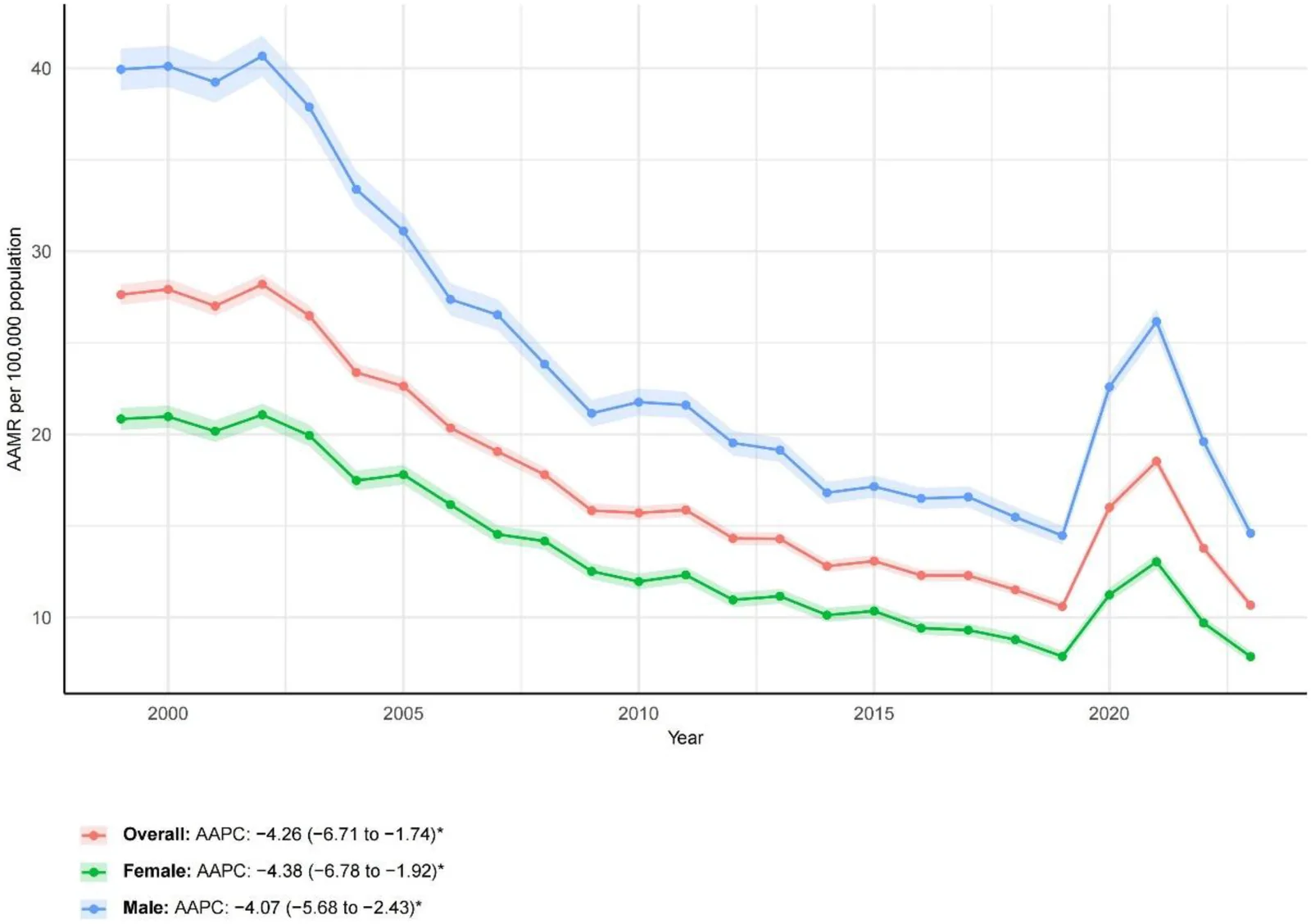
OBJECTIVE: This study aims to assess the comprehensive national trends in deaths related to pneumonia and AMI in the US from 1999 to 2023. METHODS: CDC wonder multiple cause of death database was used to extract data of elderly (≥65 years) with pneumonia and AMI as main or contributing cause of death. Age-Adjusted Mortality Rates (AAMRs) per 100,000 population were calculated. Trends were stratified by sex, race/ethnicity, state, urban-rural classification, census region, ten-year age group, and place of death. RESULTS: A total of 186,411 deaths associated with pneumonia and AMI during 1999-2023 were identified. The cumulative AAMR was 17.76 during 1999-2020, and 14.2 during 2021-2023. A significant decline in AAMR was found through the study period (AAPC:-4.26, 95% CI -6.71 to -1.74). The AAMR of men was higher than women, and the decrease of AAMR was steeper in women (AAPC:-4.38, 95% CI -6.78 to -1.92 among women vs. -4.07, 95% CI -5.68 to -2.43 among men). NH American Indian or Alaska Native has the highest AAMR, while NH Asian or Pacific Islander had the lowest AAPC (-5.03, 95% CI -7.95 to -2.02). Non-metropolitan had higher AAMR (22.93 vs. 16.59) and AAPC (-1.69 vs. -3.51) than metropolitan. South region showed the highest AAMR and AAPC compared to other census regions. CONCLUSIONS: The AAMR per 100,000 of pneumonia and AMI decreased among older adults in the US during 1999-2023, with higher mortality burden among men, NH American Indian or Alaska Native, rural area, and South region.
The paper
Qingdao University
Frontiers in Cardiovascular Medicine, 30 Sep 2026, Open access