Resting-state cortical alpha frequency in Parkinson's disease and multiple system atrophy: associations with diagnosis, age, and symptom burden
Abstract
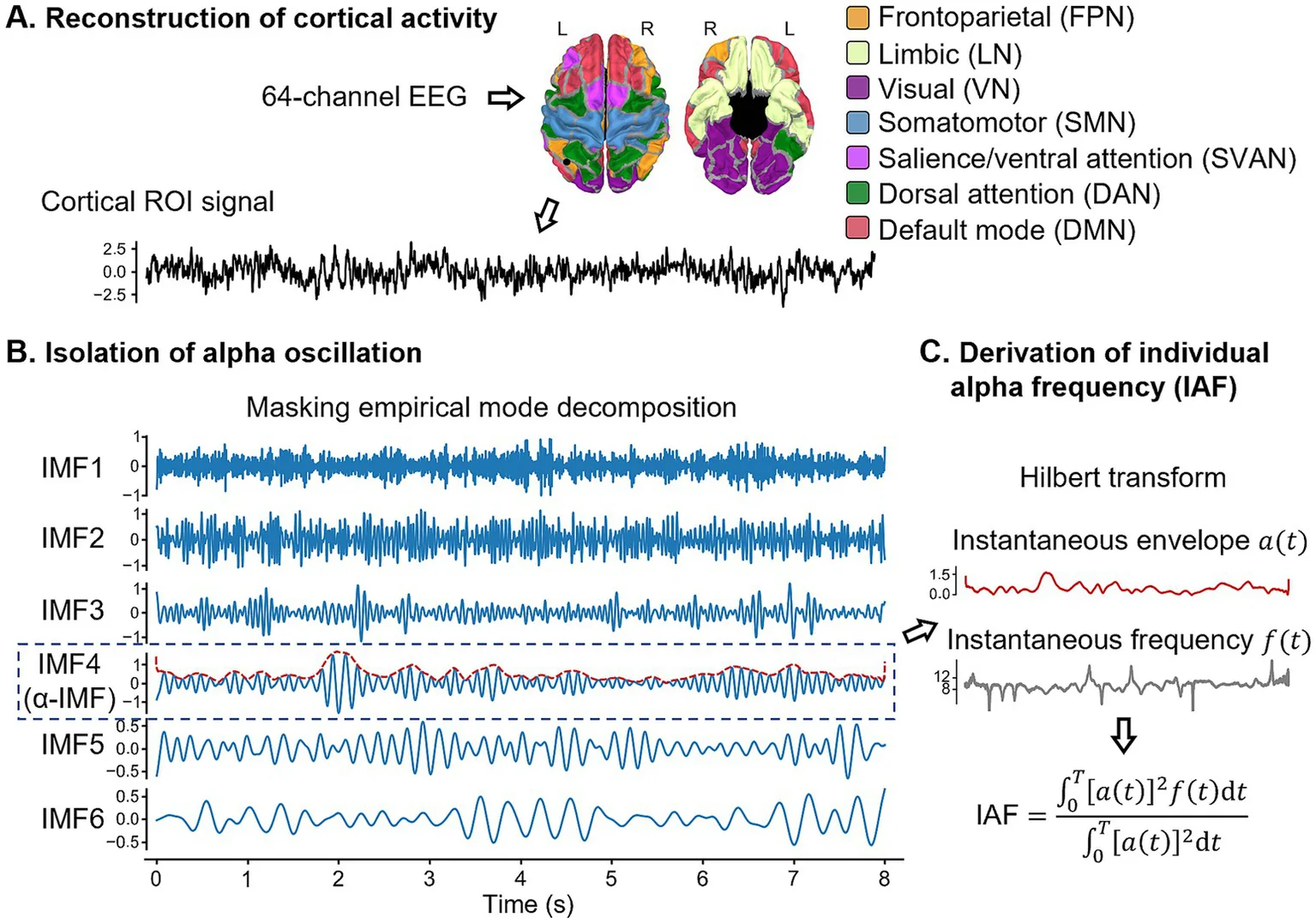
BACKGROUND: Parkinson's disease (PD) and multiple system atrophy (MSA) are clinically overlapping neurodegenerative disorders that present with a complex, heterogeneous burden of motor and non-motor symptoms. Resting-state EEG reveals that cortical alpha slowing is a hallmark of pathological aging, yet its specific presence and clinical significance in these distinct synucleinopathies remain incompletely understood. Therefore, precisely quantifying the individual alpha frequency serves as a critical, non-invasive approach to characterize cortical network dysfunction across synucleinopathies and evaluate how aging moderates its association with clinical symptom burden. METHODS: We analyzed source-reconstructed resting-state EEG data from 104 participants, comprising patients with PD, patients with the parkinsonian (MSA-P) and cerebellar subtypes (MSA-C) of MSA, and healthy controls. To accurately capture oscillatory dynamics, a data-driven masking empirical mode decomposition approach was applied to extract the individual alpha frequency across canonical cortical networks. General linear models tested diagnostic group differences, age-related effects, and age-dependent associations between individual alpha frequency and clinical symptom scores. RESULTS: Relative to healthy controls, both PD and MSA-C exhibited significant lower cortical IAF, whereas MSA-P showed no significant global IAF difference. At the network level, significant reduction of IAF was detected in the visual and dorsal attention networks in both PD and MSA-C. Advancing age independently contributed to alpha slowing across all participants without accelerating the disease-related trajectories. Notably, chronological age significantly moderated the relationship between alpha slowing and non-motor symptoms. In older patients, reduced individual alpha frequency was strongly associated with a higher burden of overall non-motor, autonomic, and psychiatric/cognitive symptoms, a relationship not observed in younger patients or with motor symptom severity. CONCLUSION: Cortical alpha slowing was detected in PD and MSA-C, but not in MSA-P. Age independently contributes to alpha slowing and strengthens its association with non-motor symptom burden, supporting age-aware interpretation of resting-state electroencephalography biomarkers in synucleinopathies.
From the paper
- Participants
The study cohort comprised a total of 104 participants, including HC and patients diagnosed with PD, MSA-P, and MSA-C.
- Result
In contrast, cortical mean IAF in MSA-P did not differ significantly from that in HC (adjusted mean difference = −0.030 Hz, 95% CI [−0.161, 0.102], t (95) = −0.452, FDR-corrected p = 0.783, Cohen’s d = −0.135).
Results, 3.2 Cortical global and network-level IAF alterations in PD and MSA
- Limitation
First, the study was cross-sectional, preventing conclusions about longitudinal IAF decline or the prediction of future clinical progression.
Quoted word for word from the full text on frontiersin.org.
- Parkinson's disease
- Multiple system atrophy
- Multiple system atrophy, cerebellar subtype
- Multiple system atrophy, parkinsonian subtype
- Global individual alpha frequency
- Humans
The paper
Peking University; Peking University First Hospital
Frontiers in Aging Neuroscience, 30 Sep 2026, Open access