Shifting competing underlying causes of death among U.S. decedents with diabetes recorded as a non-underlying cause, 1999-2024
Abstract
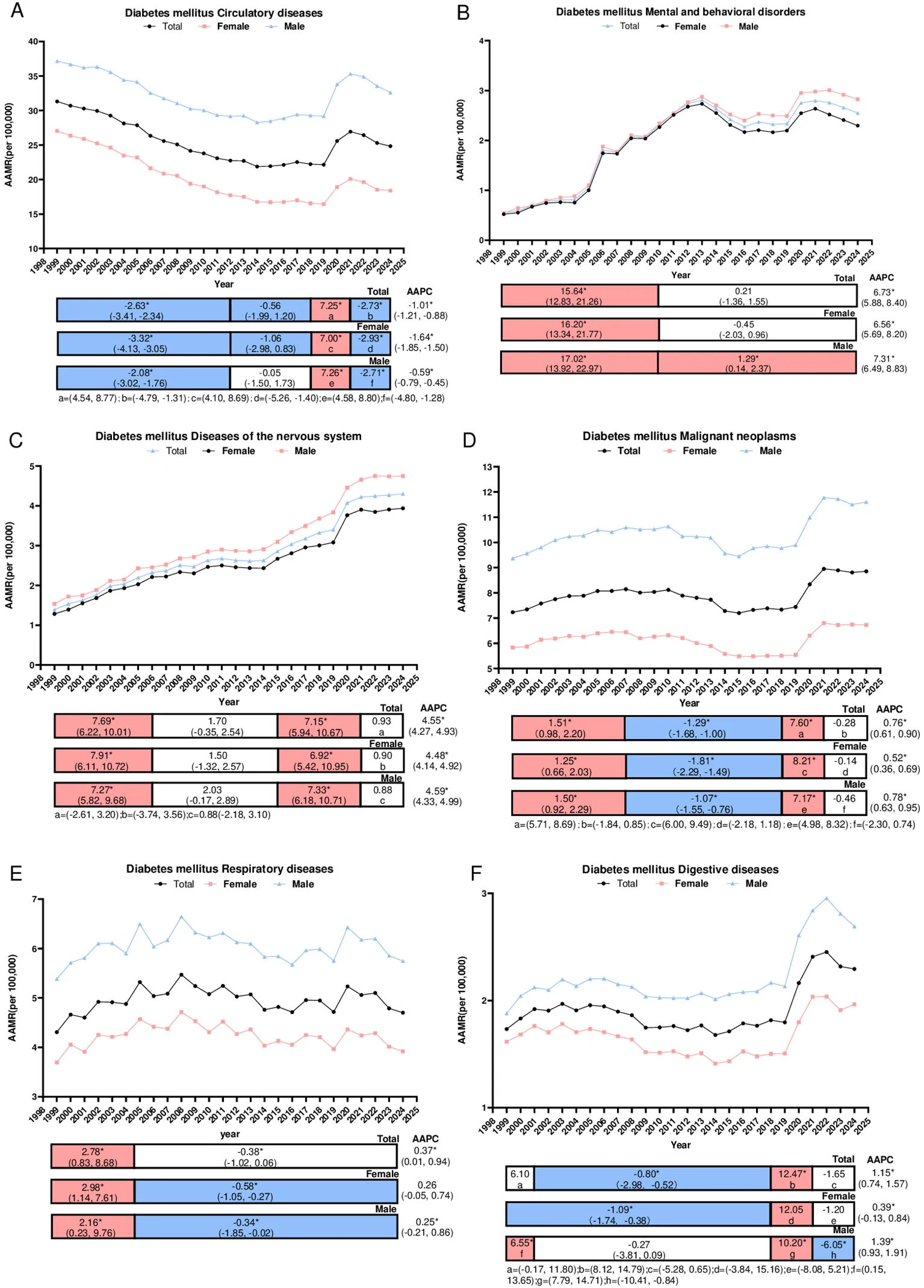
OBJECTIVE: To examine U.S. trends and underlying-cause patterns among deaths with diabetes recorded as a non-underlying cause (DM-nonUCD). METHODS: We used CDC WONDER Multiple Cause of Death data from 1999 to 2024. DM-nonUCD was defined as deaths with ICD-10 codes E10-E14 in multiple-cause fields, excluding deaths with diabetes as the underlying cause. Analyses were performed overall and for type 1 diabetes (E10) and type 2 diabetes (E11). Death counts, age-adjusted mortality rates (AAMRs), and Joinpoint trends were assessed. RESULTS: DM-nonUCD occurred in 4,794,136 deaths and increased from 141,371 in 1999 to 246,426 in 2024. The leading underlying causes were circulatory diseases (2,294,799; 47.87%), malignant neoplasms (725,592; 15.13%), and respiratory diseases (449,837; 9.38%). Circulatory diseases remained dominant but declined from 60.51% to 44.48%, with decreasing AAMR (average annual percent change [AAPC], -1.01%; 95% CI, -1.21 to -0.88). Shares increased for malignant neoplasms (14.01% to 16.30%), nervous system diseases (2.67% to 7.56%), and mental and behavioral disorders (1.05% to 4.41%). Within circulatory causes, ischemic heart disease AAMR declined (AAPC, -2.04%; 95% CI, -2.23 to -1.92), whereas hypertensive disease AAMR increased (AAPC, 3.21%; 95% CI, 2.94 to 3.56). Subtype analyses showed similar cause-distribution shifts for E10- and E11-nonUCD, with declining circulatory shares and increasing nervous system and mental and behavioral shares. CONCLUSIONS: DM-nonUCD represents a substantial proportion of deaths in which diabetes was recorded on the death certificate. The underlying-cause profile is shifting from coronary-dominated mortality toward broader multimorbidity, supporting surveillance and health-system planning that consider competing causes beyond ischemic heart disease.
From the paper
- Result
The increase was largest for hypertensive disease (AAPC, 6.47%; 95% CI, 6.13 to 6.98), followed by cerebrovascular disease (AAPC, 2.04%; 95% CI, 1.65 to 2.57) and ischemic heart disease (AAPC, 1.06%; 95% CI, 0.81 to 1.39) ( Figures 4D–F ).
- Limitation
First, death-certificate data are subject to underreporting and misclassification, and secular changes in diagnostic recognition, causal sequencing, and certification practices may have influenced both whether diabetes was recorded and which condition was selected as the underlying cause.
Quoted word for word from the full text on frontiersin.org.
The paper
Gannan Medical University
Frontiers in Endocrinology, 30 Sep 2026, Open access