GLP-1 receptor agonist initiation and risk of psychiatric hospitalisation and emergency department presentation in adults with schizophrenia and type 2 diabetes in the USA: an observational cohort study using electronic health records data
Abstract
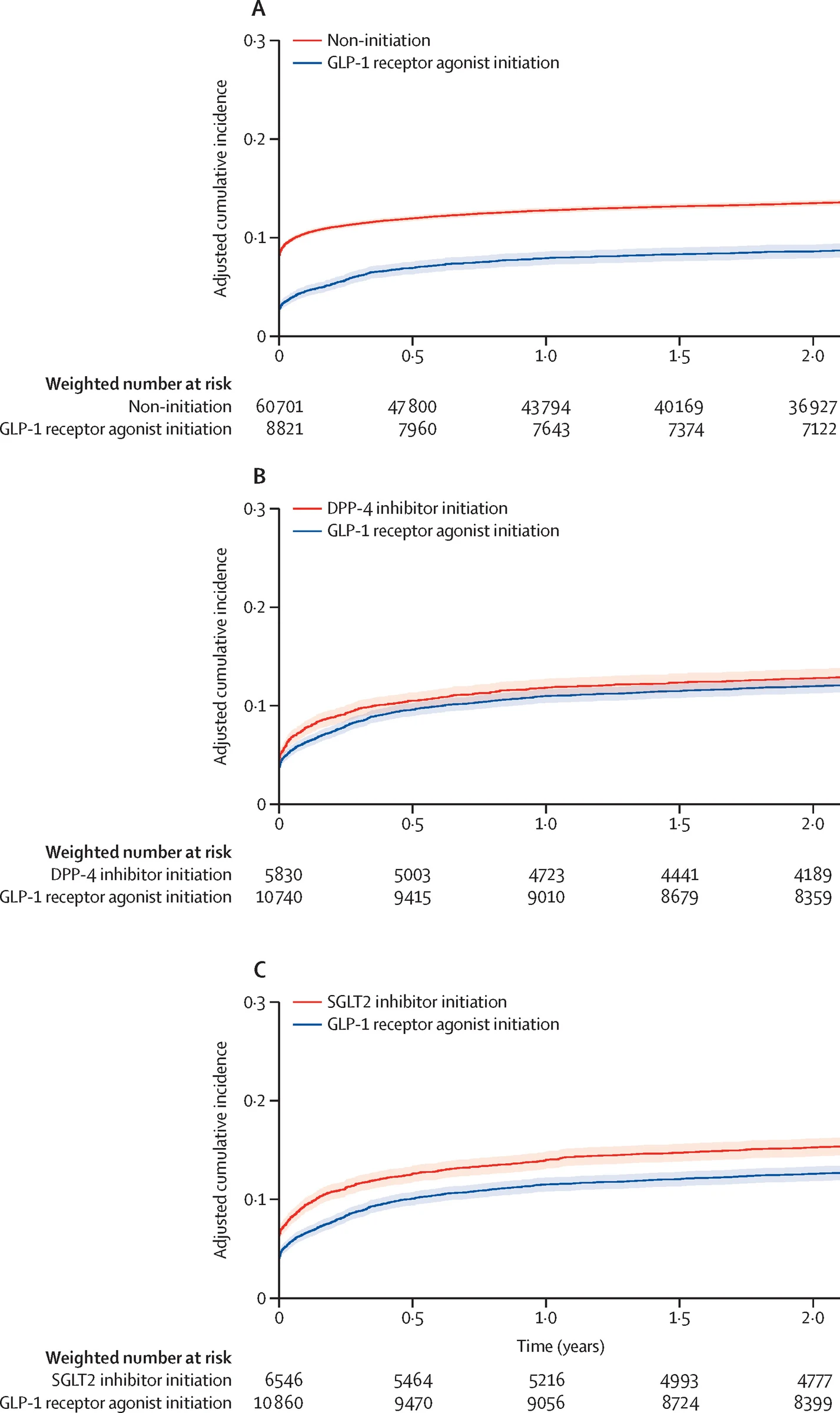
BACKGROUND: Many individuals with schizophrenia have persistent psychotic symptoms despite antipsychotic treatment, and the disorder is associated with a disproportionately high burden of metabolic dysregulation. Whether GLP-1 receptor agonists are associated with psychiatric benefit alongside their metabolic effects remains unknown. We aimed to examine associations between GLP-1 receptor agonist initiation and psychiatric hospitalisation and emergency department presentation in adults with schizophrenia and type 2 diabetes, compared with DPP-4 inhibitor initiation, SGLT2 inhibitor initiation, and non-initiation. METHODS: In this observational cohort study, we used electronic health record (EHR) data from the US NeuroBlu Data repository to construct a cohort of adults (≥18 years) with documented diagnosis of schizophrenia and comorbid type 2 diabetes. The exposure was the initiation of GLP-1 receptor agonists, compared with non-initiation or initiation of DPP-4 inhibitors or SGLT2 inhibitors. The index date, from Jan 1, 2018, was defined as the date of the first recorded psychiatric visit at which both a diagnosis of schizophrenia and comorbid type 2 diabetes were present in the participant's record. Time zero (T₀) was the date of the first prescription of any of these agents between Jan 1, 2018, and Oct 1, 2025; for non-initiators, T₀ was the index date. Participants contributed person-time from T₀ until 2 years of follow-up, the last recorded clinical observation in the NeuroBlu Data repository, or the end of the observation period (March 24, 2026), whichever happened earliest. The main outcomes of interest included risk of psychiatric hospitalisation and psychiatric emergency department presentation. Inverse probability weighting was applied to balance demographic, clinical, and pharmacological covariates, and weighted regression models were used. Analyses were conducted using an intention-to-treat framework, whereby exposure status was defined according to the medication initiated at T₀. FINDINGS: A total of 70 257 individuals met the inclusion criteria; mean age was 53·1 years [SD 12·32] and 33 882 [48·2%] were women. Among the 70 257 eligible individuals, 9093 (12·9%) initiated GLP-1 receptor agonists, 4968 (7·1%) initiated DPP-4 inhibitors, 5328 (7·6%) initiated SGLT2 inhibitors, and 50 868 (72·4%) were non-initiators. In weighted regression analyses, GLP-1 receptor agonist initiation was associated with a lower risk of psychiatric hospitalisation compared with non-initiation (weighted hazard ratio [HR] 0·76 [95% CI 0·71-0·82]), DPP-4 inhibitor initiation (0·82 [0·75-0·90]), and SGLT2 inhibitor initiation (0·83 [0·78-0·88]). GLP-1 receptor agonist initiation was also associated with a lower risk of emergency department presentation than non-initiation (0·71 [0·65-0·77]), DPP-4 inhibitor initiation (0·87 [0·80-0·95]), and SGLT2 inhibitor initiation (0·80 [0·73-0·88]). INTERPRETATION: GLP-1-based therapy initiation was associated with lower psychiatric acute-care use than non-initiation and initiation of DPP-4 or SGLT2 inhibitors in adults with schizophrenia and type 2 diabetes. Potential residual confounding and selection bias restrict generalisability of the results. The findings suggest that lower psychiatric acute-care use could be a favourable secondary benefit when GLP-1-based therapies are clinically indicated for metabolic management, although their use as primary psychiatric treatments require investigation in randomised and mechanistic studies. FUNDING: Synergy for the Development of Innovative Clinical Treatments in Schizophrenia (SYNDICAT) project (GNT2035912).
The paper
Deakin University
The Lancet Psychiatry, 15 Oct 2026