Indication-specific adverse event profiles of semaglutide and liraglutide: a FAERS disproportionality analysis
Abstract
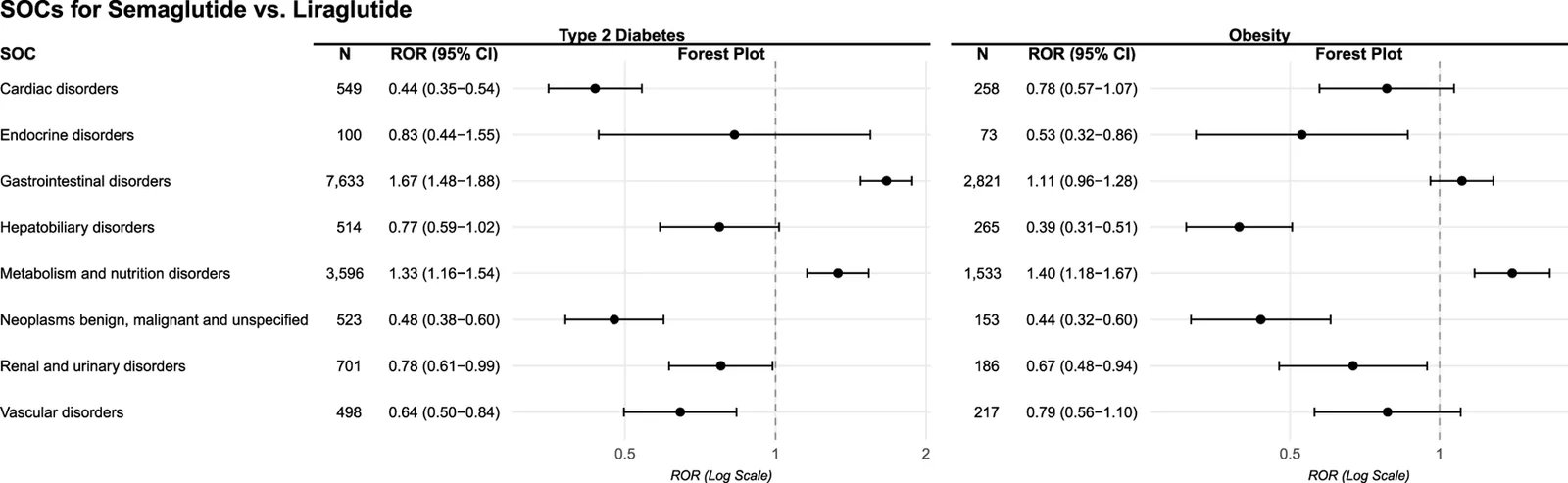
OBJECTIVE: By 2021, regulatory agencies had approved two glucagon-like peptide-1 receptor agonists (GLP-1RAs), semaglutide and liraglutide, for the treatment of type 2 diabetes and obesity. Since then, concerns have emerged about whether adverse events (AEs) differ by GLP-1RA or indication. RESEARCH DESIGN AND METHODS: We analyzed the Food and Drug Administration Adverse Event Reporting System (FAERS) reports (2021-2025) to compare adverse events associated with semaglutide and liraglutide indications. Comparisons with metformin and orlistat helped distinguish drug-related signals from disease-related signals. We defined safety signals by a positive reporting odds ratio and at least one other positive disproportionality metric. RESULTS: Among 8,213,105 FAERS reports, 33,259 met the inclusion criteria. Semaglutide generated more reports for type 2 diabetes than for obesity (13,168 vs. 5,444), and liraglutide showed a similar pattern (1,201 vs. 837). GLP-1RAs exhibited gastrointestinal AEs. Semaglutide showed signals for slowed gastrointestinal motility across both indications, particularly impaired gastric emptying, in both type 2 diabetes and obesity reports (ROR = 8.35, 95% CI = 1.16-59.97 and ROR = 4.01, 95% CI = 2.12-7.58, respectively). Liraglutide demonstrated signals for more severe gastrointestinal AEs, including abdominal distention in type 2 diabetes (ROR = 1.46, 95% CI = 1.12-1.91) and pancreatitis in obesity (ROR = 2.90, 95% CI = 1.91-4.39) reports. Additional notable safety signals included optic ischemic neuropathy with semaglutide (ROR = 4.42, 95% CI = 1.41-13.87) and psychiatric AEs, including suicidal ideation (ROR = 5.98, 95% CI = 1.24-24.19). CONCLUSION: We identified robust signals for GLP-1RAs, including impaired gastric emptying, ileus, and ischemic optic neuropathy. Additionally, we identified signals for suicidal ideation. Future studies are needed to evaluate for causal relationships.
The paper
Columbia University; Columbia College
Frontiers in Pharmacology, 29 Sep 2026, Open access