Real-world threshold-based eligibility for emerging lipoprotein(a)-targeted therapies in chronic and acute coronary syndrome
5 years
Abstract
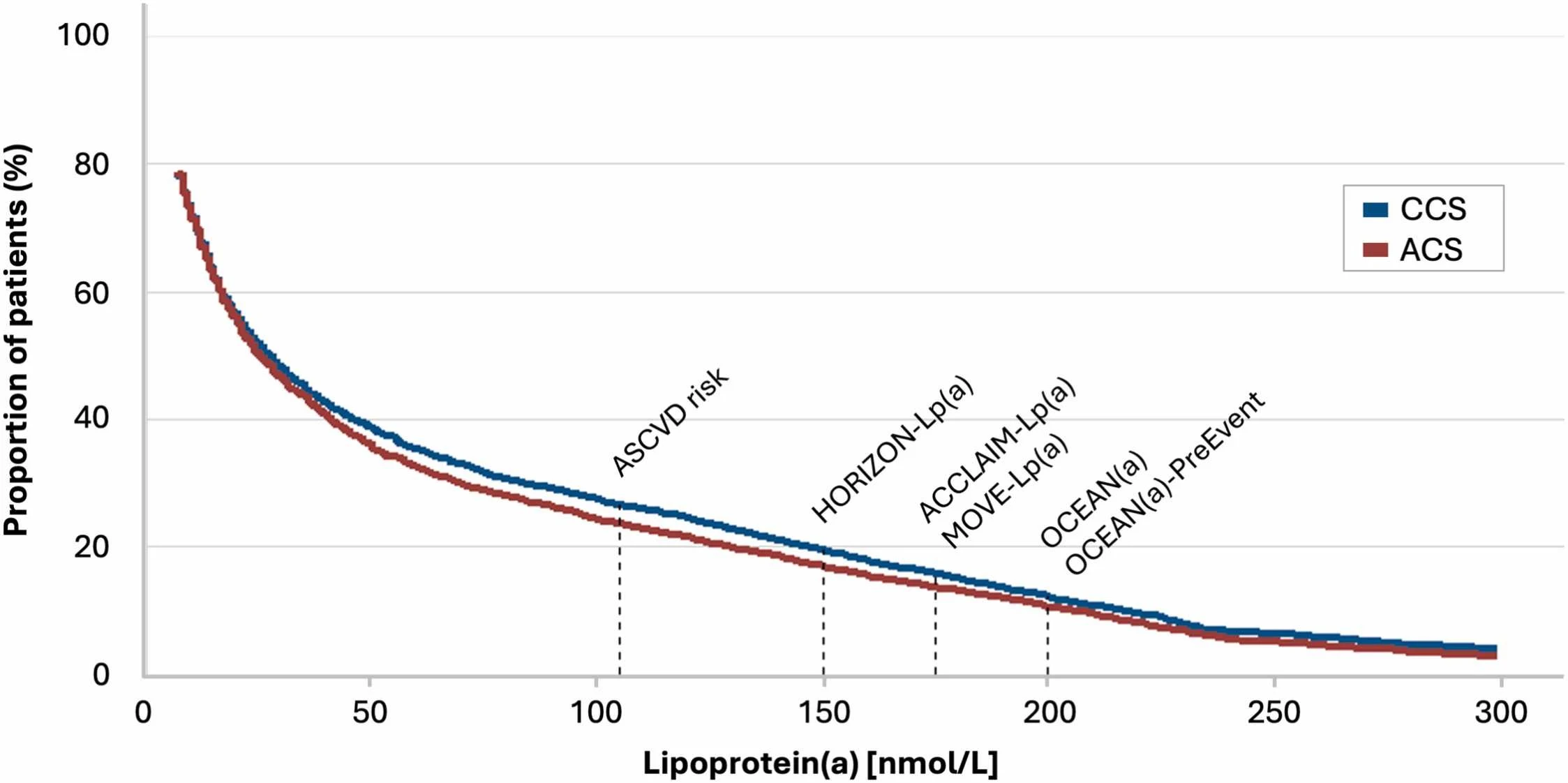
BACKGROUND: Elevated lipoprotein(a) [Lp(a)] is a causal risk factor for atherosclerotic cardiovascular disease. Phase 3 programs are evaluating Lp(a)-lowering therapies using high entry thresholds; however, the real-world prevalence of trial-aligned Lp(a) thresholds in secondary prevention remains uncertain. OBJECTIVE: To assess the prevalence of trial-aligned Lp(a) thresholds, national apheresis criteria, and the prognostic impact of elevated Lp(a) in a contemporary percutaneous coronary intervention (PCI) cohort. METHODS: Patients undergoing PCI at a tertiary center with Lp(a) reported in nmol/L were analyzed. The proportion meeting trial-aligned thresholds (≥150, ≥175, ≥200 nmol/L) and the European Society of Cardiology/European Atherosclerosis Society risk-enhancing threshold (≥105 nmol/L) was estimated. National apheresis criteria were applied. 5-year major adverse cardiovascular events (MACE) and target lesion failure (TLF) were assessed. RESULTS: Among 5942 patients with PCI, 25.2% had Lp(a) ≥105 nmol/L, with progressively smaller proportions meeting higher thresholds: 18.4% ≥150 nmol/L, 14.8% ≥175 nmol/L, 11.6% ≥200 nmol/L. Lp(a) concentrations were similar in chronic and acute coronary syndrome (CCS and ACS) (CCS, median 28.0 [IQR 9.0-118.5] vs ACS, 25.0 [IQR 9.0-96.5] nmol/L; P = .117). 1.8% to 6.1% met national apheresis criteria. Over 5 years, higher Lp(a) was independently associated with risk of MACE (adjusted hazard ratio [HR] per 1 SD 1.06 [95% CI 1.01-1.12]; P = .015) and TLF (adjusted HR per 1 SD 1.05 [95% CI 1.00-1.10]; P = .044). CONCLUSION: Elevated Lp(a) was highly prevalent and independently predicted adverse 5-year outcomes in a contemporary PCI cohort. While a substantial proportion met trial-aligned Lp(a) thresholds for emerging therapies, few fulfilled apheresis criteria. Systematic Lp(a) testing may improve risk stratification and identify patients meeting trial-aligned Lp(a) thresholds for emerging therapies.
The paper
Medical University of Vienna
Journal of Clinical Lipidology, 25 Sep 2026