Lung function decline and scan findings linked to later frailty
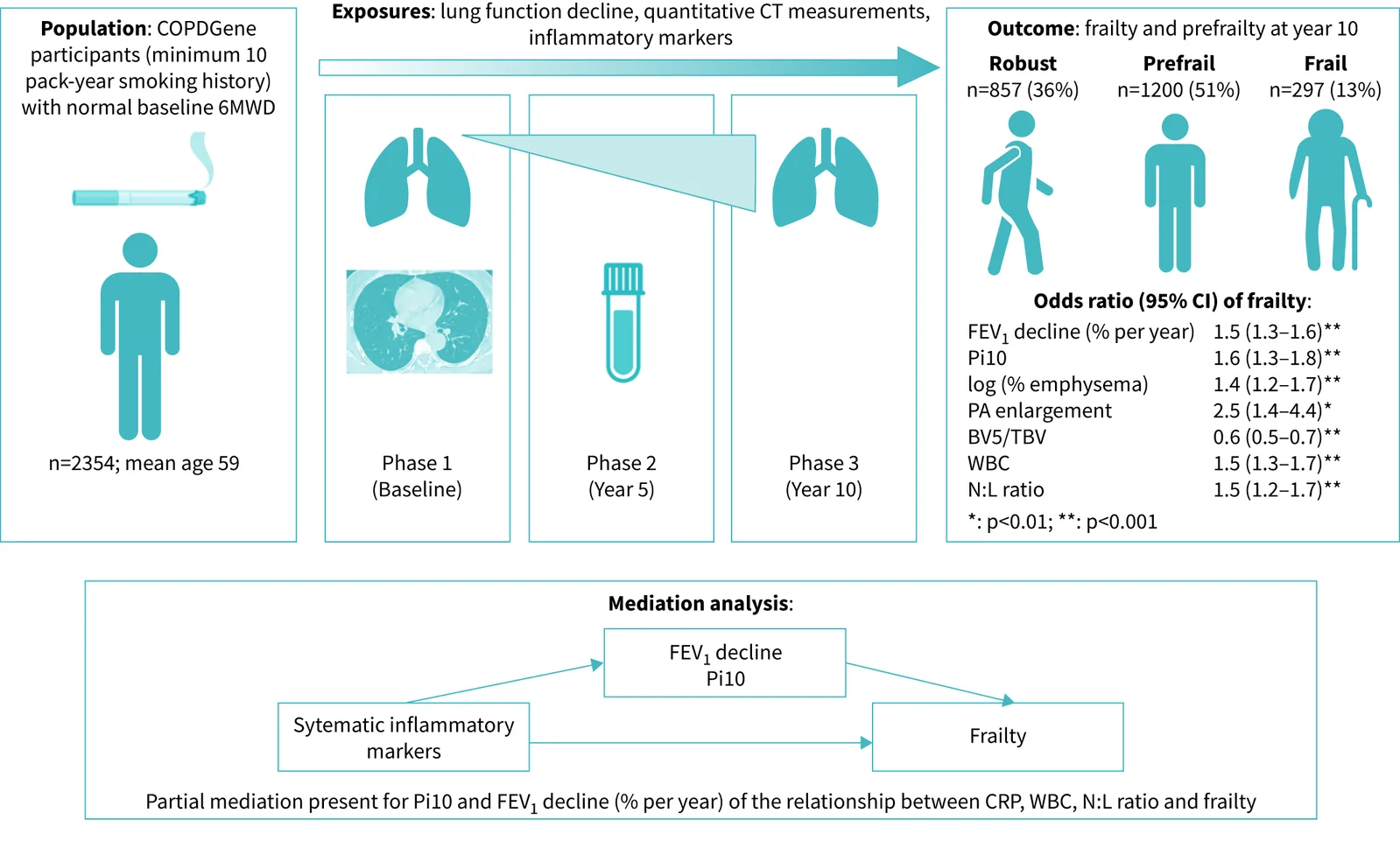
Each 1%-per-year drop in the volume of air forcibly exhaled in one second was linked to 1.47 times the odds of frailty at 10 years.
Multicentre
Limit: Baseline frailty was unmeasured, so follow-up cases could already have been frail
Stake: An author works for Biogen.
An observational cohort study followed 2,354 adults aged 45–80 with a cigarette smoking history over 10 years. All had a normal six-minute walking-test distance at the start and completed breathing tests at three visits. Researchers assessed frailty, a state of reduced physical reserve, at the final visit. They also analysed baseline computed tomography scans, which use X-rays to create detailed images.
Greater airway wall thickening, more emphysema—damage to the lungs’ air sacs—and an enlarged lung artery were associated with higher odds of frailty. A smaller share of lung blood-vessel volume in small vessels was also linked to frailty. Decline in the volume of air participants could force out in one second was associated with higher odds. At follow-up, 297 participants (13%) were frail.
Why it matters
Frailty concerns the body’s physical reserve as people grow older. The study addressed whether lung measurements offer clues to later frailty risk in people with a smoking history.
Caveats
This observational study cannot show that lung changes caused frailty. Participants had a smoking history and met the study’s walking-test and follow-up requirements.
From the paper
- Result
… log (% emphysema) and PA enlargement were significantly associated with increased odds of frailty (adjusted ORs, respectively: 1.52 (95% CI 1.30–1.77; p<0.001), 1.38 (95% CI 1.14–1.67; p<0.001) and 2.49 (95% CI 1.41–4.41; p=0.002)), as was lower BV5/TBV …
Quoted word for word from the full text on publications.ersnet.org.
The paper
Brigham and Women's Hospital
ERJ Open Research, 12 Oct 2026, Open access


