Dietary Determinants of Type 2 Diabetes Among African American Populations: A Scoping Review Through a Socio-Ecological Lens
Abstract
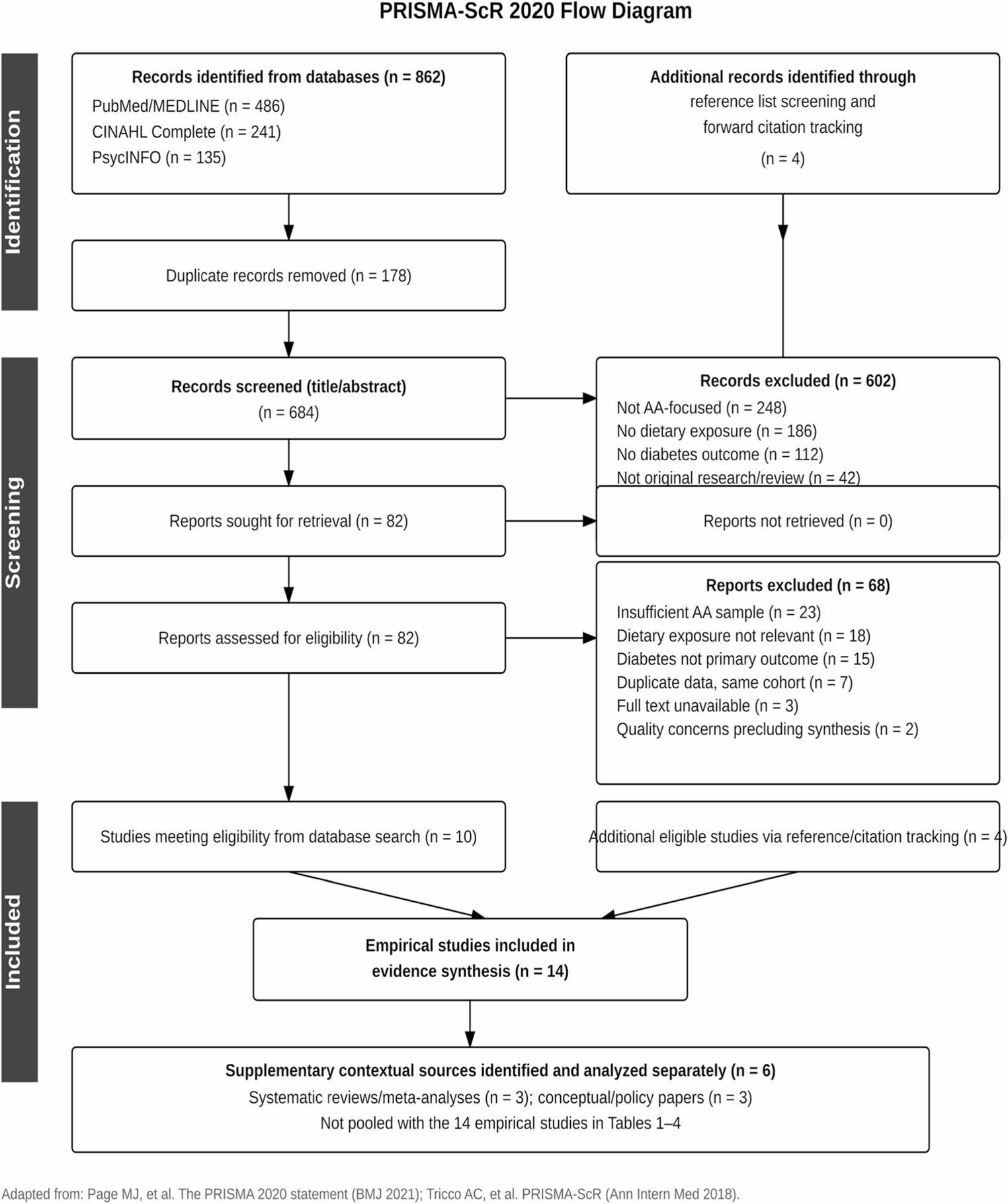
BACKGROUND: Type 2 diabetes prevalence is 1.4-fold higher among Black/African American adults than the general U.S. POPULATION: African Americans are also disproportionately represented among lower-income groups with reduced access to healthy food retail, factors closely tied to the dietary exposures examined here. Dietary patterns emerge from multilevel influences, including food environments, cultural practices, and structural determinants. This scoping review, organized using the socio-ecological model (SEM), synthesized dietary determinants of type 2 diabetes across five SEM levels specifically for African American populations. METHODS: We searched PubMed/MEDLINE, CINAHL, and PsycINFO through January 2025 for studies examining diet-related exposures (sugar-sweetened beverages, ultra-processed foods, food environments, cultural practices, structural determinants) and diabetes outcomes in Black/African American populations. Given the heterogeneity of evidence types, methods followed PRISMA-ScR. Quality was assessed using adapted Johns Hopkins criteria, and narrative synthesis organized findings across SEM levels. RESULTS: Fourteen empirical studies, supplemented by 3 reviews/meta-analyses and 3 conceptual papers, revealed a possible intervention gradient: individual-level dietary changes showed modest associations (2-10% risk reduction with SSB substitution), while community-level food environment exposures showed larger associations (34% higher diabetes incidence with unfavorable food store density; HR = 1.34, 95% CI: 1.12-1.60). Ultra-processed food consumption was linked to 17% higher diabetes risk per 10% intake increase, though not in an African American-specific sample. One qualitative study suggested cultural food practices may create management barriers. Structural racism and residential segregation were conceptually linked to "food apartheid. Evidence concentrated at individual (n = 6) and community (n = 7) levels, with no organizational-level research identified. CONCLUSIONS: Community-level interventions may offer more immediate, near-term impact relative to structural reforms, which may support longer-term equity gains; given the limited evidence base, this apparent gradient should be considered a preliminary, hypothesis-generating pattern rather than an established comparison of intervention effectiveness, and warrants further investigation.
- Cultural food practices
- Food environment
- Residential segregation
- Structural racism
- Type 2 diabetes
- Humans
The paper
Manning College of Nursing and Health Sciences; Capstone College of Nursing
Journal of Racial and Ethnic Health Disparities, 12 Oct 2026