Are Current Lipid Guidelines Adequate for South Asian Patients? A Narrative Review
Abstract
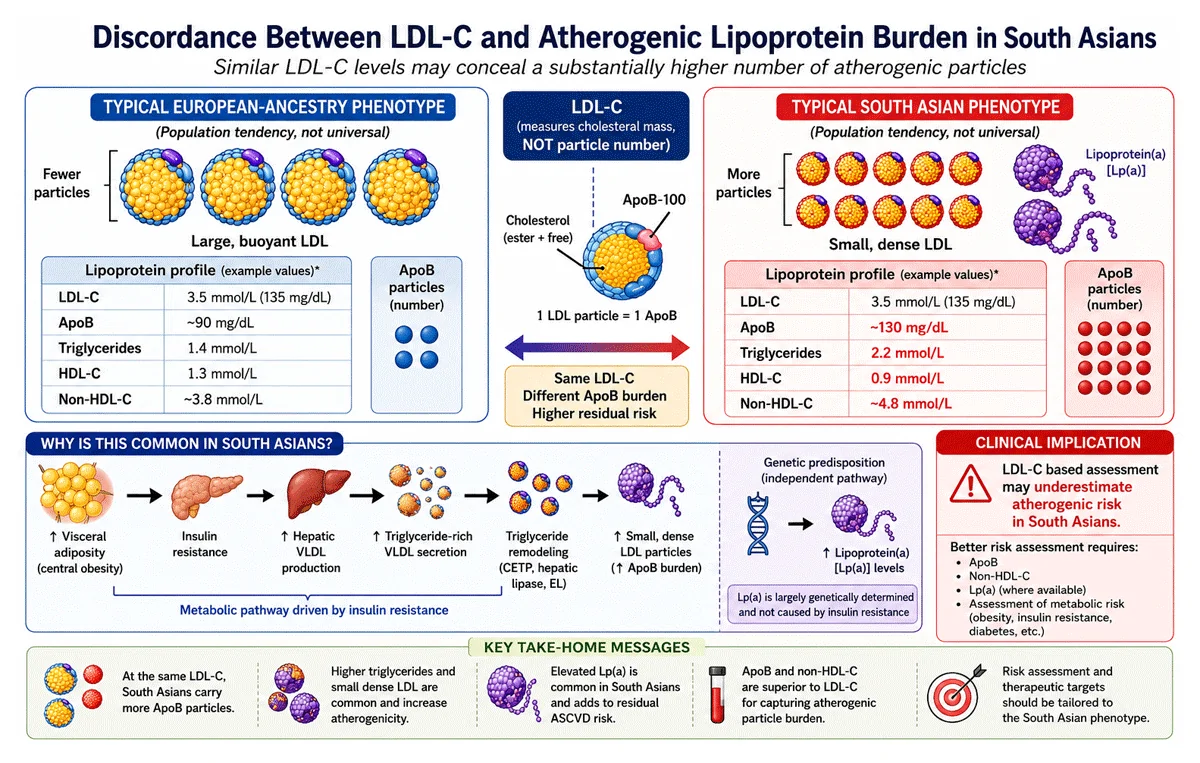
South Asians, who account for nearly one quarter of the world's population, experience a disproportionately high burden of atherosclerotic cardiovascular disease (ASCVD), often presenting 5-10 years earlier than European populations. This review evaluates whether contemporary lipid-management frameworks adequately address cardiovascular risk in South Asians. South Asians exhibit a distinct lipid phenotype characterised by elevated apolipoprotein B (ApoB), hypertriglyceridaemia, reduced HDL-cholesterol (HDL-C), increased small dense LDL (sdLDL) particles, and a high prevalence of elevated lipoprotein(a) (Lp(a)), features that are incompletely captured by conventional LDL-cholesterol (LDL-C)-based approaches. Existing cardiovascular risk tools show variable performance in South Asian populations, while contemporary guidelines differ substantially in risk assessment, LDL-cholesterol targets, incorporation of risk enhancers, and use of coronary artery calcium (CAC) scoring. Although recent guideline updates increasingly acknowledge South Asian ethnicity as a risk modifier, important gaps in calibration and implementation remain. Greater harmonisation of recommendations and validation of South Asian-specific risk assessment strategies are needed to improve cardiovascular prevention.
- Lipid and ceramide metabolism
- Atherosclerotic cardiovascular disease
- Hypertriglyceridemia
- Apolipoprotein B
- Cardiovascular risk score
- Humans
The paper
Medical Research Institute; University of Kelaniya
Global Heart, 8 Oct 2026