Comparison of cardiometabolic benefits and tolerability in patients on sustained low doses of semaglutide or tirzepatide
24 months
Abstract
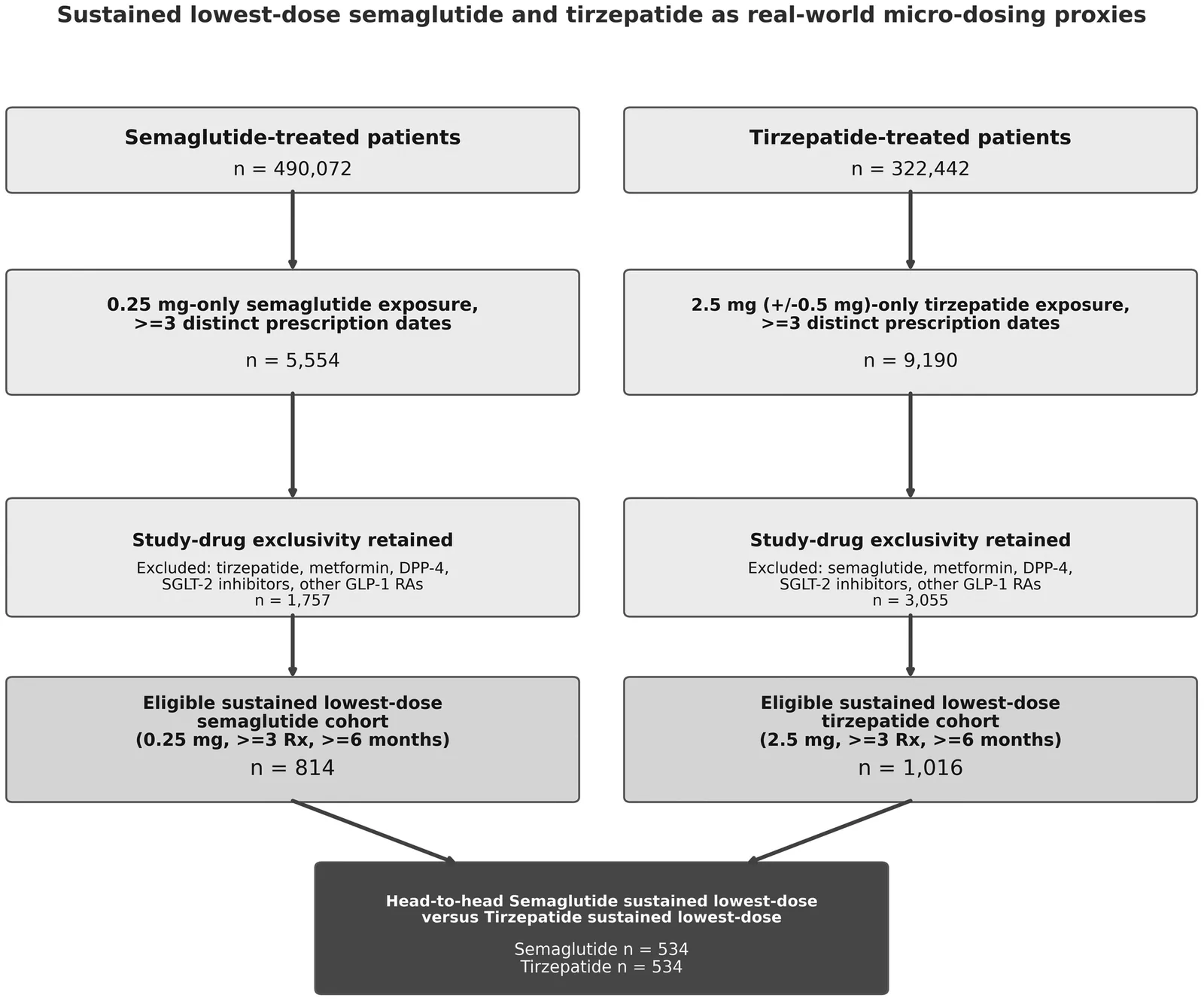
Semaglutide and tirzepatide are typically evaluated through dose escalation, yet many patients in routine care do not reach a recommended maintenance dose due to tolerability, access, cost, supply, or individualized goals. Here, we used repeated 0.25 mg only semaglutide and 2.5 mg only tirzepatide prescription records as real-world proxies for sustained treatment at the lowest approved dose, a prescribing pattern that may overlap with, but does not establish, intentional microdosing. We analyzed de-identified electronic health records (EHRs) from a federated system of 29 million patients. Among 490 072 semaglutide-treated patients, 814 met the stringent sustained low-dose criterion of at least three distinct 0.25-mg prescriptions spanning at least 6 months from the first to the last qualifying prescription and among 322 442 tirzepatide-treated patients, 1016 met the analogous criterion of at least three distinct 2.5-mg prescriptions spanning at least 6 months. In a matched head-to-head comparison aided by AI-enabled curation of clinical notes, sustained low-dose tirzepatide showed higher 24-month adverse event rates (P < .05) than sustained low-dose semaglutide for constipation (32.6% vs. 22.4%), acute kidney injury (2.7% vs. 0.4%), muscle cramps (8.3% vs. 4%), lumbar disc disease (3.3% vs. 0.3%), dyspnea on exertion (9.6% vs. 6.8%), lentigo (4.7% vs. 0.8%), and actinic keratosis (3.3% vs. 0.6%), whereas sustained low-dose semaglutide (vs. tirzepatide) had higher rates of including otitis (5.6% vs. 2.1%), diaphoresis (5.5% vs. 3.2%), and ankle swelling (6.9% vs. 3.7%). Sustained low-dose tirzepatide was associated with greater weight loss than semaglutide (mean 12-month percent weight change -5.5% vs. -2.2%; P < .05 at all timepoints). Analyses of prescription patterns supported the findings from clinical notes. For example, renal-supportive and hyperkalemia therapies increased after low-dose tirzepatide (5.6% to 9.5% at 12 months, P = .016) but not after low-dose semaglutide (8.2% to 6.6%, P = .382). Taken together, these observational associations motivate prospective studies to better characterize the outcomes and pharmacology of sustained initiation-dose semaglutide or tirzepatide, and related microdosing studies.
The paper
Nference (United States)
Biology Methods & Protocols, 31 Aug 2026