Upward changes in serum 25-hydroxyvitamin D levels in South Korea: the Korea National Health and Nutrition Examination Survey studies IX (2022-2023) versus VI (2013-2014)
Abstract
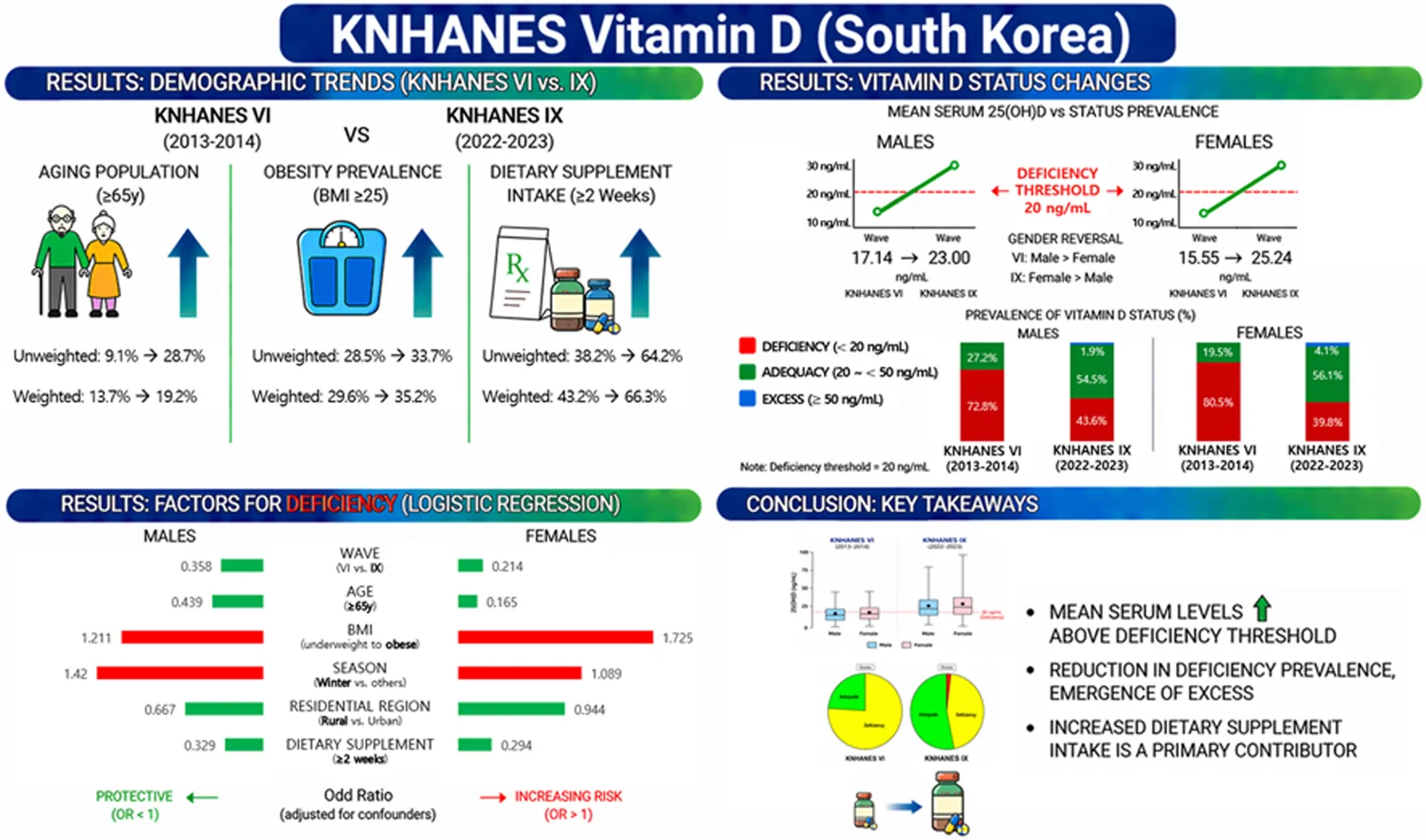
OBJECTIVES: To compare serum 25-hydroxyvitamin D (25[OH]D) concentrations and the prevalence of vitamin D deficiency between the Korea National Health and Nutrition Examination Survey (KNHANES) VI and IX, and to evaluate demographic, seasonal, and lifestyle factors associated with vitamin D status in South Korea. METHODS: Data from KNHANES IX (2022-2023), in which serum 25(OH)D concentrations were measured by liquid chromatography-tandem mass spectrometry, were compared with data from KNHANES VI (2013-2014), in which radioimmunoassay was used. Information on dietary supplement intake (≥2 weeks per year) was obtained through a standardized questionnaire. Vitamin D status was defined according to serum 25(OH)D concentrations as deficiency (<20 ng/mL), adequacy (≥20 and <50 ng/mL), and excess (≥50 ng/mL). RESULTS: Serum 25(OH)D levels significantly increased across both sexes and all age groups. The odds of vitamin D deficiency were significantly lower in KNHANES IX compared to VI, with adjusted odds ratios of 0.358 for men and 0.214 for women. The proportion of subjects taking dietary supplements increased significantly from 43.2% to 66.3%. Body mass index was significantly associated with higher odds of vitamin D deficiency exclusively among women in KNHANES IX. Winter remained persistently associated with higher odds of deficiency. CONCLUSIONS: Over the past decade, South Korea has experienced an upward shift in population-level vitamin D concentrations. These changes may be associated with increased intake of dietary supplements, but because direct standardization of analytical methods has not been achieved, the relative contributions of behavioral changes and analytical method-related differences cannot be quantified.
The paper
Dongguk University; Yonsei Goodsam Clinic
Osteoporosis and Sarcopenia, 6 Sep 2026