GLP-1 Receptor Agonists Are Associated With Lower Early Revision Risk Compared to Bariatric Surgery Following Total Hip Arthroplasty: A Retrospective Cohort Study
Abstract
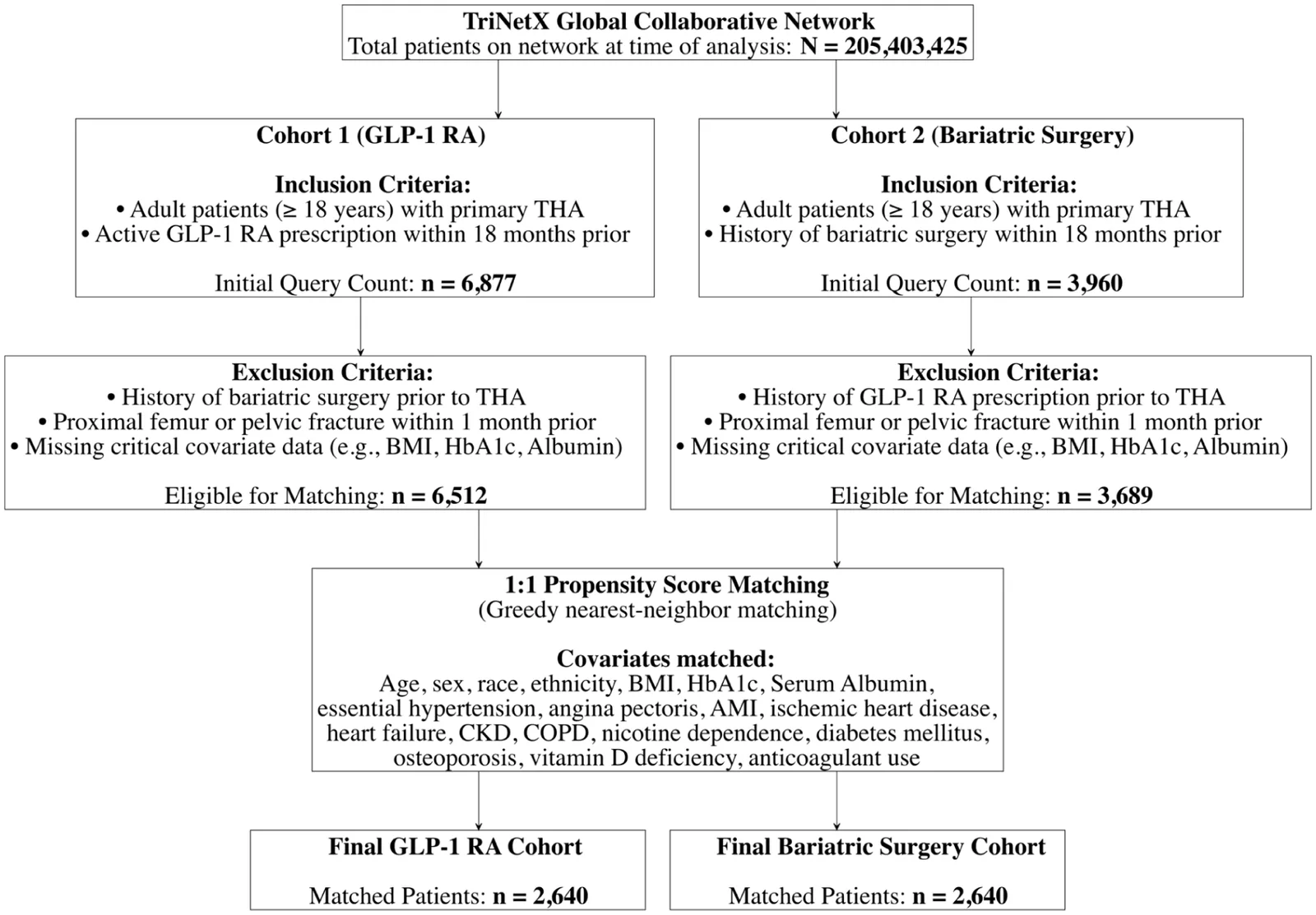
BACKGROUND: Obesity is a major modifiable risk factor in total hip arthroplasty (THA), associated with increased complications. While bariatric surgery has been the standard for massive weight loss, glucagon-like peptide-1 receptor agonists (GLP-1 RAs) are increasingly used. PURPOSES: We sought to answer 2 questions: (1) Are early postoperative complication risks different between THA patients using GLP-1 RAs versus prior bariatric surgery? (2) Do differences persist at mid-term follow-up? METHODS: We conducted a retrospective cohort study using the TriNetX Global Collaborative Network to identify adult patients (≥18 years) who underwent primary THA (current procedural terminology code 27130) between January 2015 and December 2025. Patients were divided into 2 cohorts: those with an active prescription for a GLP-1 RA (semaglutide, dulaglutide, liraglutide, tirzepatide, exenatide, albiglutide, or lixisenatide) within 18 months prior to the index THA procedure (N = 6877) or those with a history of bariatric surgery (sleeve gastrectomy, Roux-en-Y gastric bypass, adjustable gastric banding, and biliopancreatic diversion) within 18 months prior to the index THA procedure (N = 3960). Propensity-score matching (1:1) balanced cohorts on demographics and comorbidities. Outcomes included revision THA, dislocation/instability, PJI, wound complications, emergency department (ED) visits, and readmission at 1 to 90 days and 91 days to 1 year postoperatively. RESULTS: Within 90 days, the GLP-1 RA cohort had lower risks of revision, PJI, ED visits, readmission, wound dehiscence, and dislocation. At mid-term follow-up, GLP-1 RA patients continued to show lower risks of PJI, readmission, and all-cause revision. CONCLUSION: Preoperative GLP-1 RA use was associated with lower early and mid-term complications compared to bariatric surgery, suggesting a potentially safer option for pre-THA weight optimization. LEVEL OF EVIDENCE: Level III: retrospective cohort study.
The paper
Penn State College of Medicine; Penn State Milton S Hershey Medical Center
HSS Journal, 7 Oct 2026