Association of excise duty reforms with alcohol per capita consumption and alcohol-attributable life expectancy loss in Malaysia, 2000-2022: An interrupted time-series analysis
Abstract
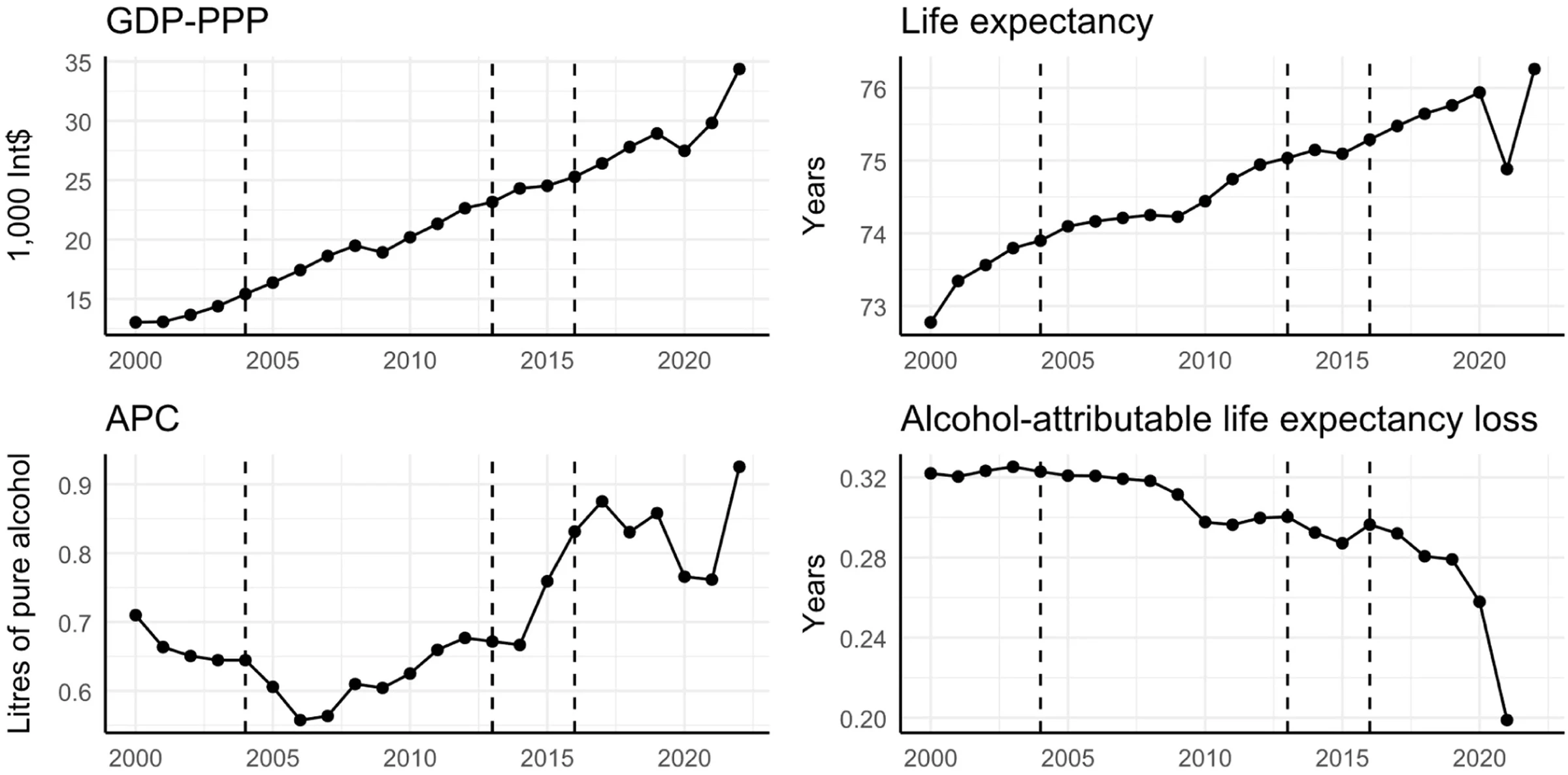
BACKGROUND: Malaysia is a predominantly Muslim, upper-middle-income country where approximately 10% of the population consumes alcohol, yet heavy episodic drinking is common among drinkers. Despite multiple excise duty reforms between 2000 and 2022, their population-level impact on alcohol consumption and alcohol-attributable harm remains unclear. This study evaluates the effects of three major excise duty changes on adult alcohol per capita consumption (APC) and estimates alcohol-attributable life expectancy loss over time. METHODS: A longitudinal ecological design was applied using annual national data (2000-2022) from WHO World Health Statistics 2025. Alcohol-attributable life expectancy loss was estimated by comparing observed WHO Global Health Observatory life tables with a counterfactual scenario of lifetime abstinence, using mortality fractions from a comparative risk assessment based on IHME Global Burden of Disease data. Interrupted time-series analysis with generalised least squares regression assessed the impact of excise duty reforms in 2004, 2012, and 2016 on APC. RESULTS: Between 2000 and 2022, gross domestic product per capita at purchasing power parity (GDP-PPP) and life expectancy increased, while alcohol-attributable life expectancy loss averaged 0.30 years. Life expectancy losses were negatively correlated with life expectancy (ρ = -0.626; 95% CI: -0.829 to -0.278) and APC (ρ = -0.557; 95% CI: -0.793 to -0.178). Following the 2004 tax increase, APC temporarily rose above projected levels before resuming a declining trajectory from 2006. The 2012 Excise Duties Order produced a significant immediate reduction in APC, sustained for two years. In contrast, the 2016 Amendment was associated with a significant rise in APC (β = 0.060, p < 0.001), with consumption exceeding the underlying upward trend. CONCLUSION: Excise duty policies can produce short-term reductions in alcohol consumption but are insufficient to sustain long-term declines.
The paper
Universiti Malaya; University of Toronto
The International Journal on Drug Policy, 9 Oct 2026