Lifetime alcohol use disorder linked to faster cognitive aging
In a longitudinal cohort, lifetime alcohol use disorder was associated with steeper cognitive decline, equivalent to 7.1 additional years of cognitive aging at age 60.
medRxiv
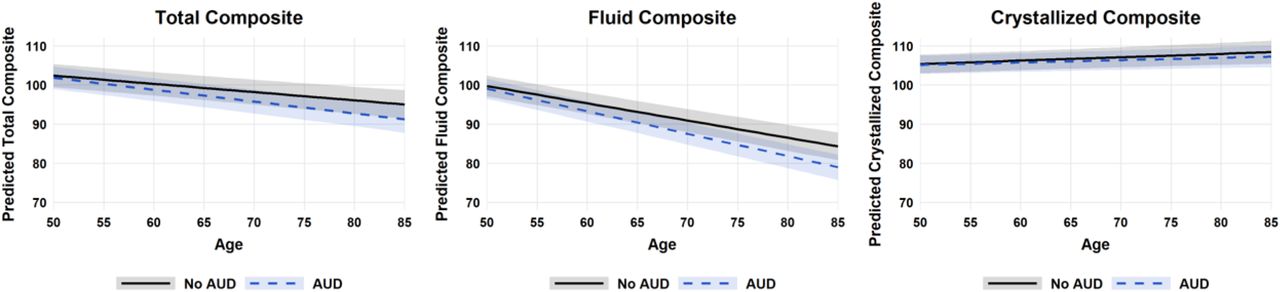
In a study of 1,421 middle-aged and older adults followed for an average of 25.0 years in the Collaborative Study on the Genetics of Alcoholism, researchers assessed how lifetime alcohol use disorder relates to cognitive trajectories. Cognitive performance was measured with the NIH Toolbox Cognition Battery. While baseline cognitive scores did not differ between participants with and without alcohol use disorder, a lifetime history of the disorder was significantly associated with steeper age-related decline in total cognitive scores (interaction estimate = -0.092) and fluid cognition (interaction estimate = -0.13). Crystallized cognition showed no significant interaction. Model projections estimated the deficit was equivalent to 7.1 additional years of cognitive aging at age 60 and 13.8 additional years at age 75. Past-year drinking measures showed no significant interaction with age.
Why it matters
The findings suggest that cumulative exposure to heavy drinking over a lifetime, rather than recent alcohol intake alone, may interact with biological aging to hasten neurocognitive decline.
Caveats
The observational design relied on retrospective interview reports to define lifetime drinking patterns and disorder criteria. In addition, the paper is a preprint that has not yet been certified by peer review.
- Alcohol
- Alcohol use disorder
- NIH Toolbox Crystallized Composite score
- NIH Toolbox Fluid Composite score
- NIH Toolbox Total Composite score
- Humans
The paper
Alcohol use disorder accelerates age-related cognitive decline
Show 21 more authors
Kathleen K. Bucholz, Grace Chan, Danielle Dick, Fanghong Dong, Howard J. Edenberg, Christina E. Garasky, Emma Johnson, Chella Kamarajan, Sivan Kinreich, John R. Kramer, Jodi Kutzner, Alex P. Miller, Zoe Neale, Ashwini Pandey, Gayathri Pandey, Gita Pathak, Jessica E. Salvatore, Marc A. Schuckit, Maggie Clapp Sullivan, Andrey Anokhin, Bernice Porjesz,Washington University in St. Louis
medRxiv · 23 Sep 2026 · Preprint, not peer-reviewed