Brain thinning detected before dementia in people under 65
An observational study of 292 people under 65 linked two positive Alzheimer’s-related spinal-fluid tests to earlier and more extensive thinning.
Journal of Neurology
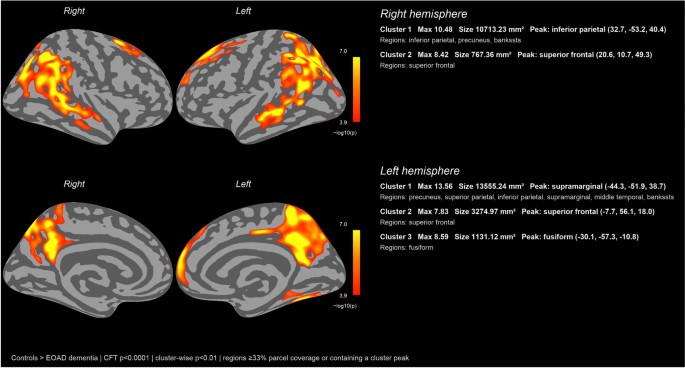
An observational study examined 292 people under 65 with brain scans and spinal-fluid tests. Researchers tested for amyloid-beta and a modified form of tau, proteins used as Alzheimer’s markers. They defined a thinning pattern in the brain’s outer layer by comparing people with test-confirmed Alzheimer’s dementia against a reference group with subjective cognitive decline—self-reported worsening of thinking—who tested negative for both markers.
In mild cognitive impairment, which involves problems with memory or thinking, thinning was more extensive when both markers were positive than when only amyloid was positive. In subjective cognitive decline, localised thinning was detected with both markers positive, but no structural changes were detected with only amyloid positive. Thinning was associated with memory for events and spatial information in mild cognitive impairment. No links between brain structure and thinking performance were found in subjective cognitive decline.
Why it matters
For early-onset Alzheimer’s disease, a key question is how brain structure changes before dementia. This work examined whether fluid-marker profiles were associated with different patterns at those earlier stages.
Caveats
The observational comparisons cannot show how thinning progressed within individuals. Researchers also selected the thinning pattern from differences between the dementia and reference groups.
- Imaging
- Subjective cognitive decline
- Mild cognitive impairment
- Early-onset Alzheimer's disease
- Aβ42/40
- Humans
The paper
Show 5 more authors
Anna Matton, Tobias Granberg, Göran Hagman, Marco Spallazzi, Miia Kivipelto,University-Hospital of Parma · Center for Alzheimer Research
Journal of Neurology · 7 Oct 2026