Early-life stress weakens actuarial senescence in bryozoans
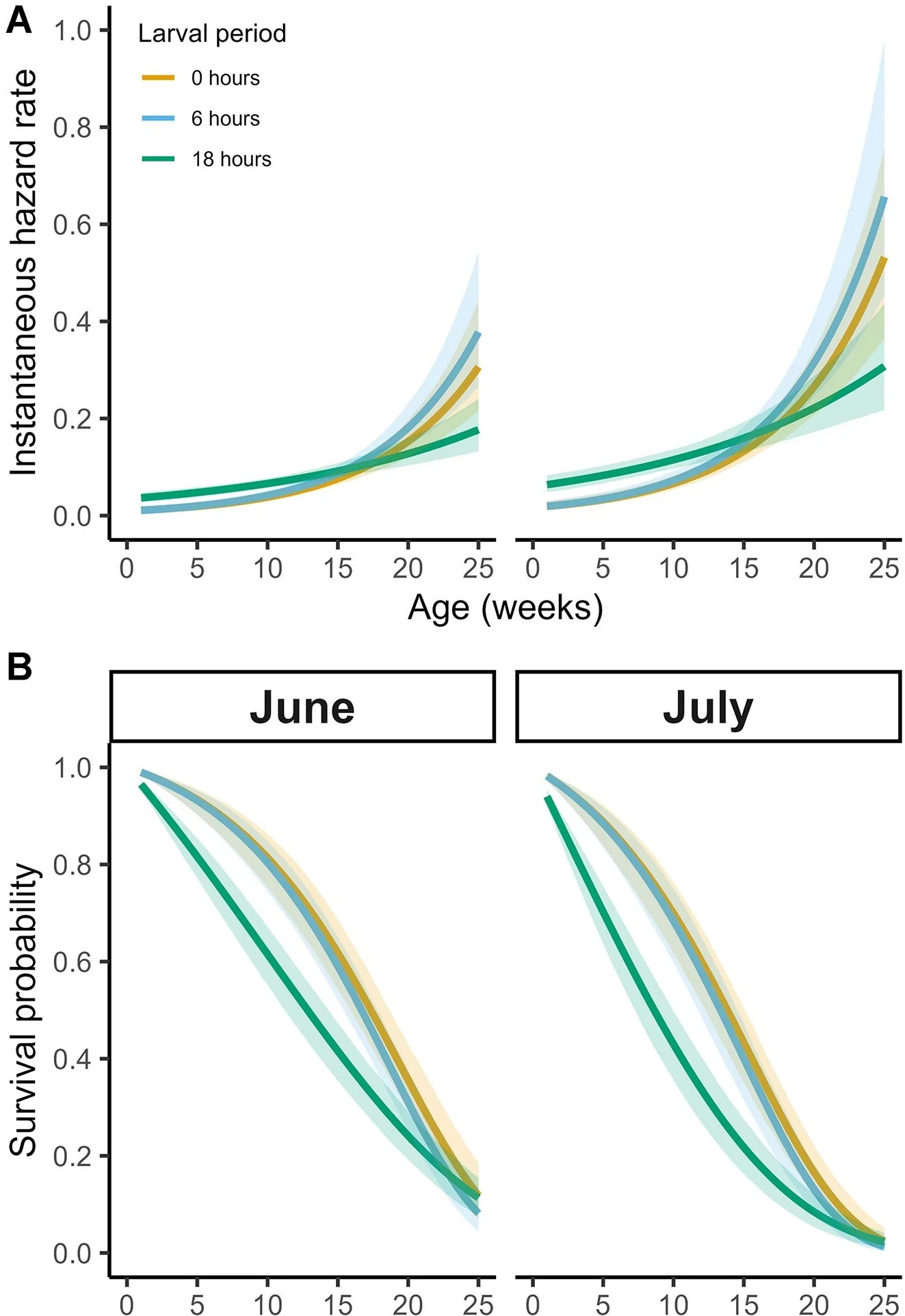
Tracking over 500 marine bryozoans in the field showed that larval energetic stress lowered lifetime reproductive success but reduced the rate of actuarial senescence.
Evolution Letters
In the colonial marine bryozoan Bugula neritina, researchers manipulated early-life stress by experimentally extending the larval period, imposing an energetic challenge. They then monitored the survival, fecundity, and growth of more than 500 individuals in the field across their lifetimes to evaluate trajectories of actuarial and reproductive senescence. Although colonial organisms with indeterminate growth have been theorized to display negligible senescence, the oldest individuals showed strong declines in both survival and reproductive output regardless of larval stress. Adults that developed from stressed larvae exhibited lower overall fitness in terms of lifetime reproductive success. However, these individuals experienced weaker actuarial senescence, alongside nuanced evidence suggesting that early-life stress may also decrease rates of reproductive senescence.
Why it matters
The results provide field evidence of invertebrate aging and suggest that the relationship between early life-history experiences and senescence rates is more complex than standard theories predict.
Caveats
The evidence that early-life stress decreases reproductive senescence was nuanced rather than definitive. In addition, the findings come from a single marine invertebrate species with indeterminate colonial growth.
The paper
Early-life stress reduces senescence in the field for an indeterminately growing ectotherm
Monash University
Evolution Letters · 2 Jul 2026