USP-48 modulates mitochondrial stress and enables longevity in low-insulin worms
A genome-wide screen in roundworms links histone H2B deubiquitination by USP-48 to mitochondrial stress signaling and extended lifespan.
Cell Reports
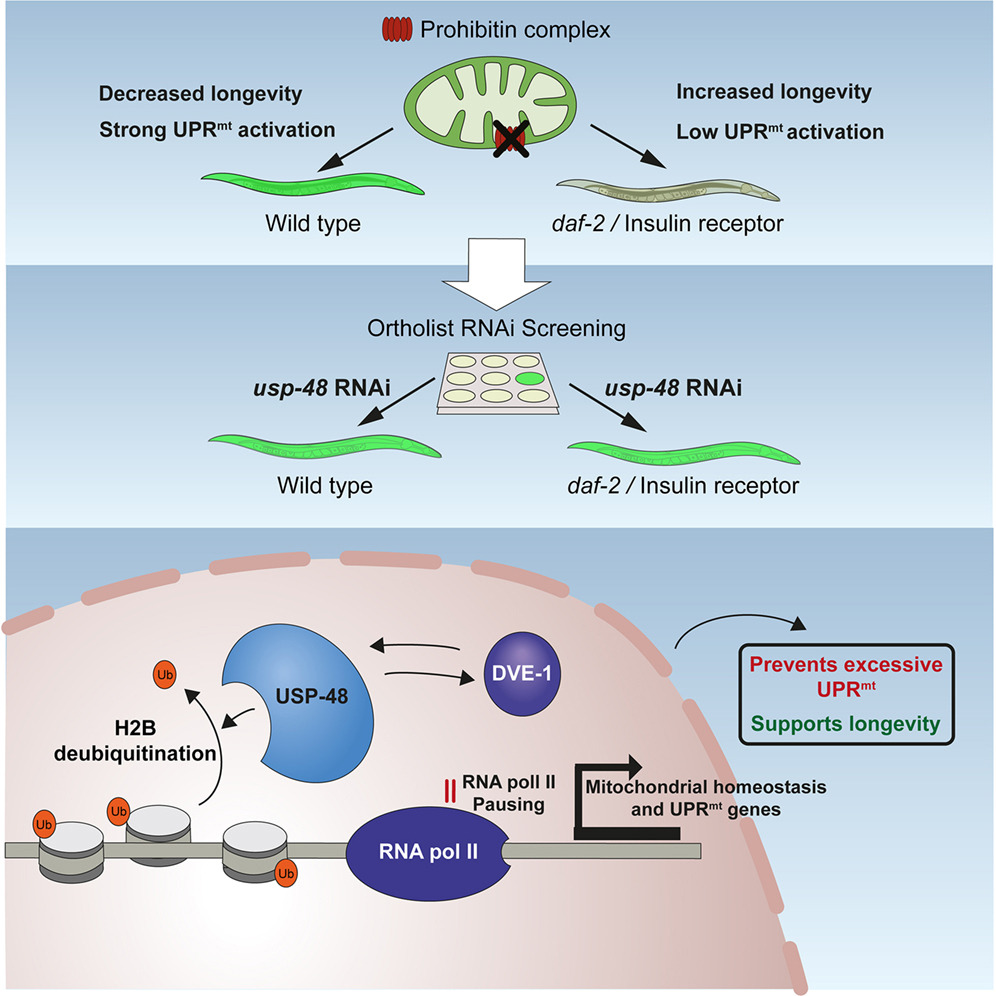
In Caenorhabditis elegans, depletion of the mitochondrial prohibitin complex shortens life in wild-type animals but extends it in long-lived daf-2 mutants. To find regulators of this divergence, researchers conducted a genome-wide double-RNAi screen. They discovered that the deubiquitinating enzyme USP-48 is required for lifespan extension under reduced insulin signaling. USP-48 affects mitochondrial structure and function and helps regulate the mitochondrial unfolded protein response alongside the transcription factor DVE-1, acting largely independent of ATFS-1. Tissue-specific experiments revealed that USP-48 functions primarily in the hypodermis, with some contribution from the germline, while remaining dispensable in muscle and intestine. Mechanistically, USP-48 promotes histone H2B deubiquitination to alter stress-responsive gene transcription.
Why it matters
The findings reveal how epigenetic marks shape mitochondrial stress responses, demonstrating that deubiquitination coordinates metabolic pathways to permit longevity.
Caveats
This study was conducted entirely in C. elegans, and the findings have not yet been evaluated in mammalian systems.
- usp-48
- Mitochondrial unfolded protein response
- Histone modification and chromatin remodelling
- Mitochondrion
- C. elegans
The paper
USP-48 enables insulin-mediated longevity and modulates the mitochondrial stress response
Show 9 more authors
María Jesús Rodriguez-Palero, Laura Cantalejo-Carrasco, Aitor Jarit-Cabanillas, Manuel D. Martínez‐Bueno, Mercedes M. Pérez-Jiménez, Enrique J. Clavijo-Bernal, Aitana Cambón, Ildefonso Cases, Matthias Eder,Consejo Superior de Investigaciones Científicas · Universidad Pablo de Olavide
Cell Reports · 30 Sep 2026