Biological aging clocks combined with genetics improve dementia risk prediction
Adding proteomic, metabolomic, and clinical aging measures to polygenic scores boosted prediction accuracy in two large human cohorts.
Alzheimer's & Dementia
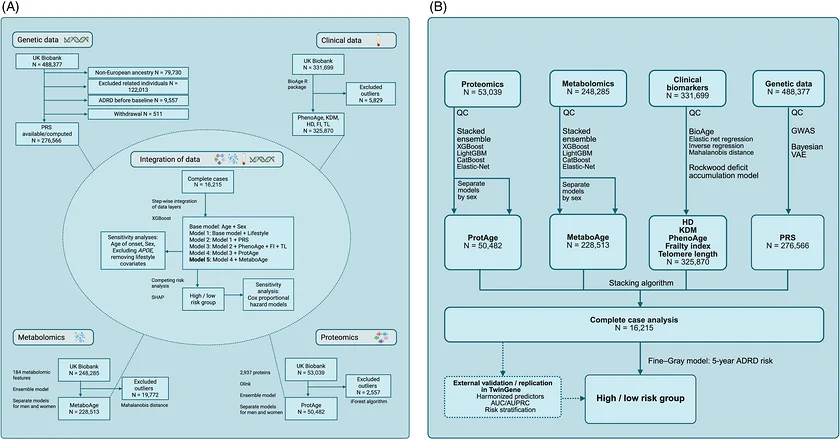
Researchers evaluated 16,215 UK Biobank participants who were dementia-free at baseline over a median follow-up of 10.08 years. During this period, 397 incident diagnoses of Alzheimer's disease and related dementias occurred. The team combined polygenic risk scores with clinical, telomere, proteomic, and metabolomic aging markers to predict disease onset. In a held-out test set, the integrated model achieved an area under the curve of 0.90. Polygenic risk was the strongest individual predictor, followed by the proteomic aging clock ProtAge. Participants in the highest predicted risk quartile had substantially higher dementia incidence. In an external validation cohort of 3,772 TwinGene participants with 331 cases, the model preserved risk stratification and achieved an area under the curve of 0.757.
Why it matters
The findings show that molecular aging markers, particularly proteomic clocks, capture distinct biological risks that complement inherited genetic susceptibility. This demonstrates how multi-omics aging metrics can refine the identification of individuals at high risk for age-related neurodegenerative diseases.
Caveats
The analysis relied on observational cohort data, and predictive performance decreased from an area under the curve of 0.90 in the initial cohort to 0.757 in external validation.
- Machine learning
- Clinical biological age
- Alzheimer's disease and related dementias
- Polygenic risk score
- Telomere length
- Humans
The paper
Karolinska Institutet
Alzheimer's & Dementia · 29 Sep 2026 · CC BY