Old mice show disrupted gene responses to memory updating
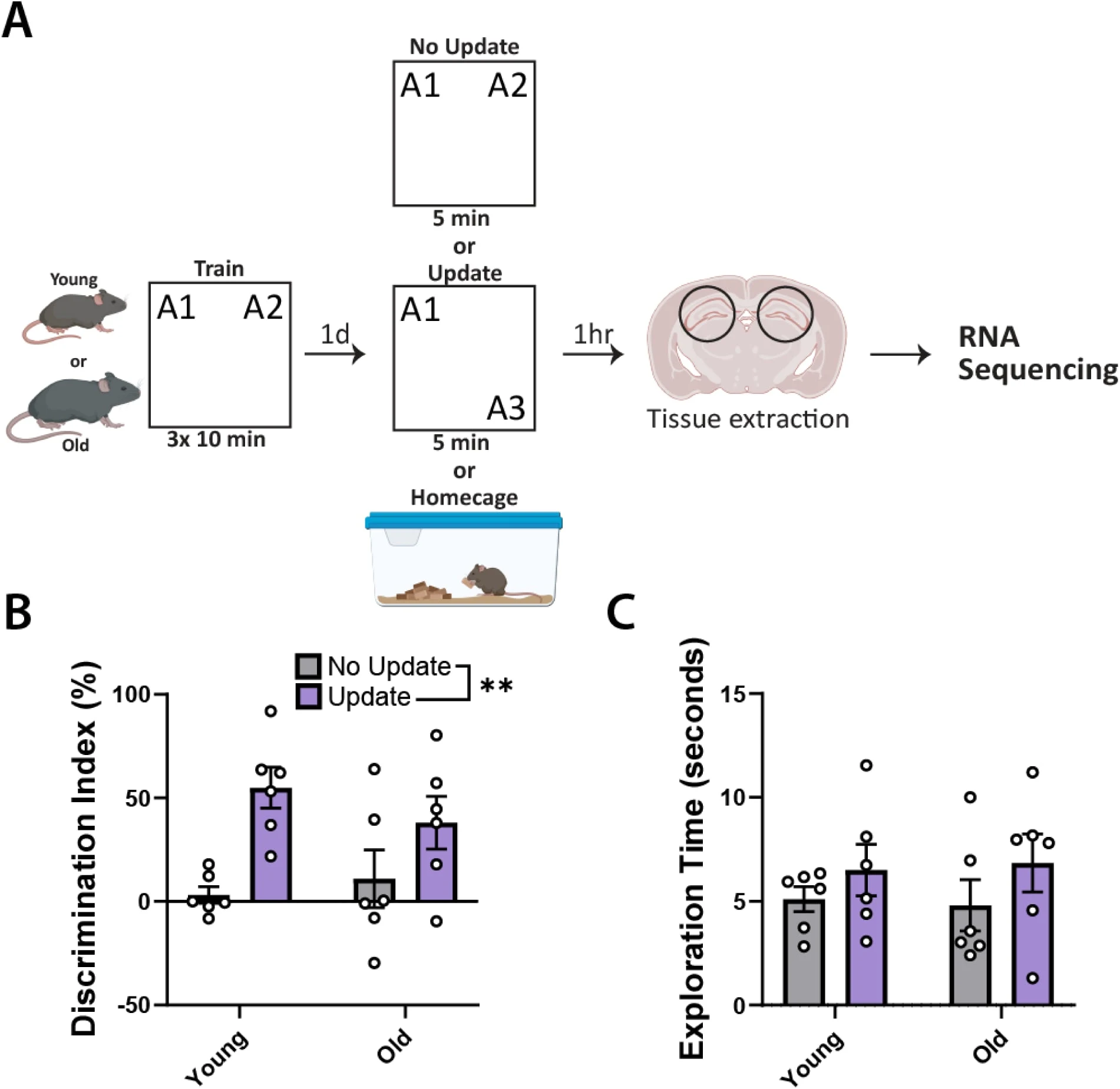
Experiments with mice aged 3 to 4 months and 18 to 20 months found different gene responses to updating memories of object locations.
Our read
Mechanisms- Studied:
- Preprint: experiments in old mice, against young mice (Randomized, blinded)
- What changed:
- Transcriptional similarity between memory updating and retrieval was higher in old mice than in young mice
- The catch:
- The study did not identify which brain cell types express candidate updating genes
- Why it’s aging research:
- It studies organisms or tissues that aged naturally.
Editor of record: Boris Djordjevic · AgingResearch.News
In an animal experiment, researchers compared C57BL/6J mice aged 3 to 4 months with mice aged 18 to 20 months. The task tested memory for object locations after one object moved. Researchers measured gene activity one hour after memory updating or recall without new information. They examined the dorsal hippocampus, part of a brain region involved in memory.
Young mice activated distinct sets of genes during memory updating and recall alone. Old mice, which failed to update memories, activated similar sets in both situations. In a separate experiment, researchers reduced the activity of Tent5a, a gene whose protein helps stabilize genetic messages, in the dorsal hippocampus of young mice. This disrupted memory updating compared with a control, indicating that Tent5a activity was necessary for this process.
Why it matters
Incorporating new information into existing memories is impaired with aging. Understanding the genes needed for that process may help researchers investigate age-related cognitive decline.
Caveats
The experiments were in mice; reducing Tent5a activity in young mice does not show whether boosting it would help old mice. The work is a preprint and has not been peer-reviewed.
The paper
Pennsylvania State University
bioRxiv, Sep 14, 2026, Open access, Preprint, not yet peer-reviewed


Comments
Be the first to comment.