Storage protein links early diet to lifespan in fruit flies
Experiments that restricted protein during larval development traced longer adult life to lower levels of a protein that stores nutrients.
Limit: Proteome normalization can cancel out global reductions, underestimating actual fold changes between groups
Edited by Boris Djordjevic · AgingResearch.News
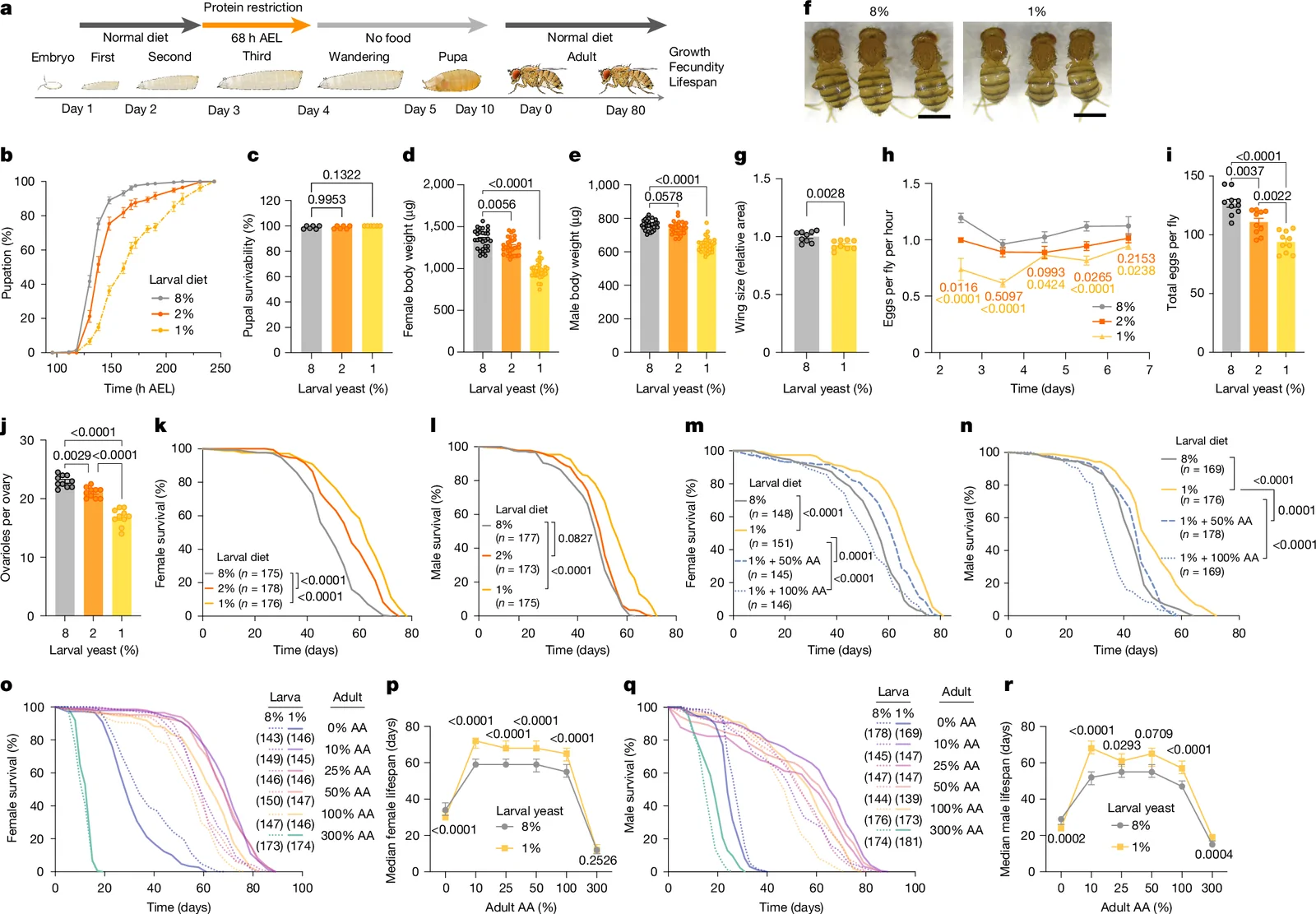
In experiments in Drosophila fruit flies, researchers restricted protein during larval development, then returned adults to a standard diet. Larvae received diets containing 2% or 1% yeast instead of 8%, starting about 68 hours after egg-laying. Adults of both sexes lived longer.
Tracing amino acids, the building blocks of proteins, showed that those eaten as larvae persisted into early adulthood and entered proteins in ribosomes, the cell’s protein-making machinery. The researchers identified Lsp2, a major storage protein, as a carrier of this dietary history. Early protein restriction lowered Lsp2 levels into early adulthood. Genetically reducing Lsp2 production also reduced ribosomal proteins and protein-making activity in early adulthood and extended lifespan.
Why it matters
Early-life nutrition can have lasting effects on lifespan. The work addresses how an animal carries that dietary history through development into adulthood.
Caveats
These laboratory experiments in fruit flies do not establish effects in people. Protein restriction also delayed development, reduced adult body weight and impaired female reproduction, especially in early adulthood.
The paper
Lsp2 links early-life diet to adult translation and lifespan in Drosophila
Champalimaud Foundation; Kyoto University
Nature, Sep 23, 2026, Open access
