Mobile screening for a cancer precursor is feasible in England
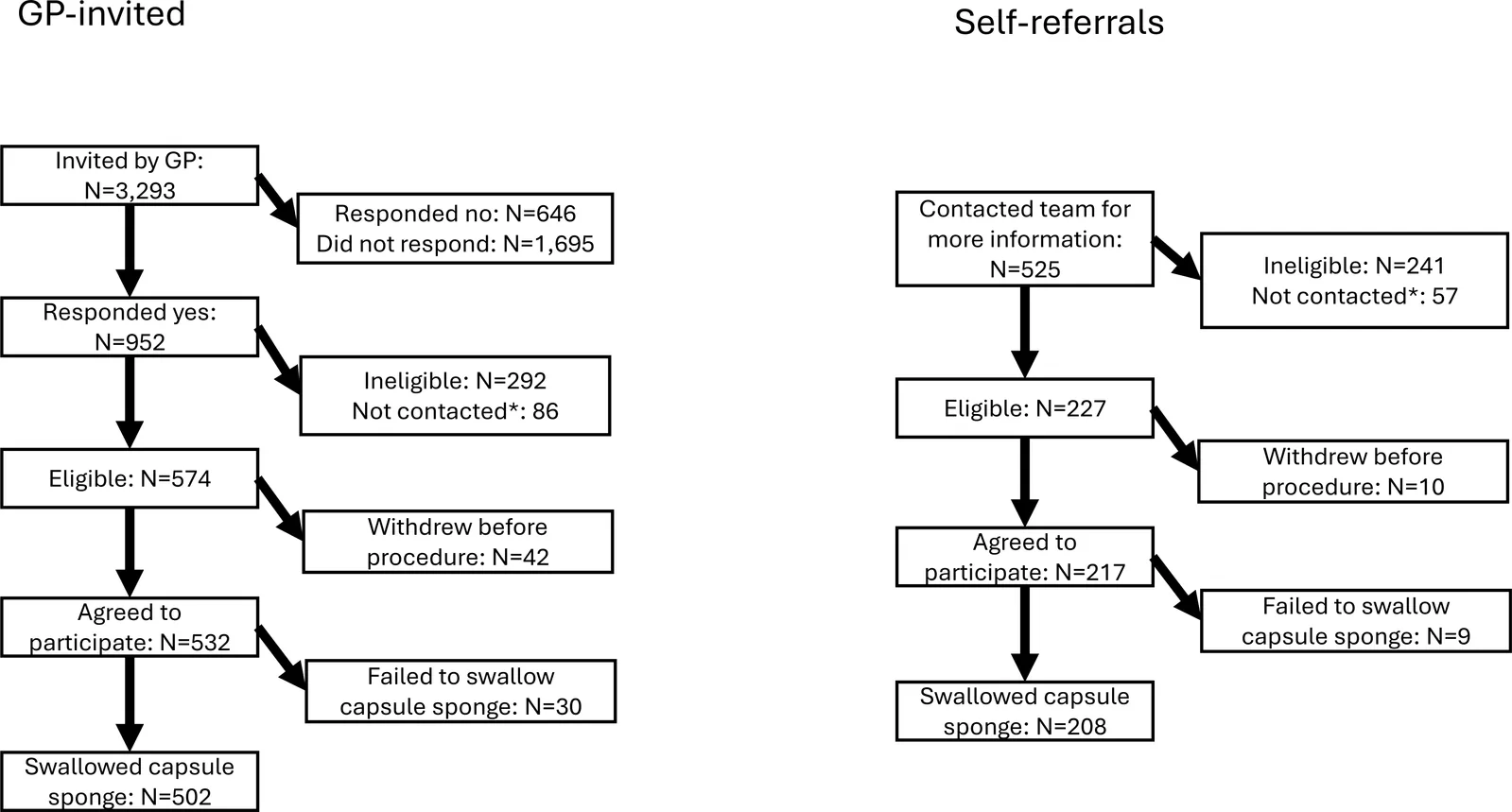
A capsule sponge test reached 15% of people invited by family doctors and 39.6% of those who self-referred.
Our read
Interventions- Studied:
- Single-arm trial in GP-invited and self-referred adults with reflux (Multicenter, registered ISRCTN91655550)
- What changed:
- Capsule sponge swallowing succeeded in 94.4% of GP-invited participants and 95.9% of self-referred participants
- The catch:
- Missing data on nonparticipants prevent judging how representative the screened participants were
- Stake:
- Cancer Research UK funded the study. An author works for Sawston Partnership. Authors also declare ties to 2 more companies.
- Why it’s aging research:
- It bears on staying healthy in midlife and later life.
Editor of record: Boris Djordjevic · AgingResearch.News
In an implementation study in England, 3,293 people aged 50 or older with repeat prescriptions for proton pump inhibitors, drugs that reduce stomach acid, received screening invitations from family doctors. Recruitment ran from June 2021 to January 2023 across three practices. People aged 40 or older taking nonprescription reflux medicines could also self-refer.
After eligibility checks, 502 doctor-invited participants and 208 self-referred participants successfully swallowed a capsule sponge in a mobile unit. Those with positive results were referred for endoscopy, an examination using a camera. Barrett’s esophagus, a precursor to cancer of the food pipe, was diagnosed in 4.2% and 3.4% of these groups, respectively. Over 99% of participants found the test acceptable. The authors concluded that mobile screening was feasible and that encouraging self-referrals increased uptake.
Why it matters
For older adults with reflux, screening can identify a precursor to esophageal cancer. This study addressed the practical challenge of offering that screening outside hospitals.
Caveats
The recruitment groups were not randomized and had different age criteria, so their uptake rates are not a like-for-like comparison. The findings do not cover people with known Barrett’s esophagus or difficulty swallowing, who were excluded.
From the paper
- Participants
In total, 710 individuals successfully swallowed a capsule sponge, of whom 29.3% self-referred.
- Events by group
… this would correspond to 5.1% of GP-invited and 3.5% of self-referrals having BO, including 0.5% in each group having dysplastic BO.
Results, Outcomes among individuals who swallowed a capsule sponge
- Limitation
We only know why a small proportion of individuals contacted by their GPs declined to participate, and we did not have individual-level GP data for individuals who did not respond to the invitation, so it was not possible to compare the characteristics of individuals who did and did not respond.
Quoted word for word from the full text on PubMed Central.
- Capsule sponge test on a mobile unit
- Capsule sponge test
- Barrett's esophagus
- Dysplasia
- Gastro-esophageal reflux disease
- Humans
The paper
University of London; Macmillan GP
BMJ Open Gastroenterology, Sep 22, 2026, Open access

Comments
Be the first to comment.