Stool blood screening linked to fewer colorectal cancer deaths
Adjusted estimates linked invitations to a 26% lower colorectal cancer death rate and participation to a 43% lower rate, versus the comparison group.
Limit: The final adjustment ignored links between screening exposure and age or calendar time
Edited by Boris Djordjevic · AgingResearch.News
In a prospective cohort study, researchers followed 376,511 men and women in Sweden’s Stockholm-Gotland region, where screening invitations targeted ages 60 to 69. Birth-year groups were randomly selected for invitations in 2008–2012 or a comparison group invited later or never. Screening used stool tests for hidden blood. Follow-up continued until emigration, death or the end of 2021.
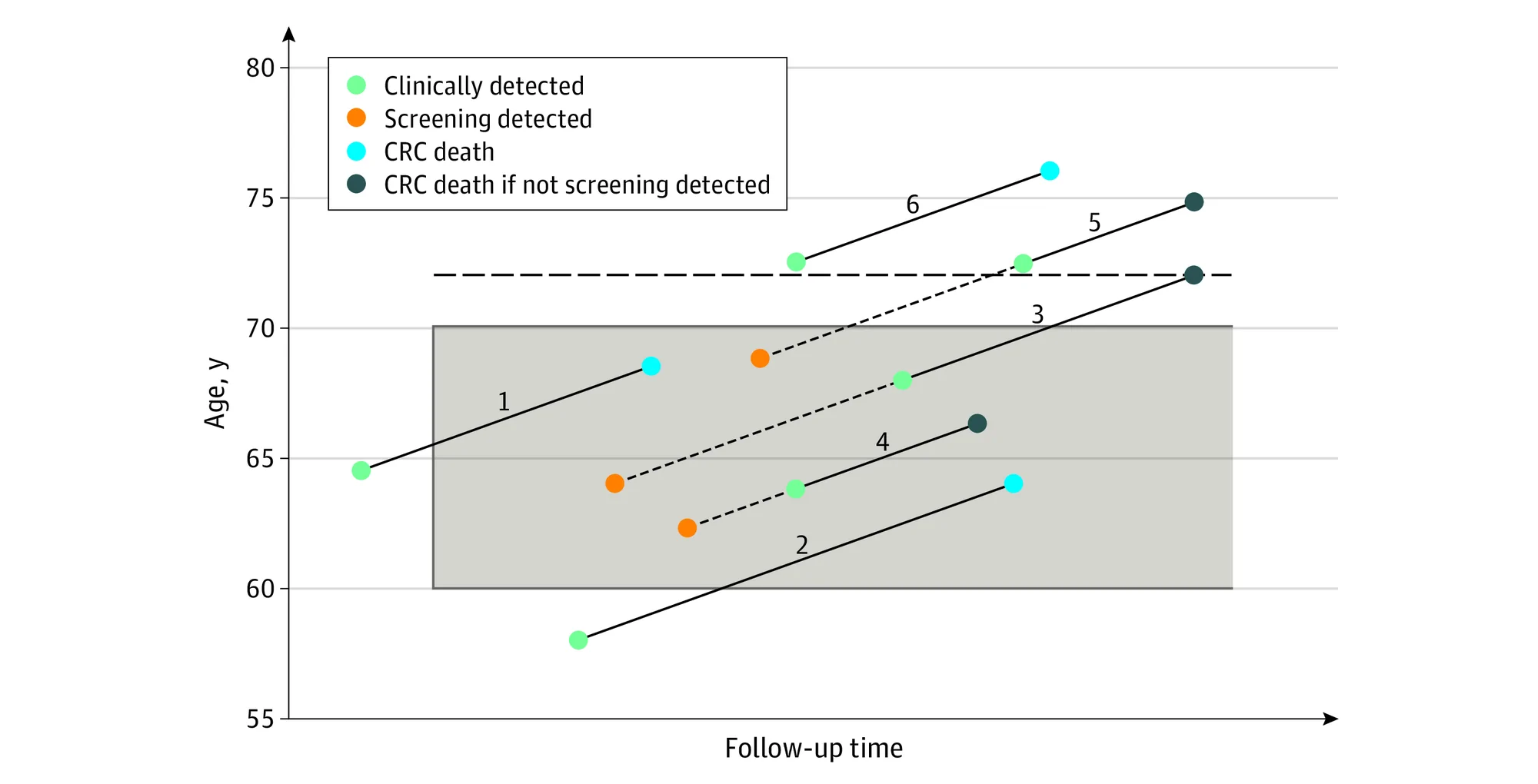
There were 856 deaths from colorectal (colon and rectal) cancer among 203,692 people in the earlier-invitation group and 812 among 172,819 comparison participants. After adjustments, invitations were associated with a 26% lower colorectal cancer death rate than in the comparison group. Adjustments accounted for cancers diagnosed more than two years after invitations stopped and comparison participants invited to screen. Further adjustments for nonparticipation and screening participation in the comparison group yielded an estimated 43% lower rate associated with participation.
Why it matters
The study addressed how to evaluate cancer screening programs for older adults. The authors said the findings support efforts to increase screening uptake.
Caveats
Participation was not randomly assigned; with adjustment only for age and follow-up time, the range of likely values included no mortality difference. The study covered screening invitations at ages 60 to 69 and excluded people with colorectal cancer before follow-up.
From the paper
- Participants
After data cleaning there were 376 511 individuals, including 203 692 individuals in the SG (99 472 men [48.8%]; mean [SD] age at start of follow-up, 63.6 [3.2] years) and 172 819 individuals the CG (84 705 men [49.0%]; mean [SD] age at start of follow-up, 62.8 [3.5] years), with 856 CRC deaths in the SG and 812 CRC deaths in the CG during follow-up …
- Who took part
The study population consisted of all 392 190 residents of the Stockholm-Gotland region of Sweden between 2008 and 2012 (born between 1938 and 1954) and has been described previously.
- Result
With adjustment for attained age and follow-up time, the RR was 0.92 (95% CI, 0.83-1.01).
- Limitation
However, in comparison, any residual confounding introduced by this approach appears to be marginal.
- Colorectal cancer mortality
Additionally, adjusting also for contamination of CRC deaths among individuals in the CG invited to screen and with diagnosis 2 years or less after the last invitation (exposed), the RR was further reduced to 0.74 (95% CI, 0.58-0.94), which is the estimated effect of invitation to screening.
- Colorectal cancer mortality
The remaining 29.1 nonexposed CRC deaths in the SG were further adjusted using a crude method (eMethods in ), yielding a final estimated effect of screening participation of 43% (RR, 0.57; 95% CI, 0.40-0.80).
Quoted word for word from the full text on PubMed Central.
- Fecal occult blood screening invitation
- Fecal occult blood screening participation
- Colorectal cancer
- Humans
The paper
Fecal Occult Blood Screening Outcomes Adjusted for Contamination Bias and Nonadherence
Karolinska Institutet; Umeå University
JAMA Network Open, Aug 3, 2026, Open access


