Blood DNA patterns linked to later prostate and breast cancer
An analysis of 491 blood samples linked high-risk DNA patterns to a 3.55-fold increased hazard of developing prostate cancer.
Our read
Biomarkers- Studied:
- Study of people sampled before breast or prostate cancer diagnosis, up to nine years
- What changed:
- People with high-risk DNA patterns had a 3.55-fold increased hazard of developing prostate cancer
- The catch:
- The abstract omits independent validation of prediction accuracy outside the discovery set
- Stake:
- An author holds patents licensed to Roche.
Editor of record: Boris Djordjevic · AgingResearch.News
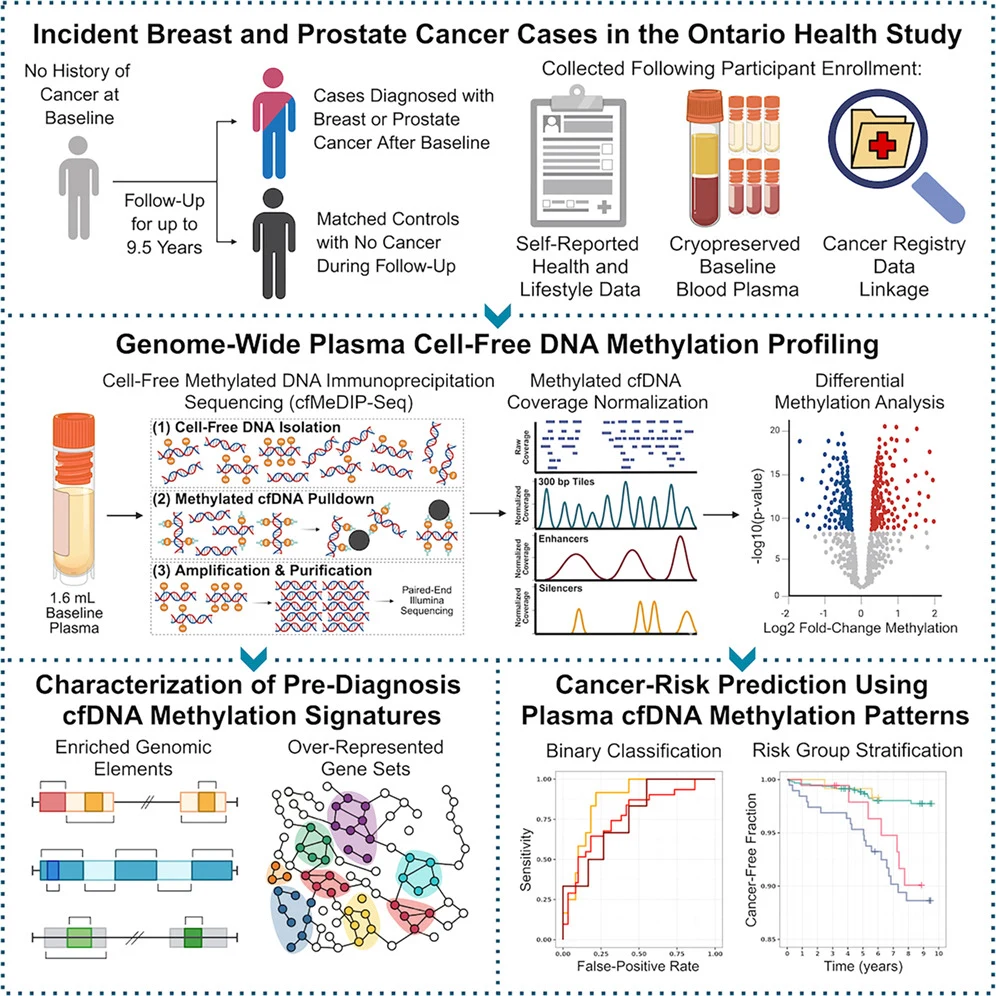
Human blood plasma—the liquid part of blood—provided 491 samples collected before breast or prostate cancer diagnosis in an observational study. Some were collected up to nine years before diagnosis. Researchers profiled methylation, chemical marks on DNA, in cell-free DNA, which circulates outside cells.
Prediction models trained on a discovery set linked methylation in gene-silencing regions to future prostate cancer. People classified as high risk had a 3.55-fold increased hazard, a measure of the rate of developing cancer over time. For breast cancer, methylation patterns modestly predicted future diagnoses but strongly distinguished established late-stage cancers. People classified as high risk for breast cancer had a 2.3-fold increased hazard. The authors described these DNA marks as promising indicators for early cancer risk prediction and surveillance.
Why it matters
Cancer surveillance is an important part of health care as people age. The authors suggest that circulating DNA marks may help identify cancer risk before clinical diagnosis.
Caveats
The prediction models were trained on a discovery set; the abstract does not describe independent validation, which matters for judging how well they would predict cancer in other people.
The paper
Ontario Institute for Cancer Research; University of Toronto
Cell Genomics, Sep 21, 2026, Open access

Comments
Be the first to comment.