Cycling linked to gene regulation and immune changes in Lynch syndrome
In a non-randomized study of 16 Lynch syndrome carriers, cycling for 52 weeks was associated with changes in DNA regulation and immune-cell patterns.
Our read
Interventions- Studied:
- Non-randomized trial in 8 Lynch syndrome carriers, against usual-care participants
- What changed:
- Blood T cell receptor diversity rose more with cycling than with usual care
- The catch:
- Exercise participants were older, and limited age adjustment could confound immune comparisons
- In the record:
- The 3,368th paper on exercise with results in people; 9,470 on record in all.
- Why it’s aging research:
- It studies an intervention with evidence of extending healthy life.
Editor of record: Boris Djordjevic · AgingResearch.News
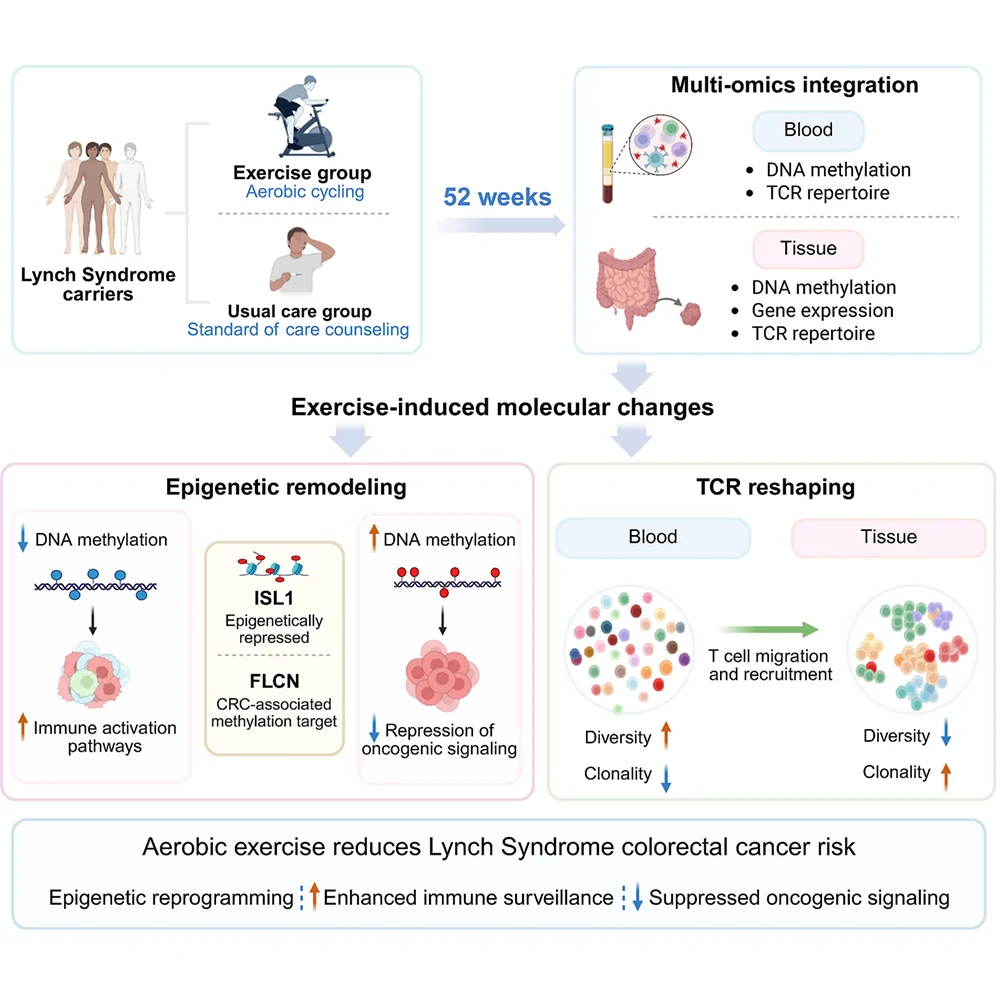
Sixteen people with Lynch syndrome, an inherited condition that raises cancer risk, were studied in a non-randomized controlled exercise trial. Nine attended 45-minute cycling classes three times weekly for 52 weeks; seven received usual-care counseling. Researchers compared blood samples collected before and after, alongside paired colon samples from 15 participants.
Cycling was associated with changes in DNA methylation, chemical marks that help regulate gene activity. Patterns in DNA circulating in blood suggested activation of first-line immune defenses, while colon tissue patterns suggested reduced activity in processes linked to cancer. In an immune analysis of eight participants, four per group, cycling was associated with greater diversity of T cell receptors in blood. These receptors help immune cells recognize targets. Colon receptor patterns suggested recruitment of immune cells responding to particular targets.
Why it matters
For cancer, an age-related disease, the authors propose changes in gene regulation and immune responses as potential mechanisms of exercise-mediated protection in Lynch syndrome.
Caveats
The small, non-randomized groups differed in age, reported as 46 years for exercisers and 35.5 for controls. These molecular results do not establish cancer prevention, and their relevance beyond Lynch syndrome carriers without diabetes or hypertension remains uncertain.
From the paper
- Participants
A total of 16 participants were enrolled in the epigenetics study, with 9 in the exercise group and 7 in the control group.
- Who took part
Briefly, 21 participants diagnosed with Lynch syndrome were enrolled, including 11 participants in the exercise group who underwent a 52-week aerobic exercise intervention consisting of 45-min cycling classes three times per week and 10 participants in the usual-care control group who received standard-of-care counseling without enrollment in cycling classes …
- Analyzed for TCR repertoire diversity
Among them, 8 (4 per group) were also included in the immune cohort study.
- Events by group
Conversely, tissue-derived DMRs showed 90% hypermethylation in the exercise group and 80% hypomethylation in the control group.
Results, Exercise-induced changes in global DNA methylation patterns and eDMRs identification
- Limitation
Our multi-omics approach underscores a novel interplay between epigenetic and immune remodeling, offering mechanistic insights into exercise-mediated CRC prevention in LS carriers.
- ISL1
Notably, among the four genes, only ISL1 showed significant downregulation in the exercise group (BH-adjusted p < 0.05, C), while the remaining genes did not exhibit statistically significant expression changes.
Results, Identification of exercise-induced epigenetically regulated genes in tissue
- TCR repertoire diversity
In peripheral blood, the exercise group showed increased diversity over time compared to control, as evidenced by elevated rarefaction curves ( A and S3B), higher Inverse Simpson index, and lower Gini coefficient (p < 0.05; A and 4B; E and S3F), thus indicating lower clonal dominance and greater evenness …
Quoted word for word from the full text on PubMed Central.
Exercise is part of Bryan Johnson's Blueprint
The paper
Exercise-associated epigenetic remodeling and TCR repertoire dynamics in Lynch syndrome carriers
The University of Texas MD Anderson Cancer Center
iScience, Aug 28, 2026, Open access


Comments
Be the first to comment.