Brain-age estimates can be reliable with ultra-low-field scans
Four leading approaches had average absolute errors of 6.7–8.21 years against actual ages in 23 adults scanned with ultra-low-field magnetic resonance imaging.
Cohort study
Limit: Only 23 adults were scanned, so chance findings and unstable rankings cannot be excluded
Edited by Boris Djordjevic · AgingResearch.News
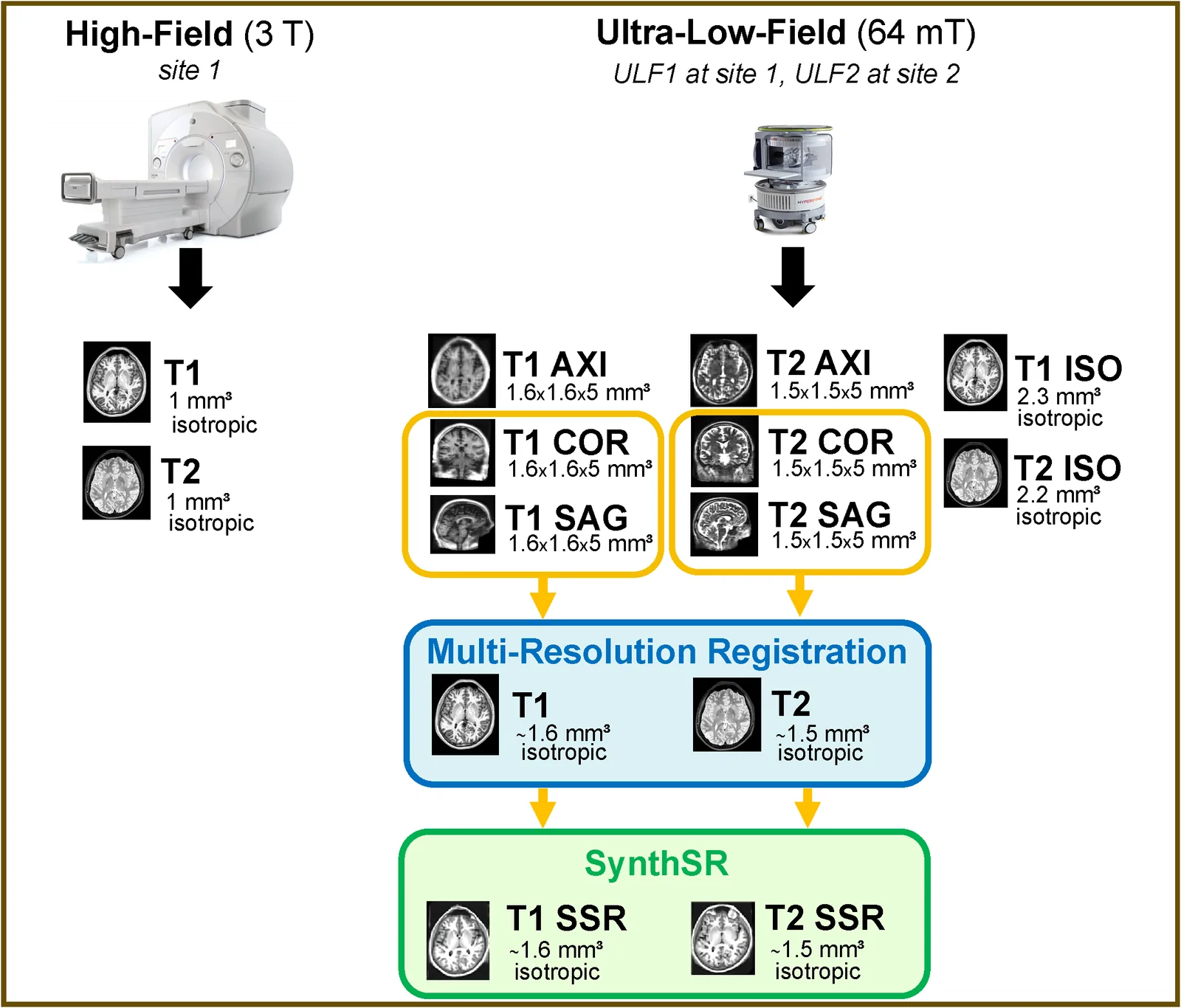
In an observational study, 23 generally healthy adults aged 20–69 underwent magnetic resonance imaging (MRI) on one high-field scanner and two ultra-low-field scanners. Ultra-low-field scanners use weaker magnetic fields and are cheaper and more accessible. Brain-age software uses scans to estimate the brain’s biological age.
The researchers compared five software packages across scan types and image-processing methods. The two ultra-low-field scanning sessions were no more than 36 days apart. Results varied widely across combinations. Several approaches performed comparably to high-field scans. The four leading combinations produced highly consistent estimates between the two ultra-low-field scanners. Some scans also performed well without image enhancement. Performance depended on the software, scan type and processing.
Why it matters
Brain age is a proposed marker of brain health and disease risk. The authors suggest that cheaper, more accessible scans could expand its use in population research and long-term monitoring.
Caveats
This small observational study assessed age estimates, not disease prediction or clinical decisions, and does not establish performance in people with major neurological or psychiatric conditions. Some image processing also used each participant’s high-field scan as a reference.
From the paper
- Limitation
First, the sample size was modest, so chance findings, for example in the form of unstable pipeline rankings and their differences, cannot be excluded.
Quoted word for word from the full text on PubMed Central.
The paper
Brain-age in ultra-low-field MRI: How well does it work?
University College London
Imaging Neuroscience, Sep 15, 2026, Open access

Comments
Be the first to comment.