Clinical Frailty Scale and 12-month adverse health outcomes among community-dwelling older adults in Vietnam: a prospective cohort study
12 months, dose-response
Abstract
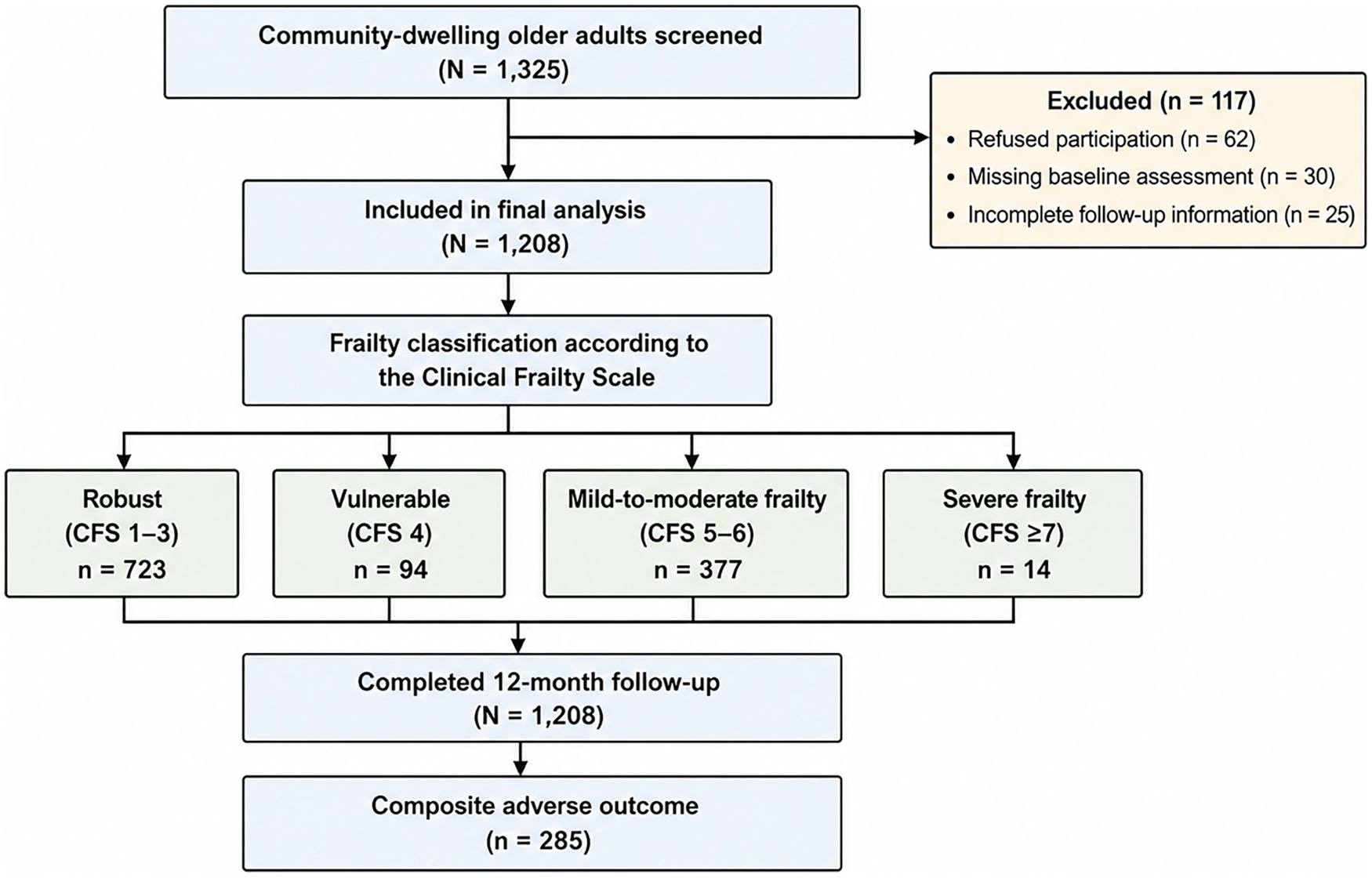
BACKGROUND: Frailty is an important predictor of adverse health outcomes in older adults, but evidence from community settings in Vietnam remains limited. This study examined the association between frailty and adverse health outcomes among community-dwelling older adults. METHODS: In this prospective cohort study, 1,208 community-dwelling older adults were assessed using the Clinical Frailty Scale (CFS) and followed for 12 months. The primary outcome was a composite of all-cause mortality, falls, and hospitalization. Multivariable logistic regression was used to evaluate the independent association between frailty and adverse outcomes. RESULTS: Of the participants, 59.9% were robust, 7.8% vulnerable, 31.2% had mild-to-moderate frailty, and 1.2% had severe frailty. During follow-up, 23.6% experienced at least one adverse outcome. Event rates increased progressively across frailty categories, from 9.7% in robust participants to 64.3% in those with severe frailty (P for trend <0.001). After adjustment for demographic characteristics, lifestyle factors, multimorbidity, polypharmacy, and cognitive impairment, frailty remained independently associated with adverse outcomes (adjusted OR per one-point increase in CFS: 1.88, 95% CI: 1.67-2.11; P < 0.001). CONCLUSION: Frailty was highly prevalent and strongly associated with adverse health outcomes among community-dwelling older adults. These findings support the use of the Clinical Frailty Scale to identify community-dwelling older adults who may benefit from closer monitoring and targeted preventive care.
From the paper
- Participants
A total of 1,208 participants with complete baseline and 12-month follow-up data were included in the final analysis.
- Follow-up
Baseline recruitment and assessment were conducted between November 2023 and April 2025, and participants were followed for 12 months after baseline assessment.
- Limitation
First, participants were recruited from a single community setting, which may limit the generalizability of the findings to other populations.
Quoted word for word from the full text on PubMed Central.
The paper
University of Medicine and Pharmacy at Ho Chi Minh City
Frontiers in Medicine, 3 Sep 2026, Open access