Self-Reported Health Literacy and Current Conventional Cigarette Smoking Among Korean Adults: A Cross-Sectional Analysis of the 2024 Korea National Health and Nutrition Examination Survey
Declared no competing interests
Abstract
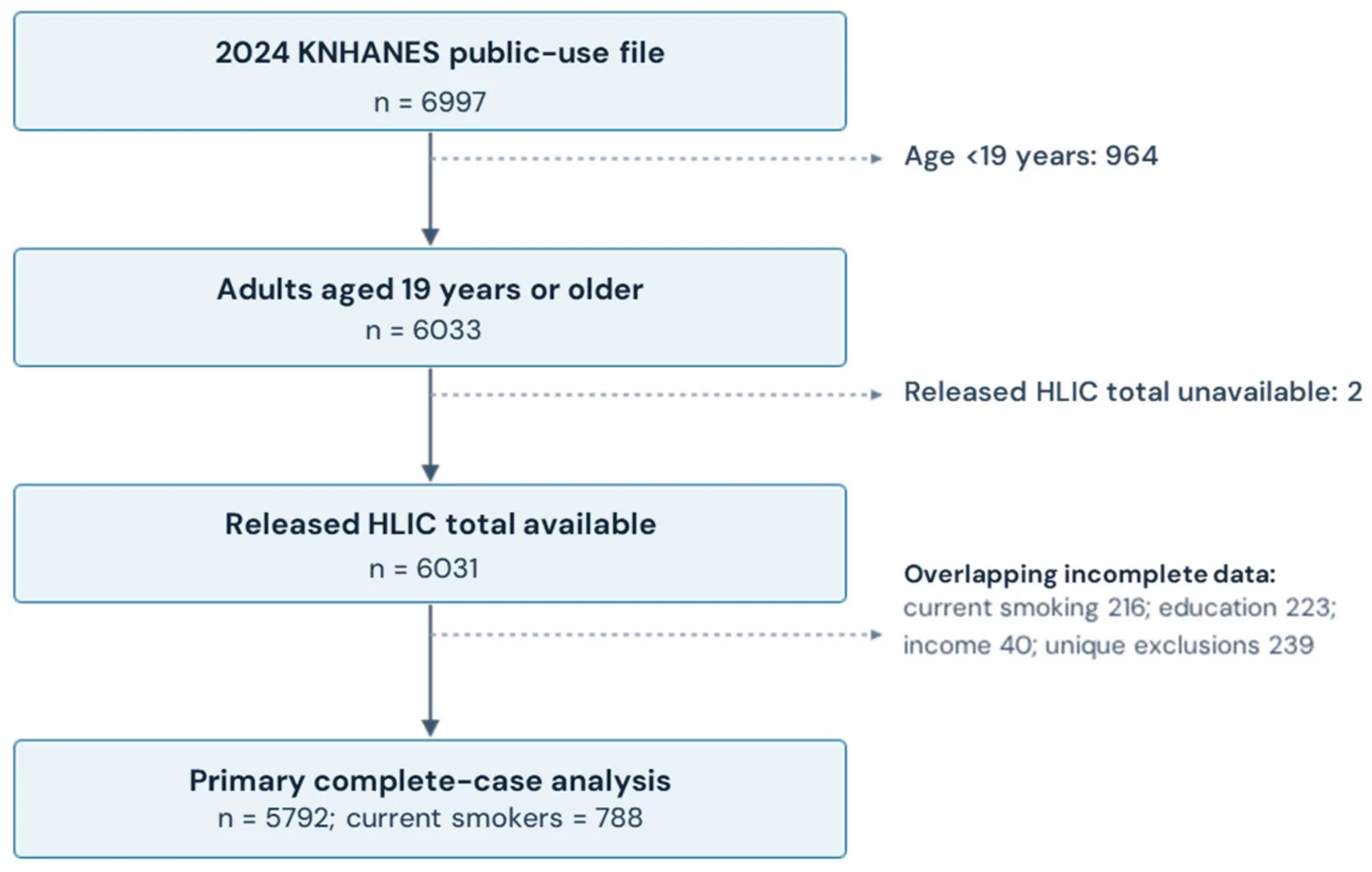
Background/Objectives: Analyses of the 2023 Korea National Health and Nutrition Examination Survey described health-literacy distributions by smoking status but did not model current conventional cigarette smoking across continuous Health Literacy Index for the Community (HLIC) scores or report a standardized absolute difference. Methods: We analyzed 5792 adults aged ≥19 years. Survey-weighted quasi-Poisson models estimated prevalence ratios (PRs) per 5-point-lower HLIC score, adjusting for age, sex, education, and household income. Standardized prevalences were compared for scores below versus at or above 30. Exploratory analyses separated former smokers from adults with fewer than 100 lifetime cigarettes and tested interaction by sex. Results: The adjusted PR per 5-point-lower score was 1.103 (95% confidence interval (CI), 1.020-1.192). Standardized smoking prevalence was 18.08% below 30 and 14.74% at or above 30; the difference was 3.34 percentage points (95% CI, 1.08-5.60). There was no clear evidence of sex-related heterogeneity on the PR scale (interaction p = 0.541), although the estimate among women was imprecise. Conclusions: Lower self-reported HLIC was associated with modestly higher smoking prevalence. The cross-sectional design precludes temporal inference, but the association may be relevant to the design and evaluation of accessible smoking-prevention and cessation services. Longitudinal and intervention studies are needed.
From the paper
- Participants
The sample included 3650 adults with HLIC scores of 30 or higher and 2142 with scores below 30.
- Result
The adjusted PR was 1.222 (95% CI, 1.069–1.396) for HLIC below 30 versus at or above 30 and 1.248 (95% CI, 1.054–1.477) for HLIC below 28 versus at or above 28.
Results, 3.2. Primary Association and Absolute Prevalence Contrast
- Limitation
Because HLIC and smoking were measured concurrently, their temporal order could not be determined.
Quoted word for word from the full text on PubMed Central.
The paper
Woosuk University; Chungnam National University
Healthcare, 6 Sep 2026