Protein links to Alzheimer’s markers differ by gene variant
An observational analysis of 115 veterans aged 50–76 without cognitive impairment found different links between immune signaling and Alzheimer’s-related markers depending on a gene variant.
Registered NCT02719327
Stake: An author holds shares in CERimmune Therapeutics. An author holds patents with Bioventix.
Edited by Boris Djordjevic · AgingResearch.News
An observational study analyzed fluid surrounding the brain and spinal cord from 115 cognitively unimpaired veterans aged 50–76. Researchers used baseline samples collected before participants received an investigational drug in a separate trial.
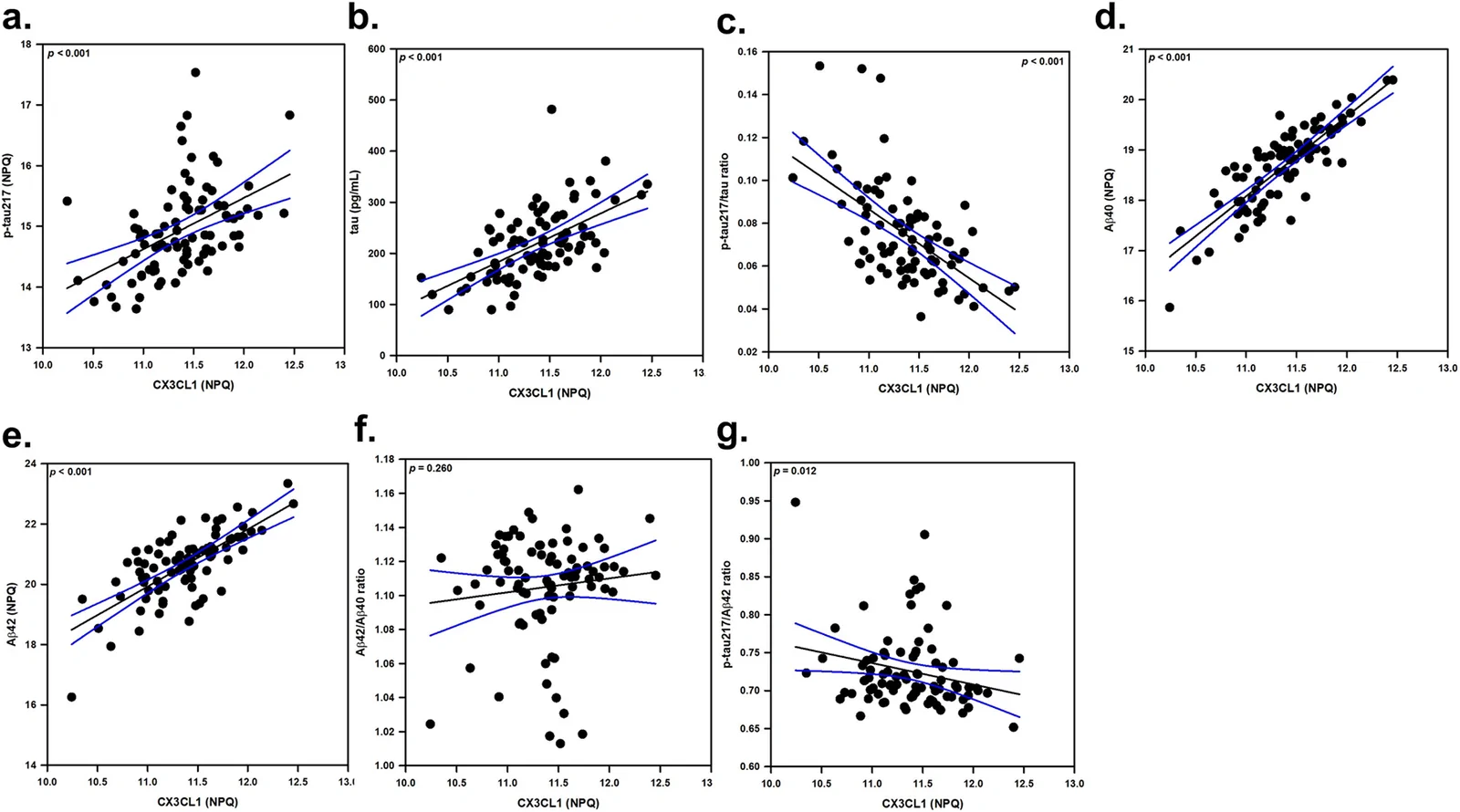
They compared carriers of APOE ε4, a gene variant, with non-carriers. In statistical models, MMP-9, a protein-cutting enzyme, accounted for associations between CX3CL1, a protein involved in signaling by brain immune cells, and Alzheimer’s-related markers. This pattern appeared only in carriers, across three ratios involving amyloid and tau, proteins measured as markers of Alzheimer’s disease. CX3CL1 also correlated with a combined measure of inflammation-promoting proteins in carriers, but with a combined measure of inflammation-limiting proteins in non-carriers.
Why it matters
The authors suggest that immune-system dysregulation related to Alzheimer’s disease may occur even in carriers of this gene variant who have no cognitive impairment.
Caveats
This cross-sectional analysis cannot establish that either protein caused changes in Alzheimer’s-related markers. Participants were Veterans Affairs–eligible veterans aged 50–76 without cognitive impairment; the findings do not establish the same relationships in people with cognitive impairment or outside that age range.
From the paper
- Limitation
The sample size used for this study is small and results should be considered preliminary.
Quoted word for word from the full text on PubMed Central.
The paper
University of Wisconsin–Madison
Neurobiology of Disease, Sep 13, 2026, Open access

Comments
Be the first to comment.