Blood protein linked to higher death rates in US women
The relative rate of death from any cause was 1.29 per one-unit rise in protein levels on a logarithmic scale that compresses large differences.
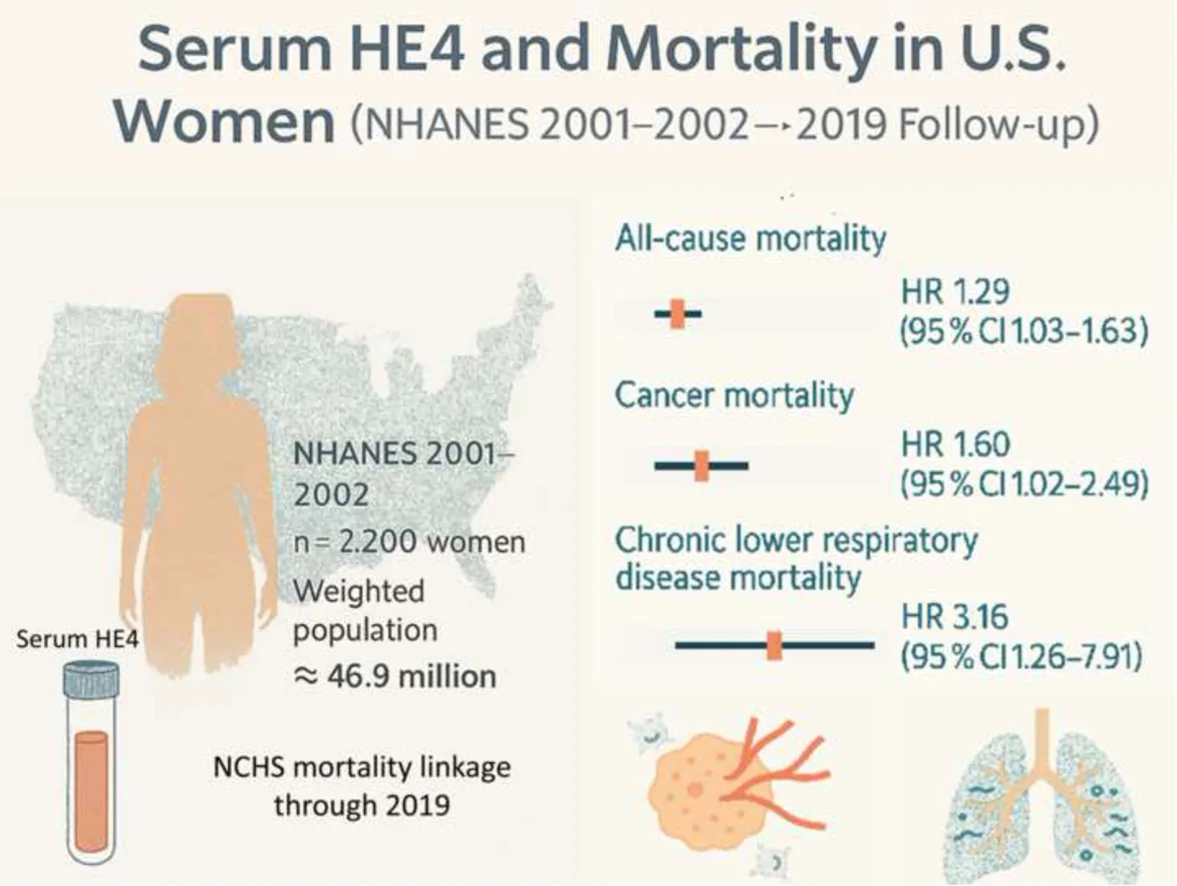
199.3 months, dose-response
Limit: Excluding 186 women with missing covariate data could bias the mortality association
Edited by Boris Djordjevic · AgingResearch.News
An observational cohort study included 2,200 U.S. women aged 20–85 with blood measurements of human epididymis protein 4 (HE4), a protein used as a marker for cancers of the female reproductive system. Researchers analyzed national survey data from 2001–2002 and linked them to death records through 2019. Over a median 199.3 months, 466 women died.
The researchers analyzed HE4 levels on a natural-log scale, which compresses large differences. Each one-unit rise was associated with hazard ratios—measures of relative death rates—of 1.29 for death from any cause and 1.60 for cancer death. These associations remained after adjustment for age, smoking, kidney function and other factors. Sensitivity analyses were broadly consistent.
Why it matters
HE4 levels increased with age in this cohort. The authors suggest the protein may help predict long-term mortality beyond its existing role in cancer care.
Caveats
This observational analysis cannot establish that HE4 caused higher mortality. The cohort covered women aged 20–85 living outside institutions, not men or institutionalized people; the proposed marker needs validation in other cohorts.
From the paper
- Participants
After further excluding participants without mortality information (n = 2) and those lacking complete covariate data required for regression modeling (n = 186), the final analytic cohort comprised 2200 individuals (unweighted n = 2200; weighted population 46,904,119).
- Result
Higher HE4 levels were strongly associated with CKD (OR = 2.07, 95% CI: 1.38–3.12, p = 0.002) and history of lung disease (OR = 1.34, 95% CI: 1.056–1.709, p = 0.019).
Quoted word for word from the full text on PubMed Central.

