Heart and blood biological ages are linked to heart disease
In 937 apparently healthy adults, a combined model predicted age with an average error of 4.29 years, against 4.60 for blood and 6.08 for heart scans.
Limit: Medication dose, treatment duration, and adherence were unavailable, leaving possible treatment-related confounding
Edited by Boris Djordjevic · AgingResearch.News
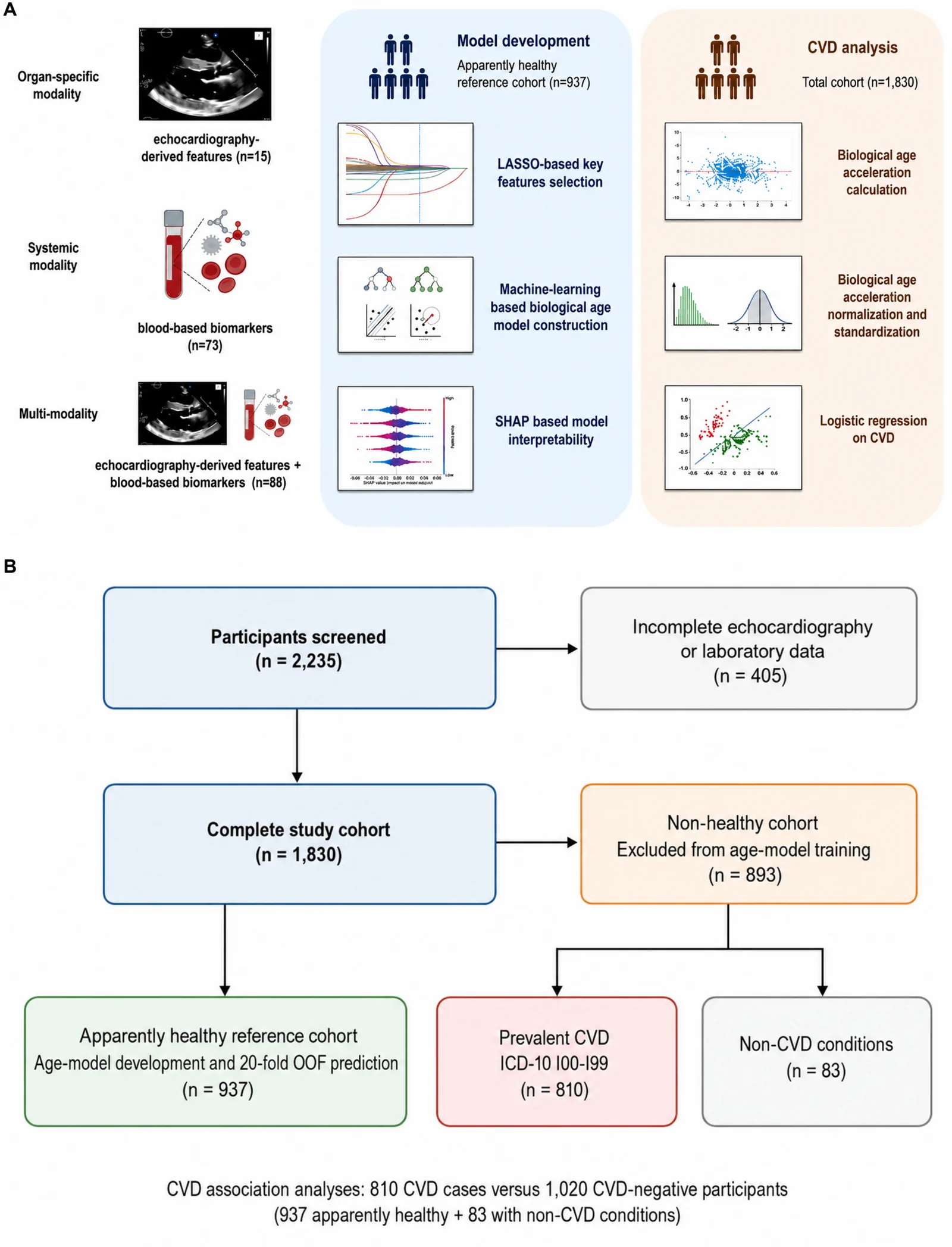
In an observational study, researchers analyzed 1,830 adults with an average age of 55.87 years, 77.81% male, who underwent routine health checks. They trained machine-learning models on 937 apparently healthy participants to predict chronological age from 15 ultrasound measures of the heart, 73 blood markers, and both combined.
In these participants, the combined model predicted age with an average error of 4.29 years, compared with 4.60 years for blood and 6.08 years for heart scans. In comparisons between 810 participants with cardiovascular disease and 1,020 without it, faster biological aging was linked to higher odds of disease in all three models. For each standard deviation increase in age acceleration, the odds ratio for cardiovascular disease was 1.40 for the combined model, 1.36 for heart, and 1.31 for blood. Among disease subtypes, the link reached statistical significance for hypertension, while estimates for smaller subtypes remained imprecise.
Why it matters
Cardiovascular disease is a leading cause of illness in older adults, yet aging affects individual organs at different rates. Tracking organ-specific biological aging alongside whole-body signals may help clarify how aging in the heart relates to overall cardiovascular risk.
Caveats
Because the study was cross-sectional, it cannot determine whether accelerated biological aging preceded or followed the development of cardiovascular disease. The participants were also drawn from routine health checkups at a single hospital and were predominantly male, so the findings may not apply to broader or female populations.
From the paper
- Participants
The comparison included 810 CVD cases and 1,020 CVD-negative participants, including the 83 participants with non-cardiovascular conditions.
- Result
Cardiac BAA showed a significant positive association with CVD (OR per 1-SD increase = 1.36, 95% CI 1.23–1.52, P < 0.001), and systemic BAA was similarly associated (OR = 1.31, 95% CI 1.20–1.43, P < 0.001).
Results, Association of model-predicted BAA with the presence of CVD
- Limitation
First, the cross-sectional design of our study precludes the establishment of causal temporality between BAA and prevalent CVD, and we were unable to validate the predictive value of our models for future incident CVD events.
Quoted word for word from the full text on PubMed Central.
- Machine learning
- Cardiovascular disease
- Hypertension
- Cardiac biological age
- Multimodal biological age
- Humans
The paper
Jiangsu Province Hospital
Frontiers in Cardiovascular Medicine, Aug 25, 2026, Open access


