T cell receptor diversity loss accelerates after about age 50
In an observational study of 5,052 individuals without cancer and 798 cancer patients, this loss was further modified by sex and cytomegalovirus infection.
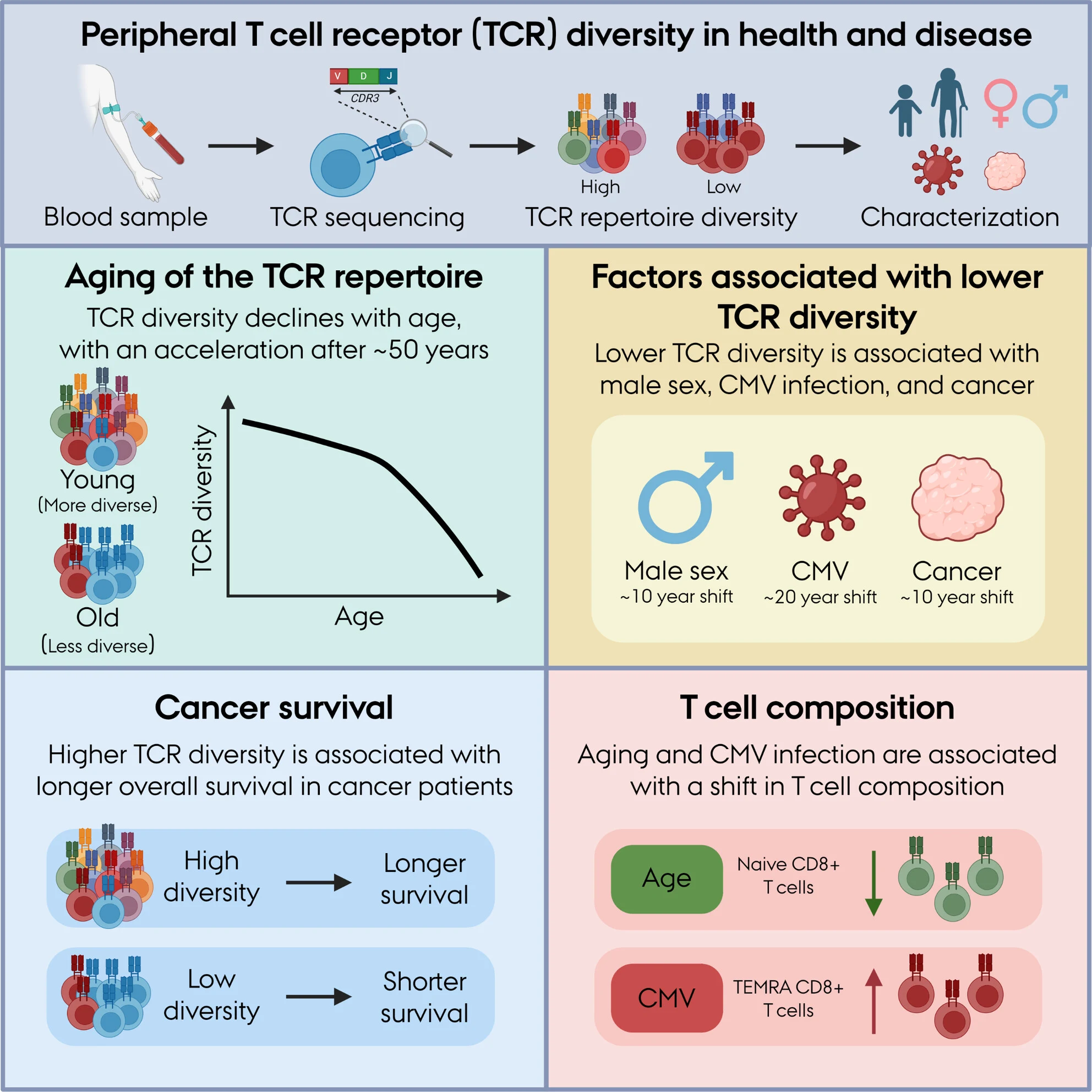
5,052 participants, cohort study, independent replication
Limit: CMV prevalence rises with age and reduces TCR diversity, confounding age-related immune decline
Edited by Boris Djordjevic · AgingResearch.News
In an observational study, researchers examined blood T cell receptor diversity in 5,052 individuals without cancer and 798 patients with cancer across 14 independent cohorts. T cell receptors are proteins on immune cells that recognize specific targets. The researchers pooled sequencing data to examine how receptor diversity varied with age, sex and chronic infection.
Diversity declined along a nonlinear path that accelerated after midlife. The rate of loss increased markedly beyond approximately 50 years of age. Sex and chronic infection with cytomegalovirus (CMV), a common virus, further modified this decline. In patients with cancer, higher blood receptor diversity was associated with improved overall survival across multiple cancer types, even after accounting for the impact of age, sex and CMV on diversity.
Why it matters
Immune function declines with age, increasing vulnerability to infections and cancer. The study points to blood T cell receptor diversity as a dynamic marker of immune aging.
Caveats
The observational design cannot establish whether lower receptor diversity causes poorer cancer survival.
From the paper
- Result
For individuals over 50 years of age, a linear model adjusted for age, sex, and CMV confirmed that cancer status was significantly associated with reduced TCR diversity (estimate = −0.0225, 95% CI: −0.032 to −0.013, p < 0.0001; Figure S5b).
Results, 2.7 Patients With Cancer Exhibit Lower TCR Diversity and Greater Clonal Hyper-Expansion
Quoted word for word from the full text on onlinelibrary.wiley.com.


