Frailty is linked to faster accumulation of chronic diseases
Compared with robust peers, frail adults lost 2.72 years of multimorbidity-free survival over 12 years, and frailty was linked to 42 of 43 chronic conditions.
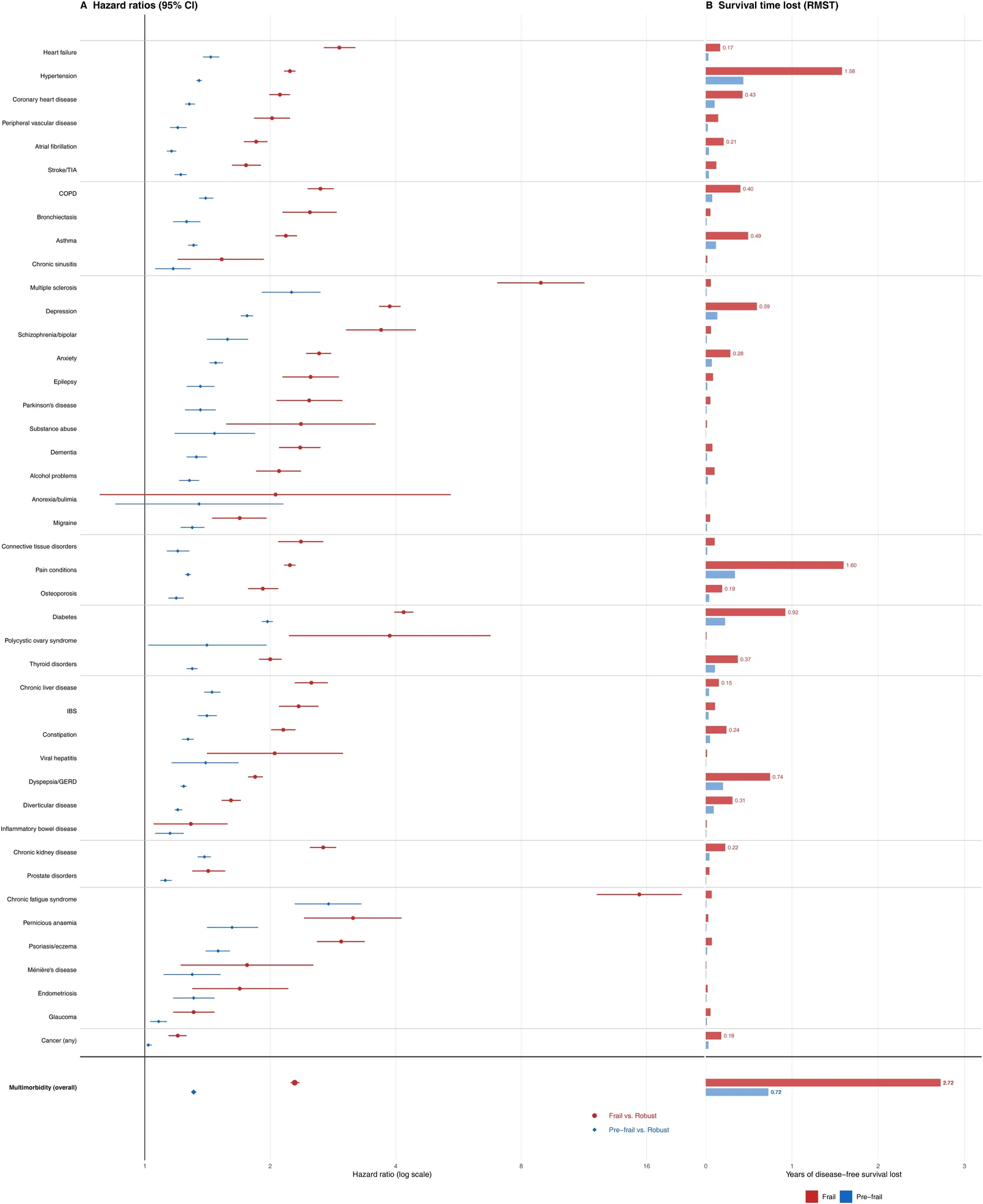
Limit: Hospital inpatient records underreport chronic conditions managed in primary care
Edited by Boris Djordjevic · AgingResearch.News
Researchers tracked 276,696 disease-free adults aged 37 to 73 years (mean age 55.3 years; 53.5% female) in a prospective cohort study from the UK Biobank over a median follow-up of more than 13 years. Participants were grouped as robust, pre-frail, or frail based on five physical traits, including grip strength, walking speed, weight loss, exhaustion, and physical activity.
Frailty was associated with a higher risk of developing 42 of 43 chronic conditions. Over 12 years, frail adults lost 2.72 years of multimorbidity-free survival—living free of two or more chronic conditions—while pre-frail adults lost 0.73 years. In a model tracking health stages, frailty was linked to higher hazards of moving from health to a first chronic disease (hazard ratio 1.77) and from a first disease to multimorbidity (hazard ratio 1.73). Frailty showed attenuated associations with death following disease onset.
Why it matters
As people age, chronic illnesses often cluster together rather than appearing in isolation. These findings suggest that identifying and addressing early signs of physical frailty in middle age could help extend the years people live free of multiple chronic diseases.
Caveats
Because this was an observational study, it cannot determine whether frailty causes chronic illnesses to develop. In addition, the findings come from community-dwelling adults in the United Kingdom who were initially free of the 43 target conditions, so they may not apply to other populations or to individuals with existing chronic diseases.
From the paper
- Participants
The analytic cohort comprised 276,696 participants: 144,284 (52.1%) robust, 125,832 (45.5%) pre-frail, and 6,580 (2.4%) frail.
- Result
The largest effect sizes in the frail versus robust comparison were observed for chronic fatigue syndrome (HR 15.37; 95% CI, 12.15–19.45), multiple sclerosis (HR 8.92; 95% CI, 7.01–11.35), diabetes (HR 4.18; 95% CI, 3.97–4.41), depression (HR 3.87; 95% CI, 3.65–4.11) …
Results, Associations of frailty with incident disease risk and survival loss
Quoted word for word from the full text on PubMed Central.
The paper
Chinese Academy of Medical Sciences & Peking Union Medical College
The Journal of Nutrition, Health & Aging, Sep 4, 2026, Open access


