Item choice mattered little in larger frailty scores
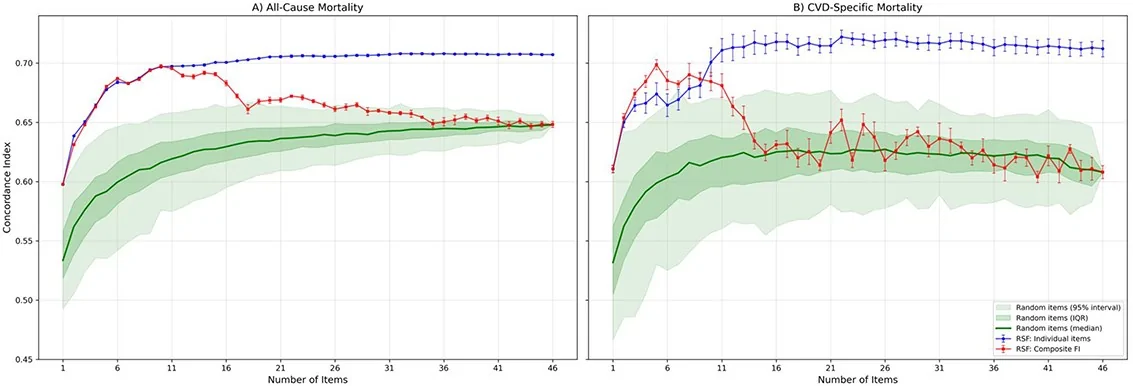
Randomly assembled scores approached the predictive performance of scores using top-ranked items at about 35 items for deaths overall and 20 for cardiovascular deaths.
Limit: The analysis excluded 36% of participants, who were older, frailer, and had higher mortality
Stake: An author holds patents with Astrazeneca Uk. An author holds patents with BioAge Labs. Authors also declare ties to 10 more companies.
Edited by Boris Djordjevic · AgingResearch.News
Researchers analyzed 3,669 US adults with self-reported cardiovascular disease in an observational study. Participants were aged 20 or older, averaged 66.1 years, and 41.6% were women. The researchers tracked deaths through December 2019, with an average follow-up of 6.07 years. They used statistical and machine-learning models to test a 46-item frailty index, a score combining accumulated health problems.
At each score length, they compared scores built from items ranked highest for prediction with 200 randomly assembled scores. With enough items, the choice of measures had negligible influence on prediction. Models using all 46 items separately predicted deaths better than combined scores. The authors cautioned that selecting items for shorter scores depended on the outcome predicted and the sample studied.
Why it matters
Frailty scores summarize accumulated health problems. The study addressed a practical question in aging research: whether predicting death requires counting a particular set of problems.
Caveats
The main analysis excluded 36% of participants with incomplete data, who were older, frailer and had higher mortality; an analysis that estimated missing values produced consistent results. The findings concern adults with self-reported cardiovascular disease, not adults generally.
From the paper
- Participants
The sample included 3669 adults living with self-reported CVD (mean ± standard deviation: age 66.1 ± 13.1 years; 41.6% women; mean FI 0.27 ± 0.12).
- Limitation
Complete-case analysis excluded 36% of CVD participants who were older, frailer and had higher mortality, though sensitivity analyses using multiple imputation produced consistent findings.
Quoted word for word from the full text on PubMed Central.
The paper
Dalhousie University; University College London
Age and Ageing, Sep 4, 2026, Open access


