Combined gene variants linked to lower coronary artery disease risk
Carrying variants in two genes together was linked to an odds ratio of 0.73 for coronary artery disease compared with noncarriers.
Our read
Mechanisms- Studied:
- Genetic association study of 408,039 UK Biobank participants, against noncarriers
- What changed:
- Coronary artery disease odds were lower in carriers of both gene variants than noncarriers (odds ratio 0.73)
- The catch:
- Benefits and side effects of actual combined drug treatment were not measured
- Stake:
- Authors work for Novartis.
- Why it’s aging research:
- It bears on staying healthy in midlife and later life.
Editor of record: Boris Djordjevic · AgingResearch.News
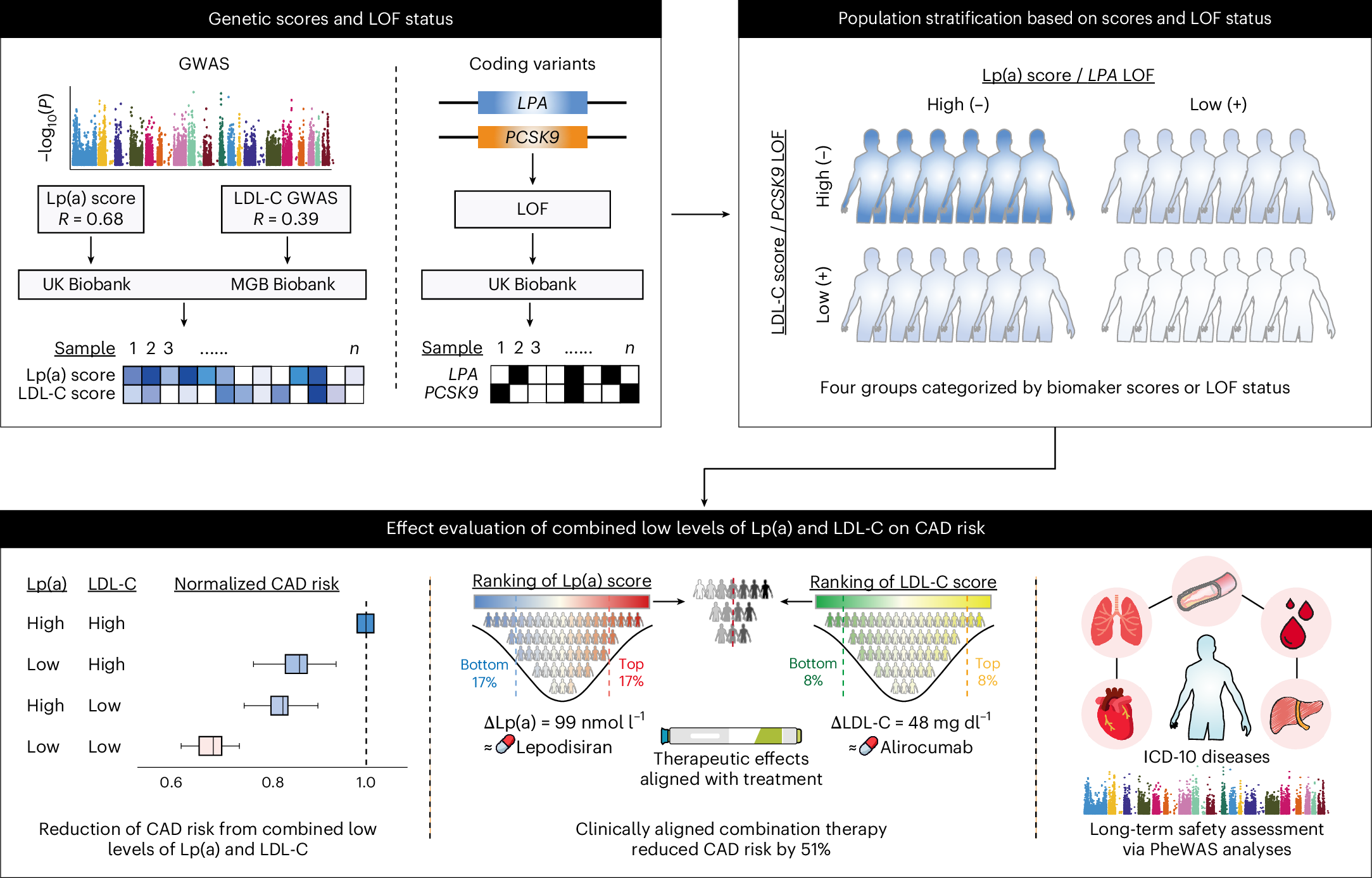
An observational genetic study analyzed 408,039 UK Biobank participants. Researchers examined gene-disabling variants associated with lower levels of two blood substances. Lipoprotein(a) is a cholesterol-carrying particle. Low-density lipoprotein cholesterol is cholesterol carried by another type of particle.
Carriers of variants affecting either substance had lower odds of coronary artery disease, which affects the arteries supplying the heart. The odds ratios were 0.91 and 0.81, respectively, compared with noncarriers. People carrying both variants had an odds ratio of 0.73. A separate analysis using genetic scores also linked lower levels of both substances to lower disease odds than either alone. Researchers replicated the additive associations in 65,171 Mass General Brigham Biobank participants.
Why it matters
Coronary artery disease is an age-related illness. The authors interpreted the genetic evidence as supporting the combined targeting of lipoprotein(a) and low-density lipoprotein cholesterol to reduce its risk.
Caveats
This observational genetic analysis was not a drug trial. It did not establish the benefits or side effects of a combined treatment.
The paper
Chinese Academy of Sciences
Nature Cardiovascular Research, Sep 3, 2026



Comments
Be the first to comment.