Screen in cells may help classify cholesterol gene variants
Combined evidence suggested 322 of 434 gene variants with uncertain, conflicting or missing classifications could qualify for reclassification, pending expert review.
Our read
Biomarkers- Studied:
- Experiments in HCT116 cells
- What changed:
- 322 of 434 uncertain LDLR variants met evidence thresholds for reclassification
- The catch:
- Cellular LDL-C uptake was a stand-in readout for in vivo LDLR function
- In the record:
- One of 22 papers on prime editing on record: 1 with results in people, 1 in animals.
- Why it’s aging research:
- It bears on staying healthy in midlife and later life.
Editor of record: Boris Djordjevic · AgingResearch.News
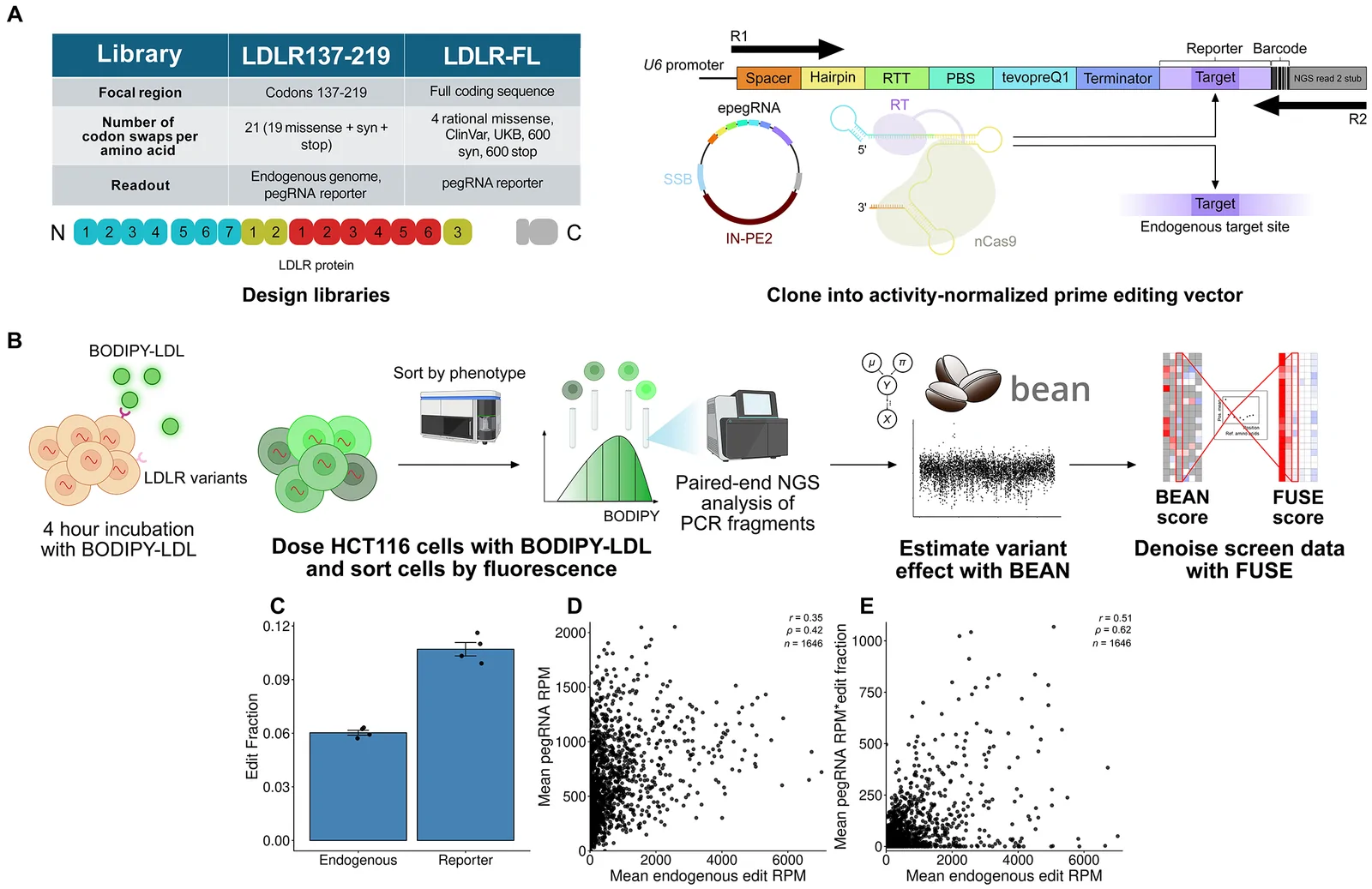
In lab experiments, researchers used HCT116 cells to screen variants of LDLR, a gene for a protein that helps cells take up cholesterol-carrying particles. Across their screens, they measured how 5,184 variants affected uptake of low-density lipoprotein, a cholesterol-carrying particle. They used prime editing, which makes targeted DNA changes, with a reporter that helped account for differences in editing efficiency.
The scores distinguished known disease-causing variants from benign ones. The team combined these results with computational predictions, population data and information on previously classified variants. Among variants with uncertain, conflicting or missing classifications, 301 appeared to qualify as benign or likely benign and 21 as disease-causing or likely disease-causing.
Why it matters
Inherited high cholesterol raises the risk of coronary artery disease, an age-related condition. Clearer variant classifications could support early cholesterol-lowering therapy and testing of at-risk relatives.
Caveats
The screen measured cholesterol uptake in lab-grown cells, not health outcomes in people. Proposed classifications still require expert review of all available evidence before diagnostic use.
The paper
LDLR Variant Classification Through Activity-Normalized Prime Editing Screening
Brigham and Women's Hospital
Circulation, Sep 1, 2026, Open access, accepted manuscript



Comments
Be the first to comment.