Longitudinal Adherence to Hepatocellular Carcinoma Surveillance and Associated Outcomes Following Ultrasound Liver Imaging Reporting and Data System (US LI-RADS) Implementation
Declared ties to: Gilead Sciences, Intercept Pharmaceuticals, GSK Pharmaceuticals and 4 more
Abstract
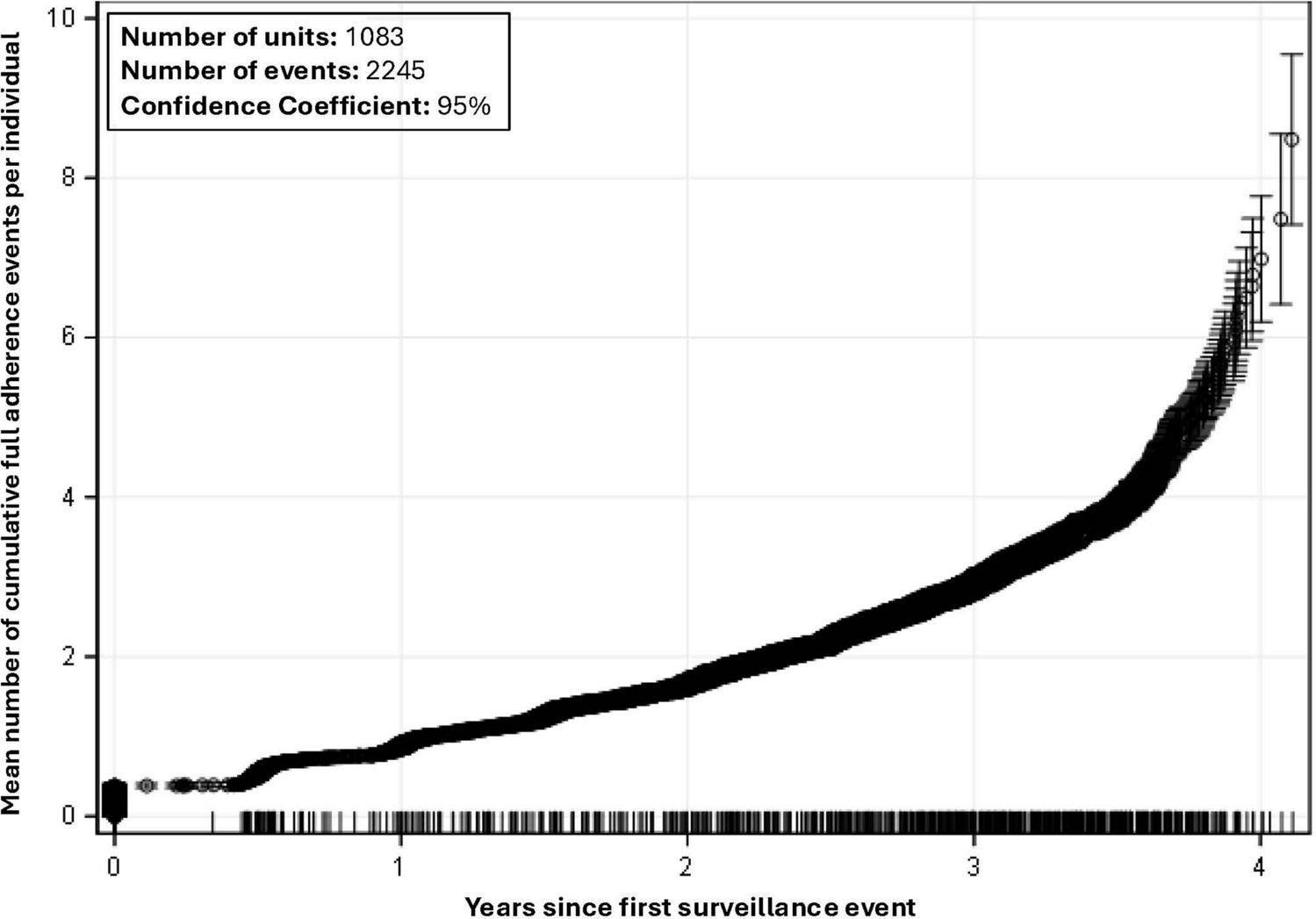
OBJECTIVES: Hepatocellular carcinoma (HCC) surveillance remains suboptimal. We evaluated longitudinal trends in HCC surveillance adherence, its associated factors, and impact on HCC-related outcomes, following US LI-RADS implementation in a safety-net system. METHODS: Electronic medical records and radiology database were queried from 6/1/2020 to /31/2021, with follow-up (median 51 months) through 12/31/2024. Multivariable repeated measures logistic regression assessed factors associated with full (vs. partial/none) HCC surveillance adherence. Adherence trends were analyzed using a nonparametric mean cumulative function. Cox proportional hazards models assessed the association between adherence and composite outcomes of HCC or death. RESULTS: Among 1083 patients, mean age was 59.3, 44% female, 64% had HBV, and 38% cirrhosis. Hepatology clinic attendance was the strongest factor associated with full adherence (OR 2.61) followed by prior ultrasound, male sex, and older age. Current alcohol use (OR 0.58) and smoking (OR 0.65) were associated with lower adherence. The rate of full adherence per patient increased over time. Controlling for covariates, suboptimal adherence at first surveillance (HRs 2.19 and 1.79 for partial adherence and non-adherence, respectively), but not at any time point, increased the risk of HCC or death. CONCLUSIONS: We observed improvements in HCC surveillance adherence after US LI-RADS implementation. Higher adherence was associated with hepatology care engagement, but lower in those with alcohol or tobacco use, with initial surveillance non-adherence increasing the risk of HCC or death. These findings underscore the role of expanded specialty care access and early targeted interventions, especially in those with behavioral health risks, to enhance HCC surveillance.
The paper
University of California, San Francisco; San Francisco General Hospital
Digestive Diseases and Sciences, 28 Aug 2026