Frailty linked to worse outcomes in severe heart valve disease
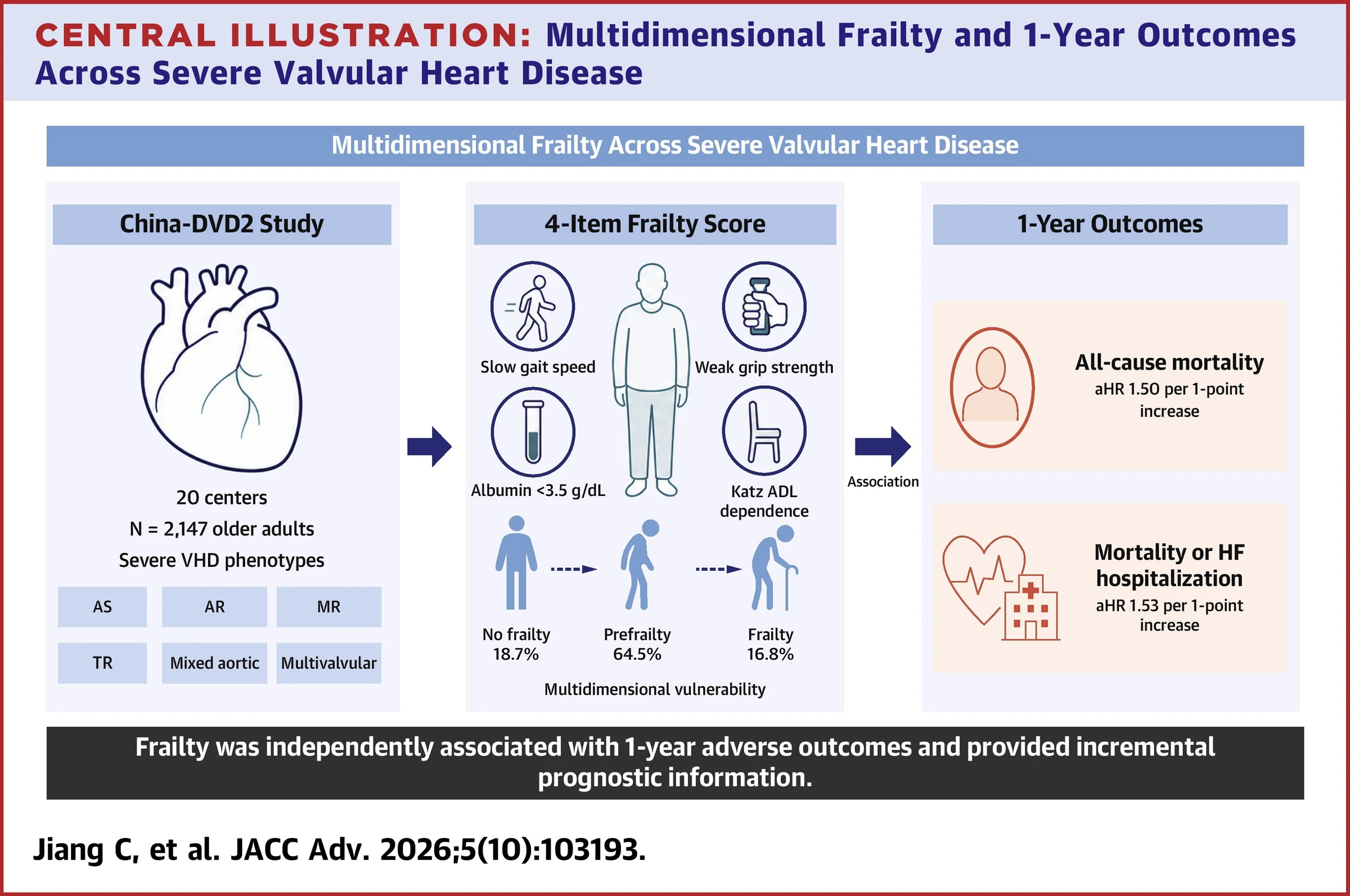
Four assessment tools identified frailty in 16.8% to 39.3% of 2,147 older patients with severe heart valve disease.
Our read
Biomarkers- Studied:
- Cohort study of 2,147 older adults with severe heart valve disease, 1 year
- What changed:
- Death from any cause was more likely with each unit increase in frailty score (hazard ratio 1.50)
- The catch:
- Missing frailty assessments may disproportionately exclude patients with more severe disease
- Why it’s aging research:
- It measures an outcome that worsens with age.
Editor of record: Boris Djordjevic · AgingResearch.News
An observational cohort study followed 2,147 people aged 65 or older with severe heart valve disease at 20 centers in mainland China. Their median age was 72.8 years, and 43.5% were women. Researchers compared four measures of frailty, a reduced ability to cope with physical stress.
A simplified score assessed grip strength, walking speed, blood levels of the protein albumin, and need for help with daily activities. Each additional point was associated with a higher rate of death over one year, with an adjusted hazard ratio of 1.50. This compares death rates over time at successive score levels, after accounting for other measured factors. The score also tracked the combined outcome of death or hospitalization for heart failure and improved risk prediction when added to an existing surgical risk score.
Why it matters
For older people with severe heart valve disease, the study addresses how physical vulnerability might inform estimates of prognosis in routine care.
Caveats
This observational analysis cannot establish cause and effect, and only 34.9% of the wider cohort completed frailty assessment; those not assessed had higher mortality. The analysis covered people aged 65 or older and excluded those with previous valve procedures or infectious endocarditis, an infection of the heart’s inner lining.
From the paper
- Participants
Among the 2,147 patients, the median age was 72.8 years (IQR: 68.7-77.6 years), and 1,213 (56.5%) were males.
- Result
As a continuous variable, the frailty score, Fried, and Fried + scales were independently associated with all-cause mortality, with adjusted HRs per unit increase of 1.50 (95% CI: 1.25-1.81), 1.37 (95% CI: 1.19-1.59), and 1.29 (95% CI: 1.13-1.47), respectively.
Results, Association of frailty status with clinical outcomes
- Limitation
First, a substantial proportion of enrolled patients did not undergo frailty assessment, potentially introducing responder bias, as patients with more severe disease may have been less able to complete assessments.
Quoted word for word from the full text on PubMed Central.
- Heart failure
- Valvular heart disease
- Essential Frailty Toolset
- European System for Cardiac Operative Risk Evaluation II
- Fried phenotype
- Humans
The paper
Chinese Academy of Medical Sciences & Peking Union Medical College
JACC Advances, Aug 28, 2026, Open access


Comments
Be the first to comment.