Oral vs. Subcutaneous Semaglutide for Obesity Treatment: A Systematic Review of Efficacy, Safety, and Patient-Oriented Outcomes
Declared no competing interests
Abstract
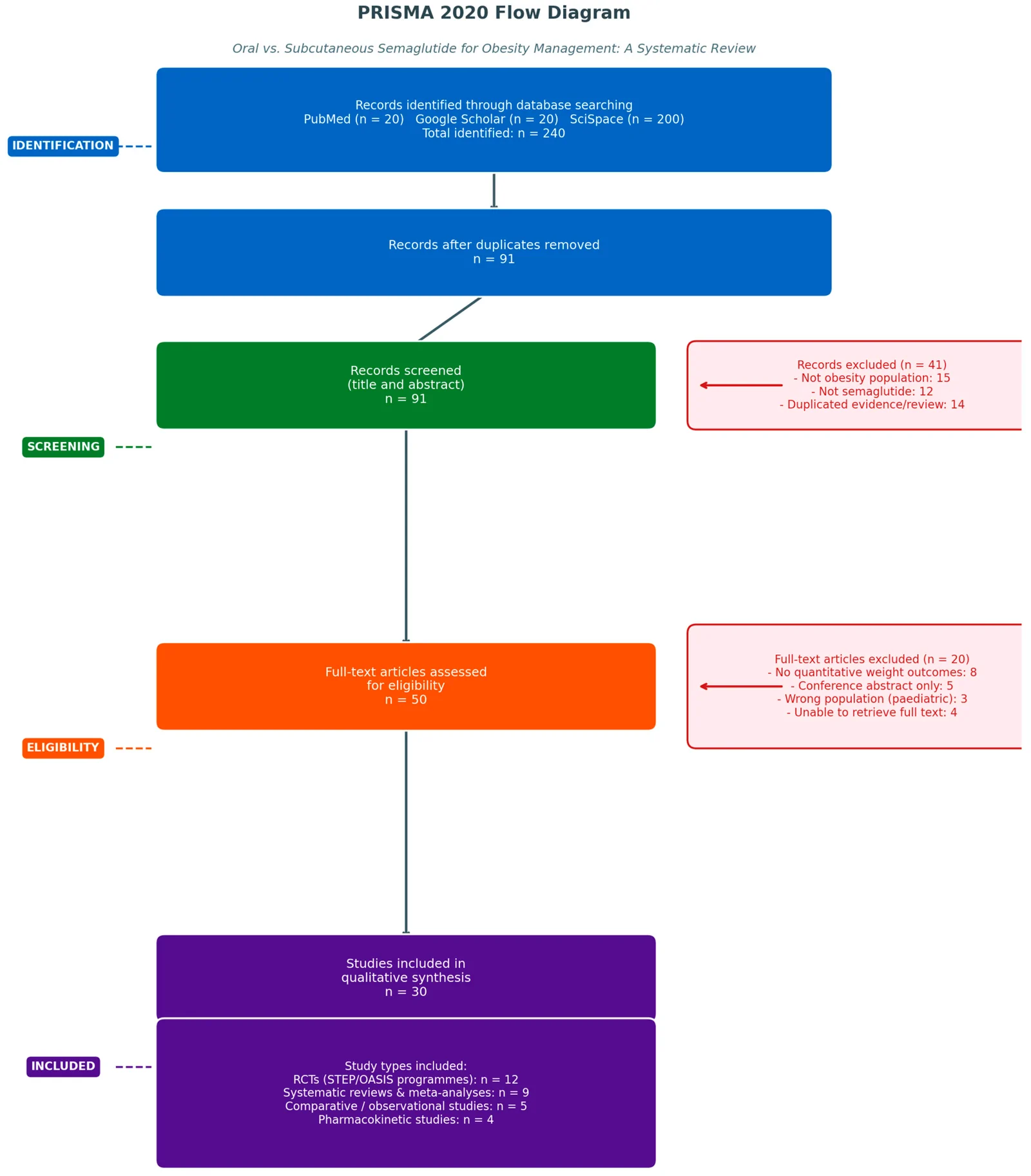
Background/Objectives: Semaglutide, a glucagon-like peptide-1 receptor agonist (GLP-1RA), is approved for weight management as both a weekly subcutaneous (s.c.) injection (2.4 mg) and a daily oral tablet (50 mg). Although head-to-head trials are lacking, the oral formulation offers potential advantages in adherence, patient preference, and accessibility. This systematic review critically appraised comparative and formulation-specific evidence to characterise the efficacy, safety, pharmacokinetics, and patient-reported outcomes of oral vs. s.c. semaglutide in adults with obesity or overweight with at least one weight-related comorbidity. Methods: PubMed, Google Scholar, and SciSpace were searched from inception to June 2025, applying PRISMA 2020 guidelines. Eligibility criteria (PICO): adults with BMI ≥ 27 kg/m²; intervention, oral semaglutide (any dose); comparator, s.c. semaglutide or placebo; outcomes, body weight, BMI, cardiometabolic markers, adverse events, adherence. Risk of bias was assessed with RoB 2.0 (RCTs) and AMSTAR-2 (systematic reviews). Results: Thirty studies met inclusion criteria (12 RCTs, nine systematic reviews/meta-analyses, five comparative/observational studies, four pharmacokinetic studies). OASIS 1 demonstrated -15.1% body weight reduction with oral semaglutide 50 mg at 68 weeks, comparable to s.c. semaglutide 2.4 mg (-14.9% in STEP 1). Both formulations significantly improved HbA1c, blood pressure, and lipid profiles. Oral bioavailability (~1%) requires co-administration with the SNAC absorption enhancer; s.c. bioavailability is ~89%. Oral semaglutide showed superior patient preference and equivalent adherence in needle-averse patients. Conclusions: Oral semaglutide 50 mg is a clinically valid alternative to s.c. semaglutide for obesity management, offering equivalent efficacy and an improved patient experience for individuals who prefer needle-free treatment. Robust direct comparative trials are needed.