Walkability in older age: built environment factors and function-sensitive assessment in urban areas
Abstract
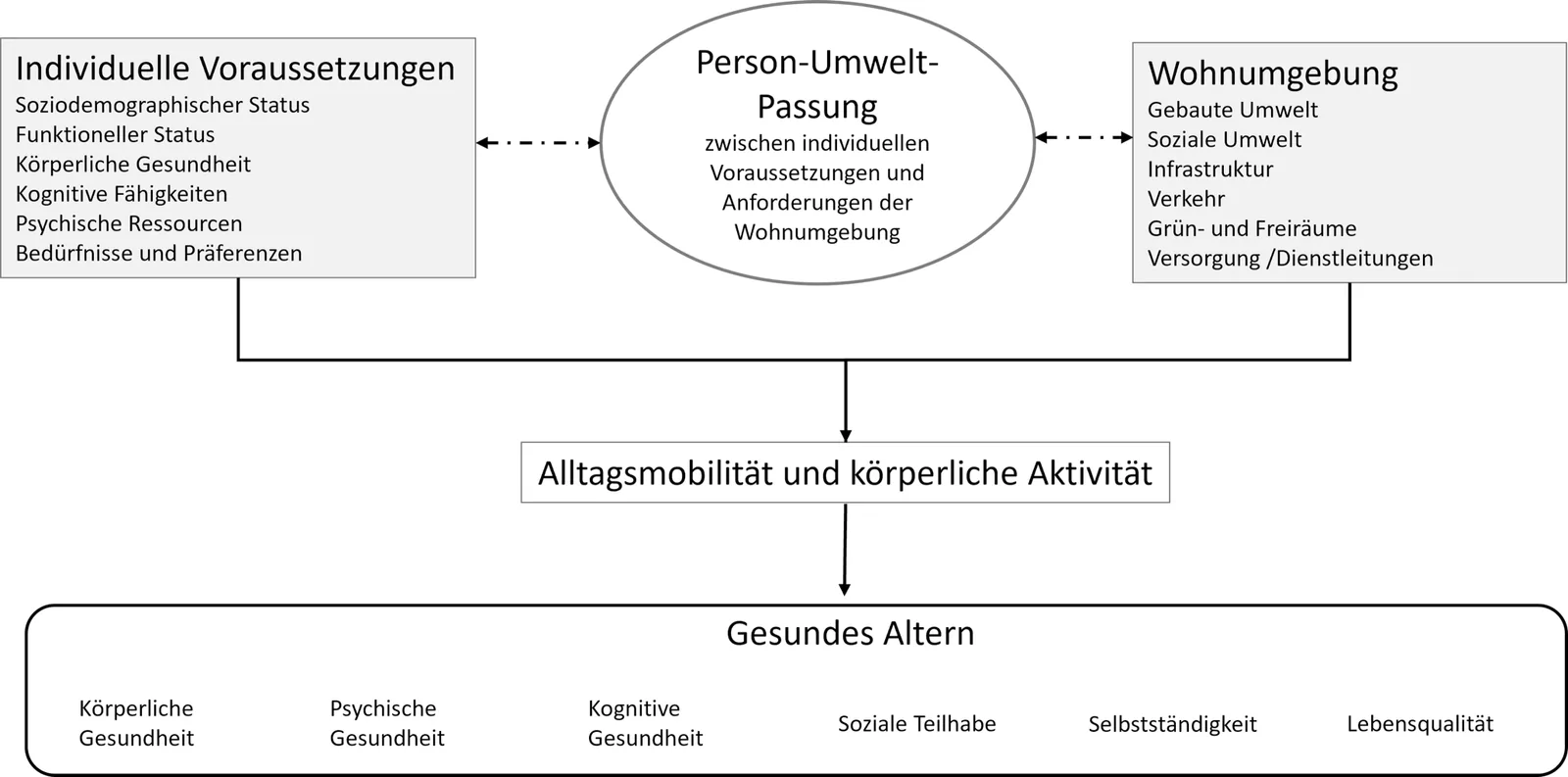
Walkability describes how supportive a neighbourhood is for walking and is a key concept for promoting mobility, physical activity and social participation in older age. However, existing approaches do not adequately reflect the specific needs of older adults, especially in the presence of functional limitations. This article outlines how walkability can be further conceptualised, measured in a function-sensitive way and empirically examined in an urban context.The paper presents an age-specific operationalization framework for walkability based on the authors' previous work and a Delphi consensus study. It includes three dimensions: residential environment and transport infrastructure, accessibility of destinations and meeting places, and attractiveness and safety of the environment. A central feature is the systematic consideration of the interaction between functional status and environmental demands.Using the planned WALK project in Munich as an example, the article illustrates how these indicators can be applied in a municipal mixed-methods study. The design combines qualitative interviews, walk-and-talk assessments, expert interviews and GIS-based analyses. The aim is to identify barriers and facilitators of everyday walking among older adults and to derive recommendations for health-promoting, age-sensitive urban planning.
The paper
LMU Klinikum
Bundesgesundheitsblatt, Gesundheitsforschung, Gesundheitsschutz, 20 Aug 2026