More walkable areas linked to lower hip fracture risk in older women
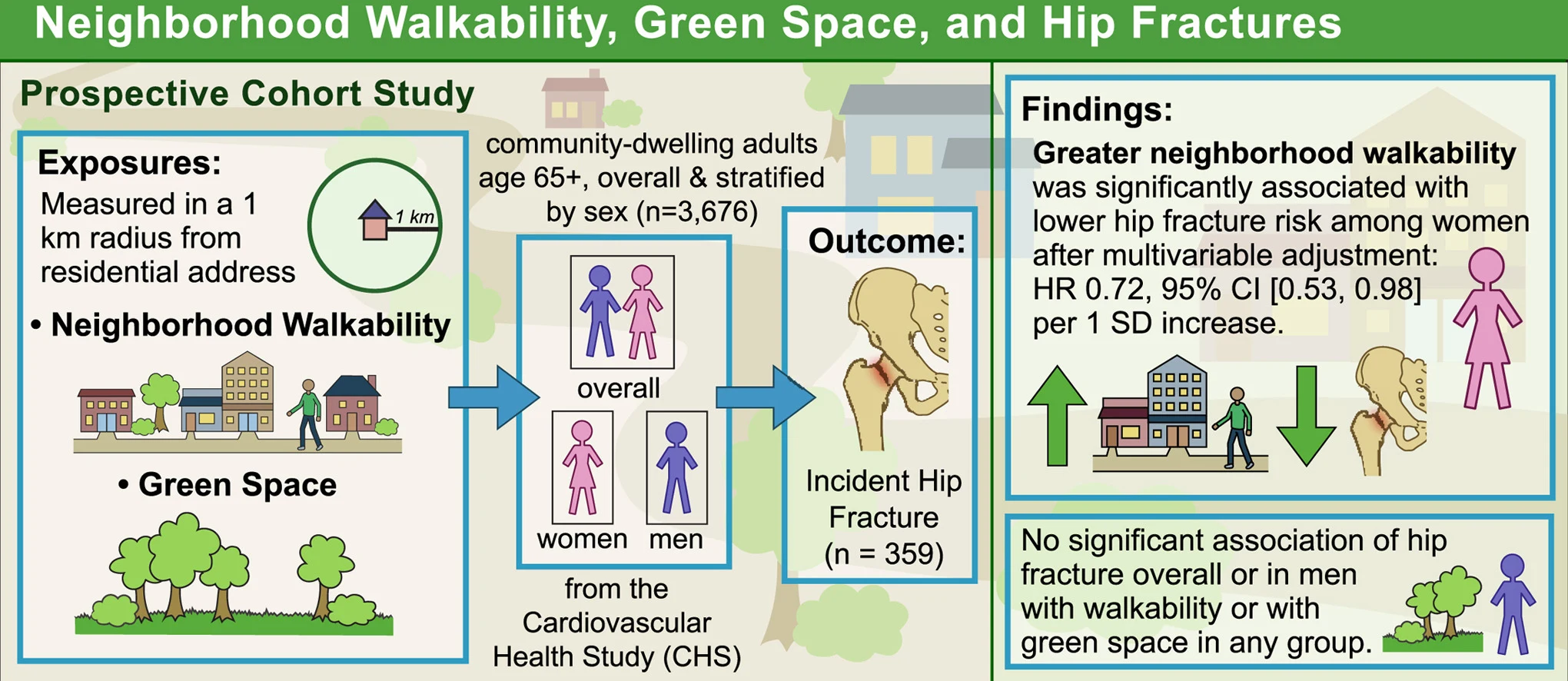
Women’s relative hip fracture rate was 0.72 compared with women one standard deviation lower in neighbourhood walkability, an increment reflecting variation in scores.
12 years
Researchers conducted an observational cohort study of 3,676 community-dwelling US adults aged 65 or older, of whom 58% were women. They assessed walkability using population density and the density of walkable destinations within one kilometre of participants’ homes. They measured green space using satellite images. These neighbourhood measurements dated from 1992–1993. Hospital discharge records identified 359 participants who experienced hip fractures over a median follow-up of 10 years.
After accounting for individual and neighbourhood characteristics, greater walkability was associated with lower hip fracture incidence among women, but not among men or the group overall. Green space was not significantly associated with hip fracture.
Why it matters
The study addressed whether neighbourhood features linked to walking and physical activity also related to fracture risk in later life, and whether those links differed between women and men.
Caveats
This observational study could not establish that greater neighbourhood walkability caused lower hip fracture risk. It assessed neighbourhood conditions at baseline.
The paper
Medical College of Georgia at Augusta University; Beth Israel Deaconess Medical Center
Environmental Research, 10 Oct 2026