Blood protein links to Alzheimer’s differed by genetic risk
Researchers linked 85 blood proteins to Alzheimer’s in people without a key genetic risk variant, compared with 10 in carriers.
Our read
Biomarkers- Studied:
- Preprint: cohort study of 18,212 older adults without dementia at enrollment, against APOE ε4 carriers
- What changed:
- Later Alzheimer’s was linked to 85 blood proteins in APOE ε4 non-carriers, against 10 in carriers
- The catch:
- Health records could miss Alzheimer’s cases, distorting protein associations
- In the record:
- The 924th paper on APOE with results in people; 3,703 on record in all. Its result on Alzheimer's disease agrees with 71 of 78 other findings on record; 5 point the other way and 2 found no change.
- Why it’s aging research:
- It bears on staying healthy in midlife and later life.
Editor of record: Boris Djordjevic · AgingResearch.News
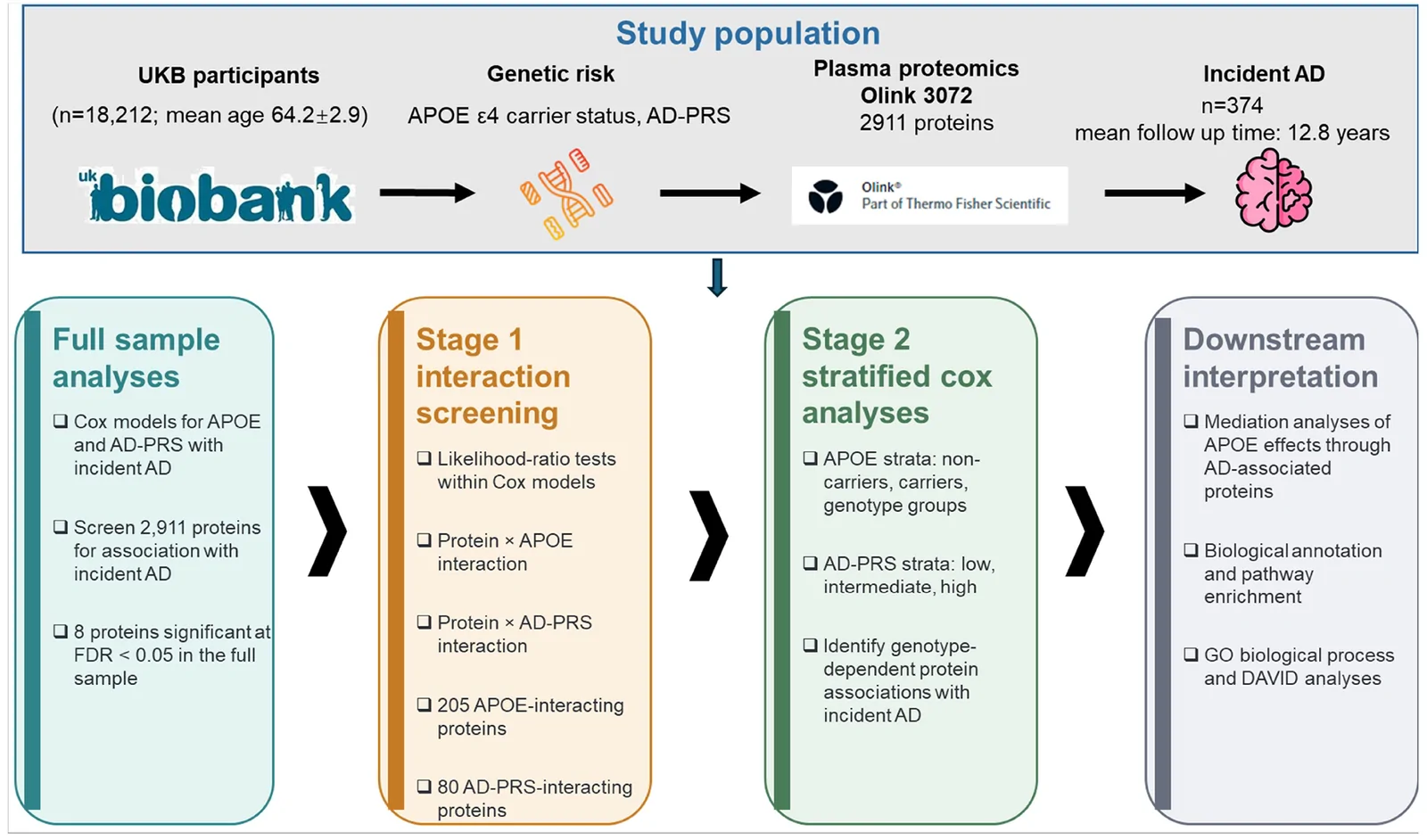
An observational cohort study followed 18,212 UK Biobank participants aged 60 or older without dementia at enrollment; 52.9% were women. Researchers analyzed 2,911 proteins in blood samples collected at enrollment. Over a mean 12.8 years, 374 participants developed Alzheimer’s disease, identified through health records.
The team grouped participants by whether they carried APOE ε4, a gene variant linked to Alzheimer’s risk, and by a score based on other genetic variants. They identified 85 proteins associated with later Alzheimer’s among non-carriers and 10 among carriers. Across the analyses by genetic risk, the researchers identified 94 proteins newly linked to Alzheimer’s risk.
Why it matters
The authors interpreted the patterns as pointing to protein-related pathways that depend on genetic background in Alzheimer’s disease, an age-related illness.
Caveats
The observational design cannot establish whether the proteins caused Alzheimer’s disease. The preprint has not been peer-reviewed, and the analysis excluded people under 60 and those with dementia at enrollment.
The paper
Novel Plasma Proteins Associated With Alzheimer's Disease Risk in APOE ε4 Carriers and Non-carriers
Boston University
Research Square, Aug 3, 2026, Open access, Preprint, not yet peer-reviewed


Comments
Be the first to comment.