Associations Between Affordability and All-Cause Mortality in the United States
Dose-response
Abstract
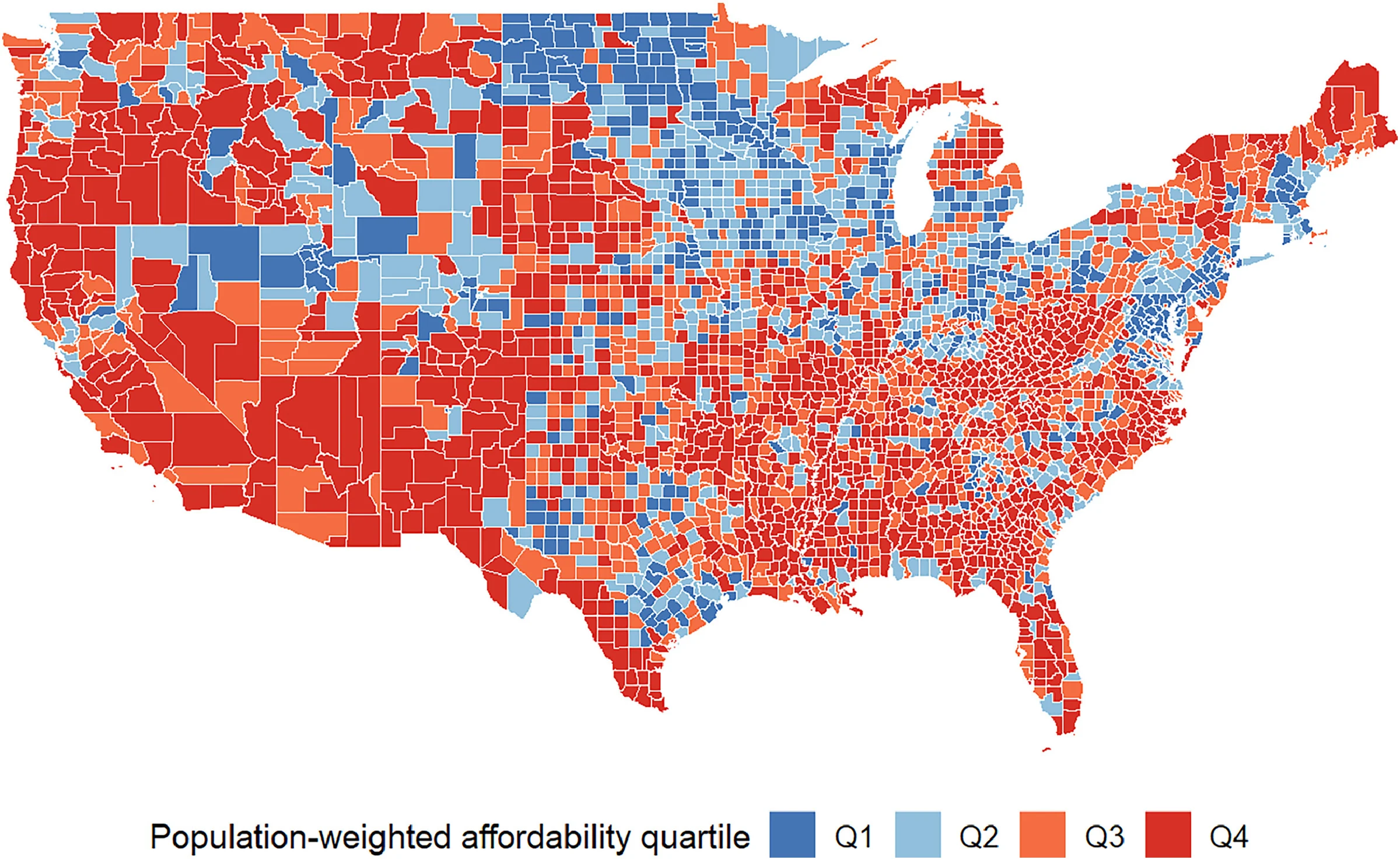
INTRODUCTION: Within the U.S., affordability, the ability to purchase necessities like food, housing, and childcare, has become a principal focus of both political and public discourse. Lack of affordability is plausibly linked to health outcomes including mortality. Yet evidence is currently lacking on affordability and health relationships. METHODS: This study investigated a detailed, community-specific measure of affordability as a predictor of age-standardized all-cause mortality rates across 3,109 counties among males and females in the U.S. Multivariable linear regression was applied and all models controlled for key covariates including indicators of education, income, older age, racial and ethnic composition, health insurance coverage, and metro vs non-metro status at the county level, and were weighted by population size. RESULTS: Among males, a 1-standard deviation (1-SD) increase in the county-level affordability ratio (signifying less affordability) was associated with a 0.228-SD higher age-standardized all-cause mortality rate across all ages-equivalent to 125.9 additional deaths per 100,000. Compared to the most affordable quartile, mortality was 88.8 deaths per 100,000 higher in the least affordable quartile (P=0.003), with evidence of a monotonic increase in mortality with decreasing affordability (P for trend across quartiles <0.001). Among females, a 1-SD increase in the county-level affordability ratio was linked to a 0.162-SD higher age-standardized all-cause mortality rate-62.1 more deaths per 100,000. Relative to the most affordable quartile, mortality was 46.9 deaths per 100,000 higher in the least affordable quartile (P=0.01; P for trend across quartiles <0.001). Qualitatively similar results were found for working-aged mortality among those aged 15-64 years. CONCLUSIONS: This study finds novel associations between affordability and all-cause mortality among Americans. Future studies should further investigate the extent to which affordability may be a social determinant of mortality.
The paper
Northeastern University
American Journal of Preventive Medicine, 12 Aug 2026, Open access