Social engagement and brain structure-informed cognitive domain trajectories in older adults: The National Health and Aging Trends Study
Abstract
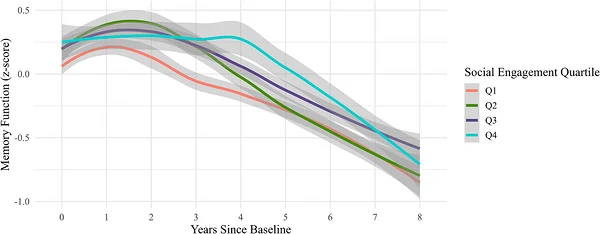
INTRODUCTION: Cognitive decline may emerge in specific domains before overt dementia, yet domain-specific cognitive benefits of social engagement remain unclear. METHODS: Using National Health and Aging Trends Study (NHATS) data (2011-2019) from 6,084 community-dwelling Medicare beneficiaries, including the oldest-old, we study associations between our social engagement index founded on neural correlates of social cognition and longitudinal memory, orientation and executive function trajectories. RESULTS: Baseline social engagement index was 5.04 (SD: 1.90). Cognitive performance decreased as a function of time. Higher baseline social engagement was associated with attenuation of aging effects in memory (β = 0.14; p < 0.001), orientation (β = 0.14; p < 0.001), and executive function (β = 0.05; p < 0.001) after 8 years. Higher quartiles of social engagement, indicating broader endorsement of multiple activities, provided incrementally greater cognitive benefits in all domains. DISCUSSION: Higher baseline social engagement among community-dwelling older adults shows incremental and sustained benefits in memory, orientation and executive functions.
The paper
University of Pittsburgh; Johns Hopkins University
Alzheimer's & Dementia, 1 Aug 2026