Brain hub connections differed with age and Alzheimer’s
An observational study of 640 cognitively healthy adults and 132 people with varying Alzheimer’s disease status mapped shared and disease-specific brain connection patterns.
Our read
Biomarkers- Studied:
- Cohort study of adults with normal cognition or Alzheimer’s disease (Independent replication)
- What changed:
- Brain connection patterns differed with age and Alzheimer’s disease, with shared and disease-specific differences
- The catch:
- Grouped scan analyses can obscure individual differences in brain connection patterns
- Why it’s aging research:
- It looks at how biology varies with age or lifespan.
Editor of record: Boris Djordjevic · AgingResearch.News
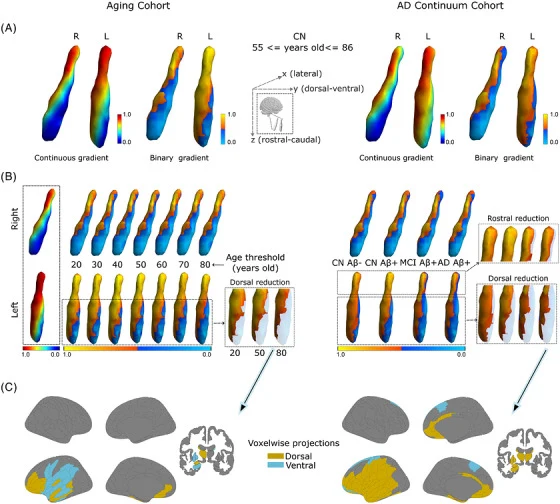
An observational study mapped brain connections in 640 cognitively normal adults aged 18–88 and 132 people ranging from normal cognition to early Alzheimer’s dementia. Researchers used magnetic resonance imaging to map connections from the locus coeruleus, a brain region that helps coordinate communication across the brain.
The connections’ organization differed with age and Alzheimer’s disease. Some differences were shared, while others were specific to Alzheimer’s. Connection patterns were also associated with cognitive performance and buildup of the protein tau in another brain region, the entorhinal cortex. Lower values of an imaging measure called the “LC gap,” which captured connection differences, were linked to slower tau accumulation in cognitively normal people with amyloid-beta protein buildup. Tau scans tracked accumulation over an average of 3.41 years.
Why it matters
The authors suggest that this brain communication hub’s connection patterns may serve as a marker of resilience against Alzheimer’s-related brain degeneration.
Caveats
The observational results, based on grouped scan analyses, cannot show that connection patterns protected against Alzheimer’s disease. The slower-tau association came from a subgroup of 16 cognitively normal people with amyloid-beta buildup.
The paper
Vulnerability of locus coeruleus connections to aging and Alzheimer's disease
Karolinska Institutet
Alzheimer's & Dementia, Aug 2026, Open access


Comments
Be the first to comment.