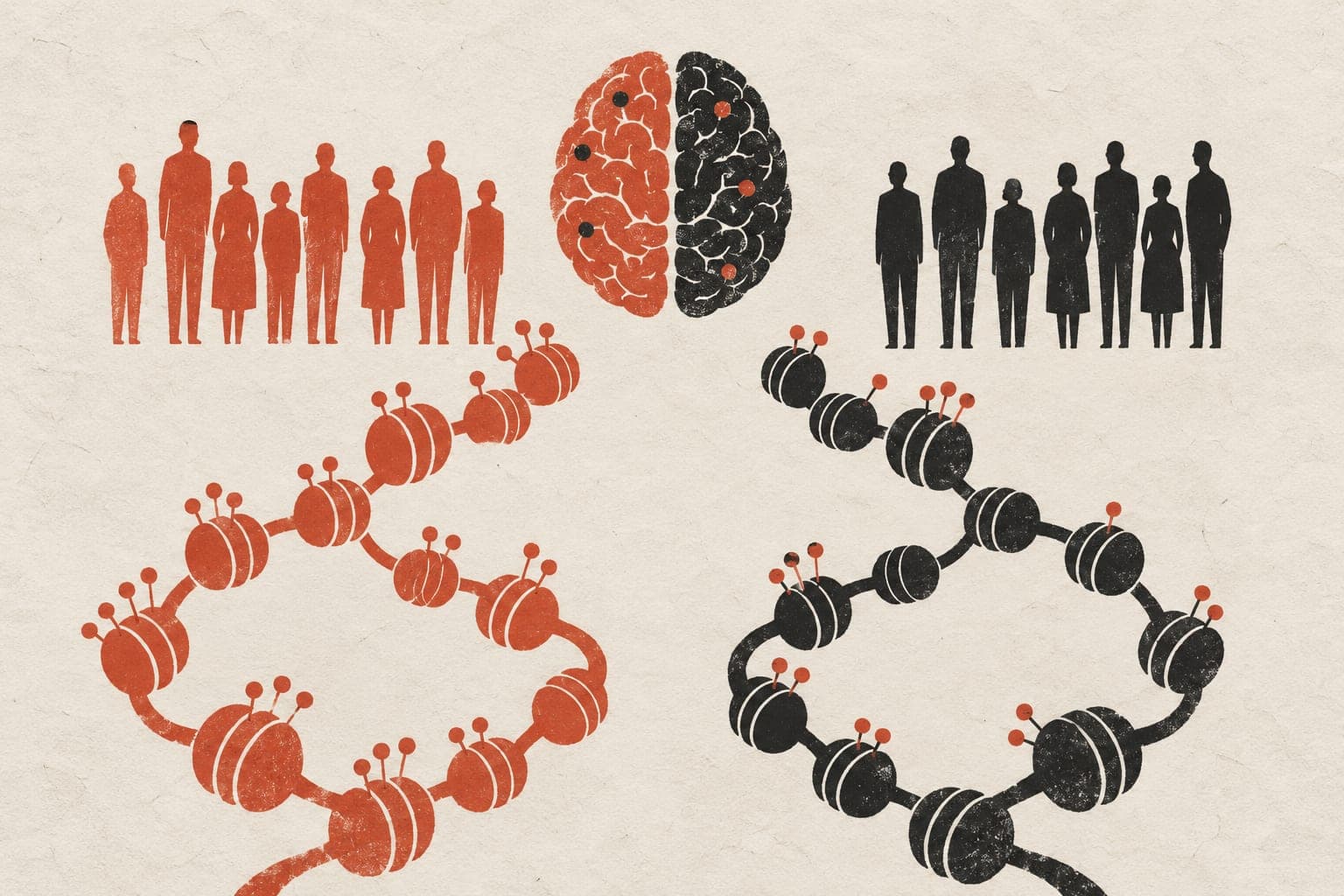
Opposing Molecular Programs in OCD and Hoarding: TWAS Reveals Distinct Senescence, Complement, and Metabolic Signatures
Abstract
Background: Obsessive-compulsive disorder (OCD) and hoarding disorder often overlap clinically, yet they differ in age at onset, longitudinal course, and treatment response. Recent genome-wide association studies have identified 30 loci for OCD and shown moderate heritability for hoarding symptoms, but the molecular basis of their partial divergence remains unclear. Objective: This study conducted a direct transcriptome-wide association study (TWAS) comparison of obsessive-compulsive symptoms (OCS) and hoarding symptoms, with specific attention to pathways involving NAD metabolism, cellular senescence, GLP-1 and insulin signaling, and synaptic pruning. Methods: Summary statistics from the 2022 hoarding symptoms GWAS involving 27,537 individuals and the 2025 OCD GWAS involving 53,660 cases were integrated with brain eQTL reference panels. Gene-set enrichment was assessed with Stouffer’s Z-score meta-analysis across six brain regions, paired statistical testing between phenotypes, and gene-level analysis of opposite-direction effects. Key Results: Cellular senescence pathways were strongly upregulated in hoarding and downregulated in OCS. Complement activation was elevated in OCS, whereas synapse pruning showed the reverse pattern. NAD metabolism and sirtuin-related genes, including SIRT2 and NAMPT, showed marked opposing regulation. GLP-1 and insulin secretion pathways were selectively upregulated in OCS. Intrinsic apoptosis was activated in both conditions, but more strongly in OCS. Mitochondrial signals were largely neutral. Conclusions and Implications: The findings support divergent molecular architectures, with hoarding showing a senescence- and NAD-biased aging profile and OCS showing immune-pruning and metabolic-reward dysregulation. These results support distinct pathophysiological models and suggest translational leads, including senolytics and NAD-boosting approaches for hoarding and GLP-1 agonists or complement-targeting strategies for OCD (Baker & Petersen, 2018; Gusev et al., 2016; Strom et al., 2022; Strom et al., 2025).
The paper
Figshare, 25 Apr 2026, Open access, CC BY, Preprint, not peer-reviewed