A home-finding task in virtual reality to test entorhinal path integration performance in patients with mild cognitive impairment
Abstract
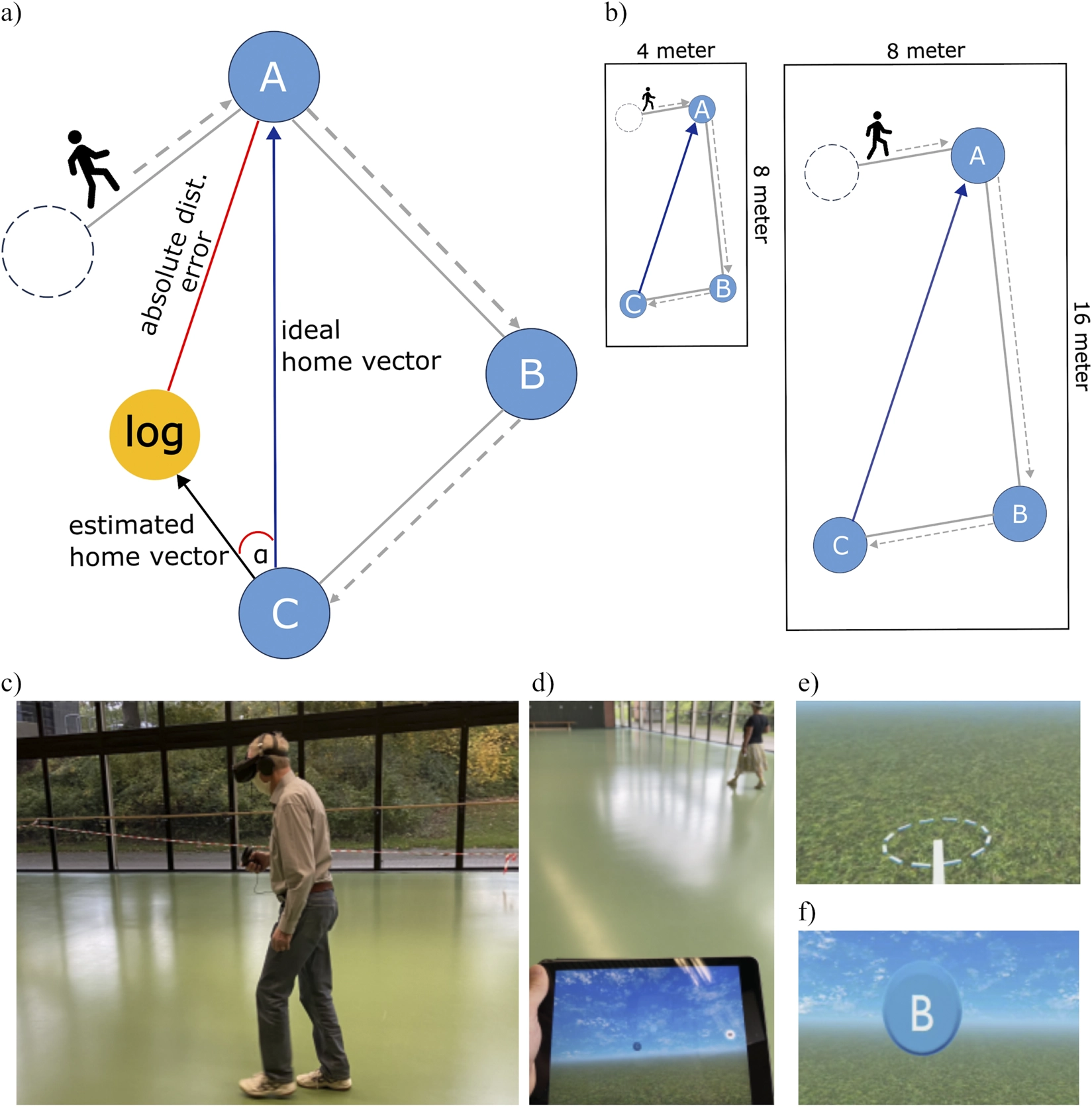
Introduction Path integration is a core mechanism of spatial navigation, relying on the continuous updating of self-position based on multisensory cues. The entorhinal cortex—particularly its grid cell network—is central to this process, and is among the first regions affected by Alzheimer’s disease (AD). Path integration deficits may therefore represent a sensitive early behavioral marker of AD-related neurodegeneration. Objective This study examined disease- and age-related alterations in entorhinal cortex–dependent path integration using an adapted home-finding task in immersive virtual reality (VR). Additionally, we investigated the effect of triangle-size scaling on path integration error magnitudes and on the ability to detect group differences. Methods Fifteen patients with MCI, 33 age-matched healthy controls, and 39 young healthy controls completed a VR-based triangle completion task. The virtual environment was created with different triangle sizes (ratio 1:2) without distal and proximal cues to isolate path integration from landmark-based navigation. Participants also underwent neuropsychological assessment and, for patients, AD-specific cerebrospinal fluid biomarker analysis. Results MCI patients showed significantly greater angular errors, and a tendency toward greater absolute distance errors than older controls. Older controls exhibited larger errors than young controls, correlating with poorer performance on measures of executive function and cognitive flexibility. Absolute distance and proportional linear error increased with greater triangle size, whereas angular error remained unaffected. Group differences in path integration errors did not significantly vary as a function of triangle size. Conclusion The VR-based path integration task reliably distinguishes between MCI patients and healthy controls, as well as between young and older adults. MCI was primarily associated with impaired rotational accuracy, whereas age-related impairments were evident across all path integration measures. An increase of triangle size amplified distance, but not angular errors, and scaling does not influence the interpretation of group differences. This VR paradigm has potential as a sensitive complementary behavioral marker for the early detection of MCI and AD, and warrants validation in larger, biomarker-confirmed cohorts.
From the paper
- Participants
We enrolled 92 participants in this study.
- Result
Holm-adjusted pairwise comparisons based on estimated marginal means indicated that old controls made slightly lower absolute distance errors than MCI patients (mean difference = −0.66, 95% CI [-1.39, 0.08], d = −0.61, p = 0.03, Figure 3a ).
Quoted word for word from the full text on frontiersin.org.
The paper
University Hospital Schleswig-Holstein
Frontiers in Virtual Reality, 23 Sep 2026, CC BY