Health measure links varied with age in Mexican women
The share of possible links present fell from 0.47 at ages 20–29 to 0.25 at 40–49 in women, then plateaued.
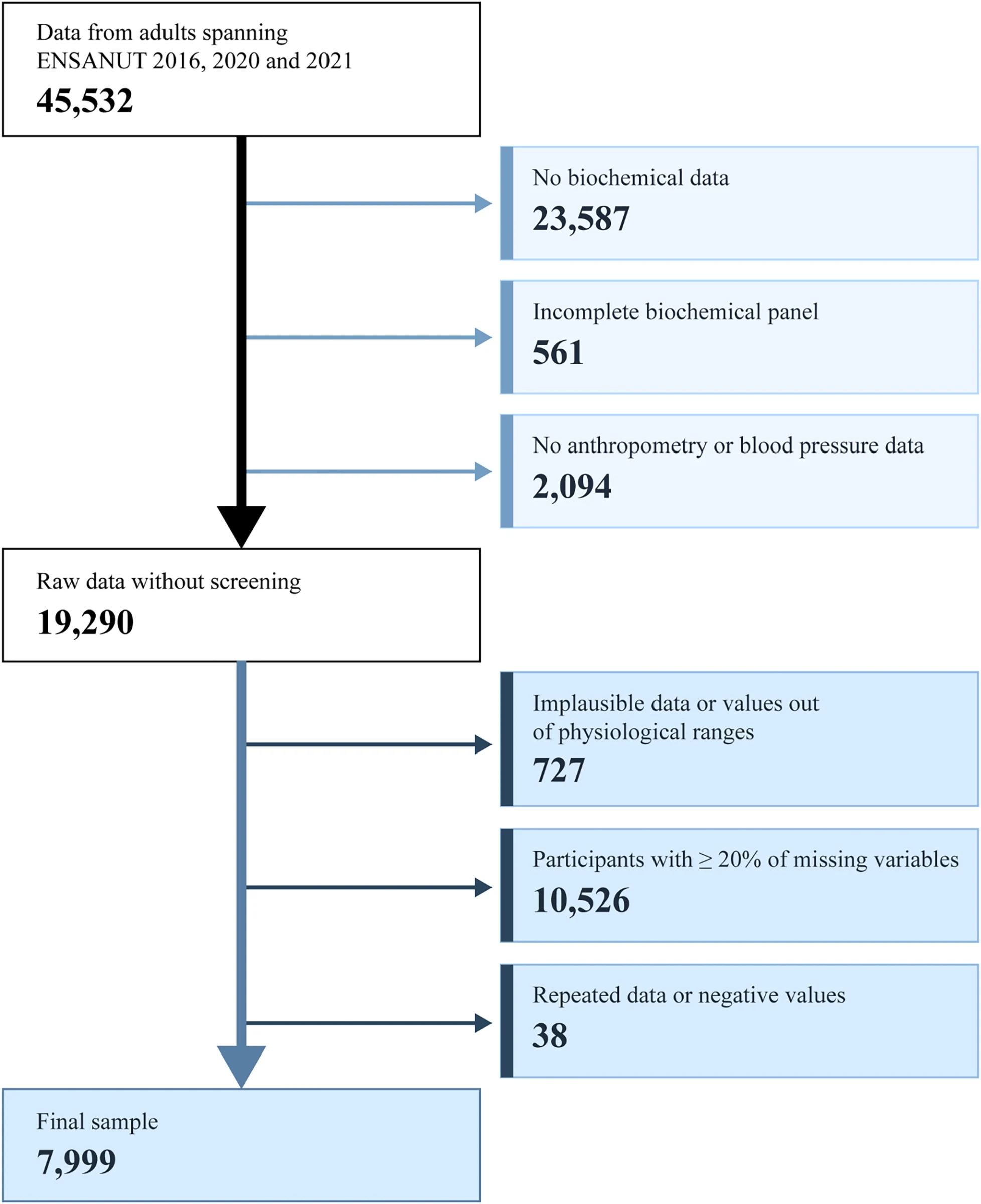
7,999 participants
Limit: Age-related differences are mixed with birth-cohort and survival effects
Edited by Boris Djordjevic · AgingResearch.News
Researchers analyzed 7,999 Mexican adults aged 20–91—5,058 women and 2,941 men—in a cross-sectional observational study. They used national health surveys from 2016, 2020 and 2021 to map correlations among 22 measures of body size, blood pressure and body chemistry. Links represented correlations across people.
In women, the networks became less densely connected and formed more distinct clusters between the 20–29 and 40–49 age groups. Blood pressure measures separated into a distinct cluster. These network patterns then plateaued through the oldest group, while individual measures changed gradually across the same ages. Men showed no comparable transition. The differences in women were already apparent between the 20–29 and 30–39 groups, at ages preceding the menopausal transition.
Why it matters
The study addresses whether relationships among health measures can reveal patterns across adult life that looking at each measure separately may miss.
Caveats
These cross-sectional comparisons cannot show how individuals changed with age. Interpreting the networks as regulation within a person requires confirmation from studies following the same people over time.
From the paper
- Participants
The analytic sample comprised 7,999 adults, of whom 5,058 were women and 2,941 were men, distributed across five age strata ( Tables 1, 2 ).
Results, 3.1 Sample characteristics and univariate trajectories
Quoted word for word from the full text on frontiersin.org.
- Blood pressure
- Dyslipidemia
- Louvain modularity
- Physiological network density
- Physiological network mean distance
- Humans
The paper
Instituto Politécnico Nacional; Universidad Nacional Autónoma de México
Frontiers in Physiology, Oct 21, 2026, Open access, CC BY