Genetic study links Epstein-Barr antibodies to prostate cancer
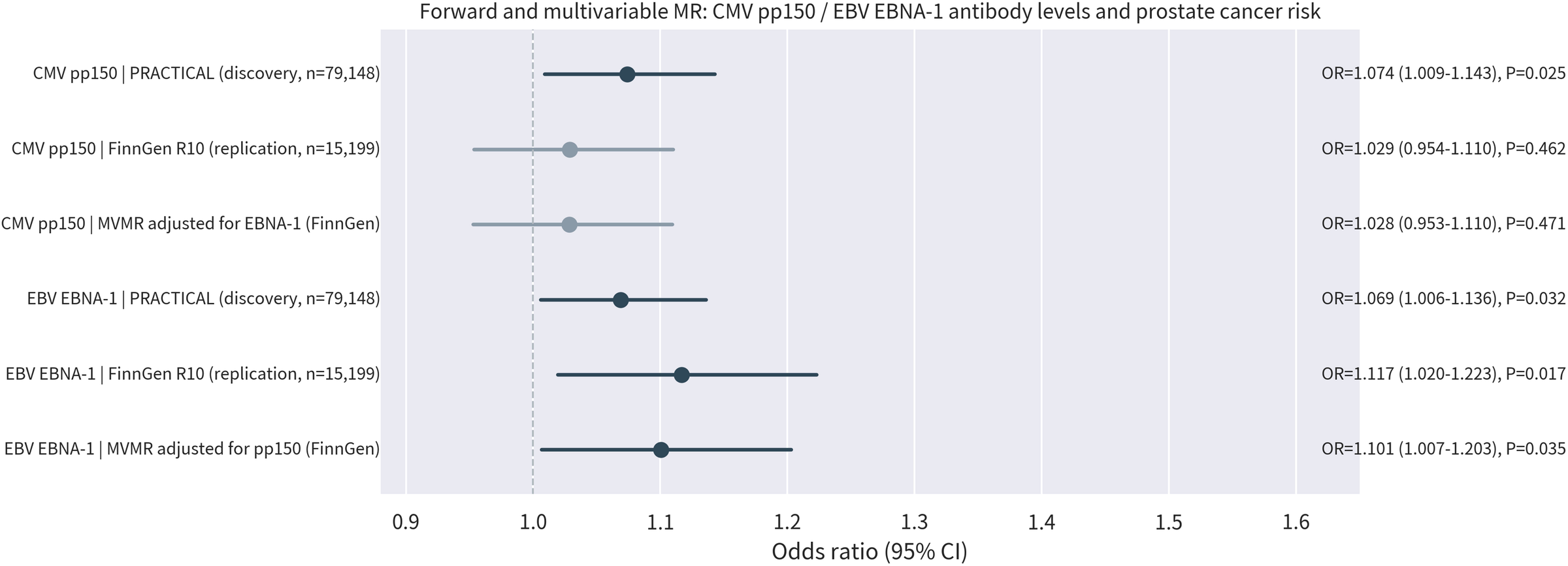
Across three datasets, genetically predicted antibody levels were linked to higher prostate cancer odds, with a pooled odds ratio of 1.074, versus 1 for no association.
Our read
Populations- Studied:
- Mendelian randomization in prostate cancer cases and controls
- What changed:
- Higher Epstein-Barr antibody levels were linked to higher prostate cancer risk (odds ratio 1.074)
- The catch:
- The Epstein-Barr association did not survive correction for testing 37 traits
Editor of record: Boris Djordjevic · AgingResearch.News
People with and without prostate cancer contributed genetic data to a two-sample Mendelian randomization analysis. The datasets included 79,148 cases and 61,106 controls in PRACTICAL; 15,199 cases and 131,266 controls in FinnGen; and 122,188 cases and 604,640 controls in Wang 2023’s European-ancestry subset. The analysis used inherited DNA differences as stand-ins for blood levels of antibodies, immune proteins that recognize infections.
Higher genetically predicted antibody levels against an Epstein-Barr virus protein were linked to higher prostate cancer odds in all three datasets. However, this association did not pass the stricter statistical threshold accounting for testing 37 measures. Only two polyomavirus signals passed: evidence of Merkel cell polyomavirus infection was linked to lower odds, and evidence of BK polyomavirus infection to higher odds. The authors regarded all findings as hypothesis-generating.
Why it matters
Prostate cancer is an age-related disease. The authors identified persistent Epstein-Barr infection as a candidate cause, offering a hypothesis about what may contribute to its development.
Caveats
The analysis used genetic stand-ins for infection-related blood measures, leaving open whether infection itself accounts for the cancer links.
Where the evidence stands
Cytomegalovirus infection
- 32 independent labs in 17 countries
- 2 findings against
- Funders: European Commission and others
- 13 of 72 findings with company ties
From the paper
- Result
… with a cross-cohort random-effects meta-analytic OR of 1.074 (95% CI 1.034–1.115, P = 2.1 × 10⁻⁴, I2 = 0%), and in the fully independent PRACTICAL + FinnGen meta-analysis (OR = 1.084, P = 0.002).
Quoted word for word from the full text on link.springer.com.
- Merkel cell polyomavirus infection
- Bk polyomavirus infection
- Cytomegalovirus infection
- Prostate cancer
- BK polyomavirus seropositivity
- Humans
The paper
Infectious Agents and Cancer, Nov 11, 2026, CC BY-NC-ND
Comments
Be the first to comment.