Multimodal analysis of sleep disturbances and heart disease in older adults: a machine learning and exploratory path analysis approach
Abstract
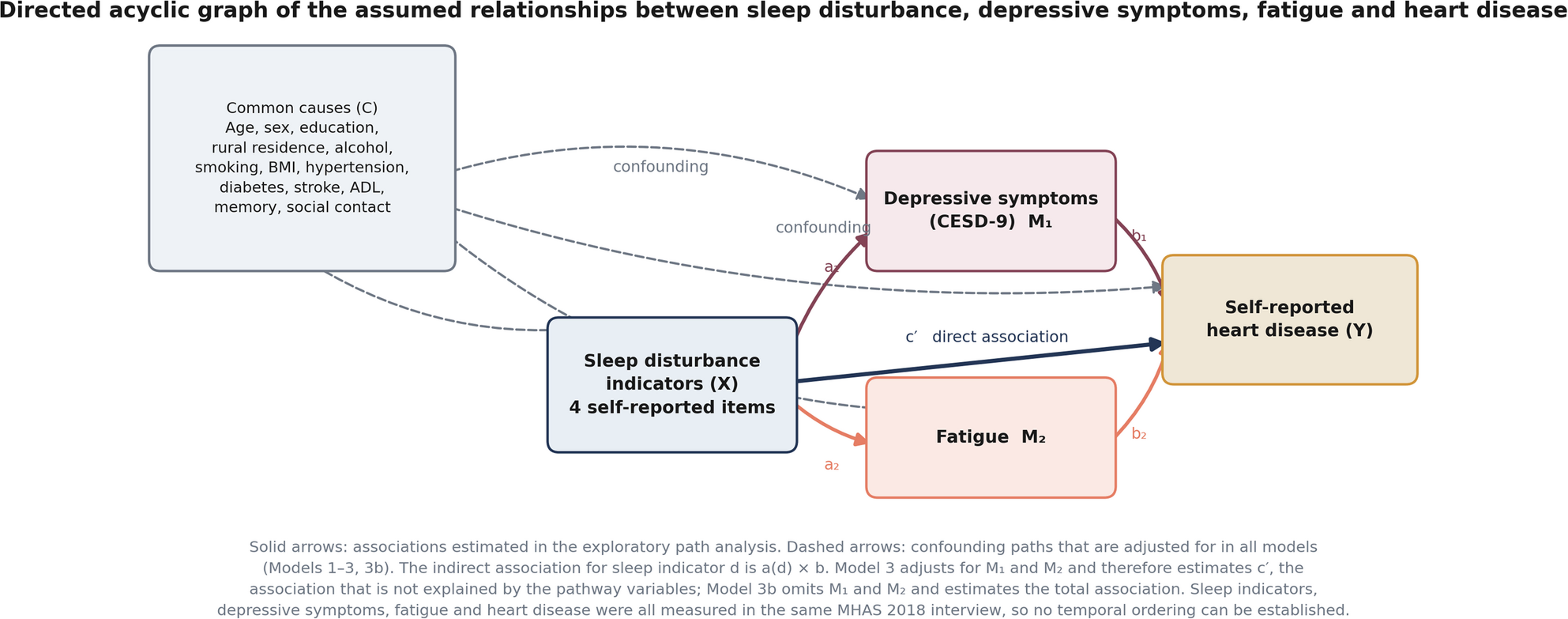
Sleep disturbances and heart disease are common among older adults, yet the psychological and functional pathways linking sleep symptoms to heart disease remain insufficiently characterized. This study examined the association between sleep disturbance indicators and heart disease among older adults using multivariable regression, exploratory path analysis, and machine-learning approaches in a cross-sectional analysis of the 2018 wave of the Mexican Health and Aging Study. This cross-sectional analysis used data from the 2018 wave (wave 5) of the Mexican Health and Aging Study and was restricted to respondents aged 50 years or older. Participants were categorized according to self-reported heart disease status. Sleep disturbance indicators included difficulty falling asleep, waking up at night, waking up too early, and feeling refreshed upon waking. Depressive symptoms were assessed using the CESD-9 score. Multivariable logistic regression models were used to estimate odds ratios and 95% confidence intervals. An exploratory path analysis was applied to examine pathways involving depressive symptoms and fatigue. As an exploratory, complementary analysis, random forest was used to assess variable importance and internal classification performance rather than clinical prediction. Among 12,709 participants aged 50 years or older, 1,585 had heart disease and 11,124 were controls. In the primary model, which estimated the total association without adjusting for depressive symptoms and fatigue, waking up at night most of the time was associated with higher odds of heart disease compared with never having this symptom (adjusted OR 1.70, 95% CI 1.41–2.03, p < 0.001), as were waking up at night sometimes (adjusted OR 1.28, 95% CI 1.10–1.48, p < 0.001) and difficulty falling asleep most of the time (adjusted OR 1.27, 95% CI 1.07–1.52, p = 0.007). Feeling refreshed upon waking most of the time was inversely associated with heart disease (adjusted OR 0.81, 95% CI 0.69–0.94, p = 0.007). Waking up too early was not associated with heart disease (adjusted OR 1.11, 95% CI 0.94–1.30, p = 0.223). These associations were less precise and were no longer statistically significant in the respondent-weighted sensitivity analysis, whereas the nighttime-awakening associations remained robust when the three CESD-9 items overlapping with sleep and fatigue were removed. The exploratory random forest analysis showed limited internal classification performance, with an AUC of 0.72 (95% CI 0.71–0.73) and a precision-recall AUC of 0.24 based on 10-fold cross-validation; at the Youden-optimal threshold sensitivity and specificity were both 0.67. Hypertension, age, fatigue, ADL score, CESD-9 score and stroke history were the most informative classification variables. Exploratory path analysis indicated that depressive symptoms and fatigue were associated with both the sleep disturbance indicators and heart disease status; these indirect associations are interpreted descriptively rather than as evidence of temporal mediation. Sleep disturbance indicators were independently associated with heart disease among older adults. Exploratory path analysis and machine learning further suggested that fatigue and depressive symptoms were associated with sleep disturbance and with heart disease status. Because this was a cross-sectional analysis, the findings should be interpreted as associative rather than causal. The random forest findings represent exploratory classification and should not be interpreted as a clinically validated prediction model.
From the paper
- Participants
Among 12,709 participants aged 50 years or older, 1,585 had heart disease and 11,124 were controls.
- Result
… waking up at night most of the time was associated with higher odds of heart disease compared with never having this symptom (adjusted OR 1.70, 95% CI 1.41–2.03, p < 0.001) …
Quoted word for word from the full text on link.springer.com.
- Difficulty falling asleep
- Feeling refreshed upon waking
- Waking up at night
- Sleep disturbance
- Heart disease
- Humans
The paper
Tongji University; Suzhou Municipal Hospital
BMC Public Health, 16 Oct 2026, Open access, CC BY-NC-ND