Dose‒response relationship between tooth loss and cognitive impairment in older adults
Dose-response
Abstract
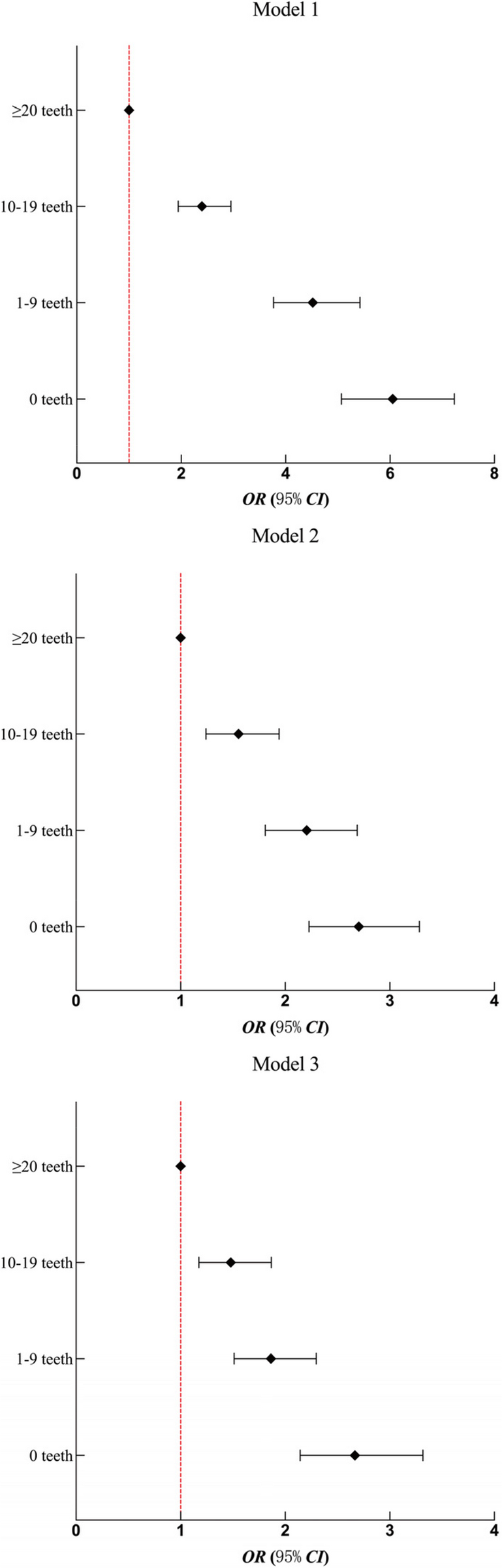
Background: In recent years, associations between oral health factors, including tooth loss, and cognitive function have received increasing attention. However, the dose-response association between tooth loss and cognitive impairment remains incompletely understood. Objective: To examine the association and dose–response relationship between the number of remaining natural teeth and cognitive impairment among older adults. Methods: The cross-sectional study included 6,997 participants aged 60 years and older from the 2018 Chinese Longitudinal Healthy Longevity Survey. Cognitive function was assessed using the Mini-Mental State Examination (MMSE), and the number of remaining natural teeth was self-reported. Multivariate logistic regression and restricted cubic spline analyses were performed to examine the association and dose–response pattern between tooth loss and cognitive impairment. Subgroup and multiplicative interaction analyses were further conducted to explore potential heterogeneity, and modified Poisson regression with robust variance was used to assess the joint association and additive interaction between tooth loss and denture use. Results: Fewer remaining natural teeth were associated with higher odds of cognitive impairment. Restricted cubic spline analysis revealed a linear dose-response association between the number of remaining natural teeth and cognitive impairment. In the joint analysis of tooth loss and denture use, participants with no remaining natural teeth who did not use dentures had the highest prevalence of cognitive impairment relative to those with ≥ 20 remaining natural teeth who used dentures (aPR = 2.801, 95% CI: 1.974–3.974); however, no statistically significant additive interaction was observed. Conclusion: Fewer remaining natural teeth were associated with higher odds of cognitive impairment among Chinese older adults, and a dose–response association was observed between them. These findings highlight the importance of oral health as a component of healthy aging and provide a basis for further longitudinal studies to clarify the temporal and potentially causal relationships between tooth loss and cognitive function.
- Dentures
- Tooth loss
- Cognitive impairment
- Mini-Mental State Examination
- Number of remaining natural teeth
- Humans
The paper
BMC Public Health, 11 Oct 2026, CC BY